
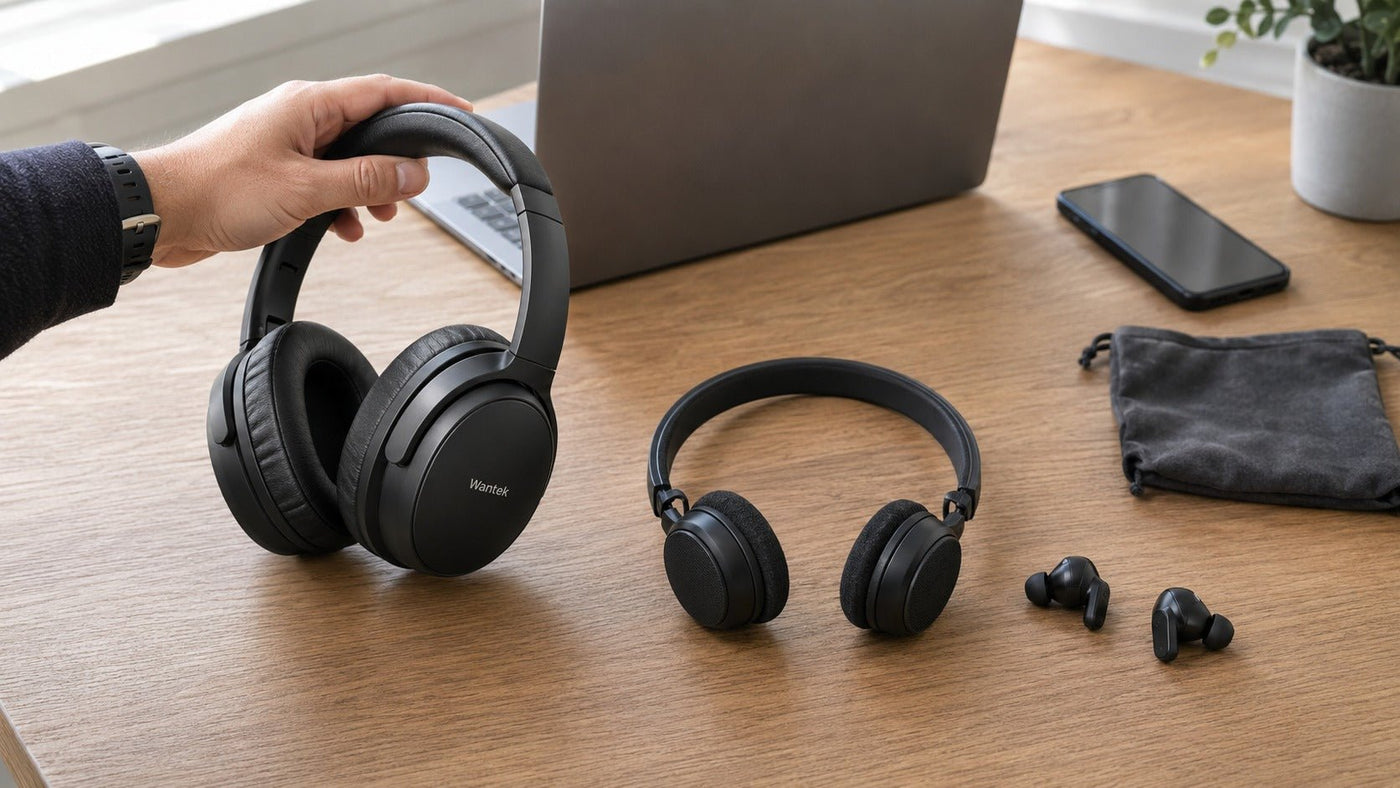
Start by defining your primary use case—commuting, office calls, gaming, studio work, travel, or fitness—and setting a realistic budget. Then evaluate three areas: sound quality, comfort, and practical features such as noise control, connectivity, battery life, and microphone performance.
For many listeners, wireless over-ear headphones with effective ANC and multipoint connectivity provide a practical balance of performance and convenience. Wired or open-back models may be better for critical listening, recording, or latency-sensitive work. This How to Choose Headphones framework helps match those trade-offs to your devices and listening habits.
The Paradox of Choice in Modern Audio
Headphones now span numerous form factors, connection standards, sound signatures, and specialized use cases. More options can make the decision harder because no model leads in every category.
Choosing headphones is not about finding a universally “best” product. It is about finding the best fit for your listening preferences, environment, hardware, and daily workflow. A gamer may prioritize imaging and latency, an audio editor may need predictable tonal balance, and a frequent traveler may value isolation and comfort above everything else.
This guide separates measurable characteristics from personal preferences so you can compare headphones systematically instead of relying on marketing language.
Part 1: The Foundational Decision—Form Factor and Driver Technology
Before comparing sound signatures or advanced features, choose the physical design. Form factor affects portability, isolation, heat, fit, and long-term comfort.
1.1 Over-Ear vs. On-Ear vs. In-Ear
| Form Factor | Advantages | Limitations | Best For |
|---|---|---|---|
| Over-Ear (Circumaural) | Earcups surround the ears; often provide strong isolation, spacious presentation, and comfortable pressure distribution | Larger, less portable, and potentially warm during long sessions | Home listening, studio work, travel, office use |
| On-Ear (Supra-aural) | More compact than most over-ear models and easier to carry | Pads press directly on the outer ear; isolation and comfort vary considerably | Commuting, casual listening, portable use |
| In-Ear/Earbuds | Highly portable, secure options available for exercise, and capable of strong bass when properly sealed | Fit is highly individual; poor sealing changes bass and isolation | Fitness, travel, everyday mobile listening |
Over-ear headphones often provide more physical space for acoustic tuning, but driver size and form factor alone do not determine fidelity. Well-designed in-ear headphones can deliver deep bass and detailed sound, while poorly tuned over-ear models may perform badly.

1.2 Dynamic vs. Planar Magnetic vs. Electrostatic Drivers
-
Dynamic drivers: Use a voice coil attached to a diaphragm within a magnetic field. They are common across entry-level and high-end headphones and can be efficient enough for portable devices.
-
Planar magnetic drivers: Apply force across a thin diaphragm positioned within a magnetic structure. Their weight, sensitivity, impedance, and amplifier requirements vary by model.
-
Electrostatic drivers: Move a charged diaphragm between stators and require a compatible energizer. They are specialized systems rather than practical general-purpose choices.
Driver technology influences design possibilities, but it does not guarantee sound quality. Frequency response, distortion, enclosure design, fit, unit consistency, and tuning remain more useful evaluation criteria.
Part 2: The Sound Signature—Understanding Frequency Response and the Harman Curve
There is no universally perfect frequency response. Headphone preference varies with hearing, fit, music, listening level, and personal taste.
The Harman target is a research-derived preference target rather than an absolute standard. Published listener-preference research found broad support for particular target-response characteristics while also showing that preferred bass levels vary among listeners.
2.1 Frequency Response Breakdown
These ranges are approximate and overlap:
-
Sub-bass (20–60 Hz): Produces low-frequency rumble and depth. Extension matters for electronic music, cinematic effects, and pipe organ recordings.
-
Mid-bass (60–250 Hz): Adds punch and body to kick drums and bass instruments. Excessive energy can make the sound thick or boomy.
-
Midrange (250 Hz–2 kHz): Carries much of the information in vocals, guitars, piano, and many acoustic instruments.
-
Upper midrange (2–6 kHz): Influences vocal presence, attack, and perceived clarity. Too much energy can sound sharp or fatiguing.
-
Treble (6–20 kHz): Affects brightness, detail, and air. Sensitivity to upper frequencies varies considerably and commonly declines with age.
A published frequency-response graph is useful, but it should be interpreted with the measurement fixture and target curve identified. Measurements from different test systems are not always directly comparable.
2.2 How to Choose Based on Genre
-
Critical listening and studio work: Look for controlled, predictable frequency response rather than exaggerated bass or treble. “Flat” should refer to a stated measurement target.
-
Hip-hop and electronic music: Strong sub-bass extension may be desirable, but bass should remain controlled and avoid masking vocals or percussion.
-
Classical and jazz: Tonal balance, imaging, dynamics, and comfortable treble often matter more than maximum bass output.
Genre recommendations are starting points, not rules. Your preferred sound signature and the quality of the recording remain decisive.
Part 3: Active Noise Cancellation—Isolation Science
How to choose noise-cancelling headphones depends on whether you need to reduce what you hear, reduce what callers hear, or accomplish both.
Active Noise Cancellation uses microphones and signal processing to generate an opposing signal that reduces selected ambient frequencies. Feedforward systems use external microphones, feedback systems monitor sound inside the earcup, and hybrid systems combine both approaches.
3.1 ANC vs. Passive Isolation
-
Passive isolation: Comes from the physical seal created by earpads or ear tips. It can be particularly useful against speech and other irregular, higher-frequency sounds.
-
Active Noise Cancellation: Usually performs best against sustained, low-frequency noise such as engines, HVAC systems, and traffic rumble. Effectiveness against nearby speech, impacts, and rapidly changing sounds varies.
The distinction between noise cancellation and sound isolation matters because neither system replaces the other.
3.2 Technical Features to Evaluate
-
Attenuation performance: Compare measurements across several frequencies rather than relying on a single reduction figure.
-
Transparency or hear-through mode: Check speech naturalness, wind handling, latency, and whether the mode provides enough environmental awareness for your use.
-
Fit and seal: Glasses, hair, ear anatomy, and earpad condition can change both passive isolation and ANC performance.
-
Pressure sensation: Some listeners experience discomfort from particular ANC implementations. Testing the headphones remains the best evaluation method.
-
Wired operation: Some powered ANC headphones can use ANC while connected through an analog cable, but the electronics still require battery power. When the battery is depleted, supported models may continue only as passive wired headphones.
ANC performance is model-, fit-, frequency-, and environment-dependent. Test it against the noises you actually encounter.
Part 4: Connectivity—Wired, Wireless, and Codec Compatibility
4.1 Bluetooth and Audio Codecs
A newer Bluetooth version does not automatically provide better sound. Audio quality depends on the supported profile, codec, source device, headphone implementation, connection conditions, and original recording.
-
SBC: The baseline codec for conventional Bluetooth stereo audio. Performance depends on the encoder and operating bitrate.
-
AAC: Common in the Apple ecosystem and supported by many other devices. Results can vary by implementation.
-
aptX family: Includes multiple variants designed for different combinations of audio quality, latency, and connection resilience. Both the source and headphones must support the same variant.
-
LDAC: A Sony-developed codec with selectable transmission rates up to 990 kbps. Official LDAC documentation also describes 330 and 660 kbps operating modes.
-
LC3: Associated with Bluetooth LE Audio. Support must be confirmed on both the source device and headphones.
If two devices do not share a preferred codec, the connection falls back to a mutually supported option. Check the specifications for both devices instead of assuming support from the operating system or Bluetooth version.
4.2 The Wired Advantage
Wired headphones remain useful for studio work, gaming, desktop listening, and situations where charging is inconvenient.
-
3.5 mm analog: The digital-to-analog conversion occurs in the source device, audio interface, amplifier, or adapter.
-
Detachable cables: Can improve serviceability because a damaged cable may be replaced without replacing the headphones.
-
USB-C audio: Conversion may occur inside the headphones, cable, or adapter. Confirm operating-system compatibility, microphone support, and control functionality.
-
Balanced connections: Connectors such as 4.4 mm may be required by certain amplifiers, but the connector alone does not guarantee better audible performance.
For a focused comparison of mobility, latency, charging, and source compatibility, use this Choosing headphones guide.
4.3 Multipoint Connectivity
Bluetooth multipoint allows compatible headphones to maintain connections with two devices. A common use case is listening to media on a computer and switching to an incoming phone call.
Implementation varies. Some products switch automatically, while others require the first stream to stop. Confirm whether multipoint works with your preferred codecs, operating systems, and call applications.
Match Your Headset to How You Work
Compare wireless headsets and Bluetooth headphones by wearing style, microphone design, listening needs, and device path.
- Work calls
- Focused listening
- Everyday wireless use
Part 5: Comfort, Ergonomics, and Build Quality
A technically capable headphone is a poor choice if it becomes uncomfortable after a short session. Comfort depends on the interaction between the product and the individual wearer.
Evaluate these factors:
-
Clamping pressure: Enough force is needed to maintain a seal, but excessive or uneven pressure can cause soreness. A single force threshold cannot predict comfort for every head shape.
-
Weight distribution: Total weight matters less when the headband and earpads distribute it evenly. Heavy headphones deserve a longer wear test.
-
Earpad dimensions: Verify that the opening accommodates your ears without pressing on them.
-
Earpad material: Synthetic leather often provides a stronger seal, while fabric or velour may feel cooler. Isolation and bass response can change with the material and pad condition.
-
Heat and ventilation: Closed over-ear models may become warm during long sessions, particularly in hot environments.
-
Glasses compatibility: Frames can break the earpad seal and create pressure points.
-
Adjustment range: Headband extension, cup rotation, and hinge movement should accommodate your head without placing the driver at an angle.
When possible, wear the headphones for at least one normal listening or work session before deciding.
Part 6: Microphone Quality and Call Performance
For remote work and customer communication, microphone performance can be as important as playback quality.
-
Microphone position: A boom places the microphone close to the mouth and maintains a more consistent speaking distance. Boomless arrays trade visible hardware for greater dependence on beamforming and signal processing.
-
Noise reduction: Microphone noise reduction attempts to reduce background sound sent to the listener. It is separate from ANC, which primarily changes what the wearer hears.
-
Wind handling: Outdoor calls require different processing from calls in an office with steady HVAC or keyboard noise.
-
Voice naturalness: Aggressive processing may reduce noise while making speech sound thin, gated, or distorted.
-
Platform behavior: Test mute synchronization, call controls, sidetone, and device switching in the applications you actually use.
For call-center and office use, a stable connection, appropriate connector, usable controls, and consistent microphone placement are more valuable than vague “AI noise cancellation” claims. Wantek focuses primarily on headsets for office, contact-center, and everyday communication workflows.

Check Your Desk Phone Before You Choose
Use your phone brand, exact model, and available connection to identify the right starting path before ordering.
- Phone brand and model
- Where calls happen
- Available connection
Similar-looking connectors are not always interchangeable.
Part 7: Battery Life and Charging
Wireless-headphone battery ratings are measured under defined conditions. Actual runtime changes with volume, ANC mode, codec, call activity, temperature, spatial-processing features, and connection behavior.
Evaluate:
-
Runtime with your normal features enabled: Compare ANC-on and ANC-off figures when both are available.
-
Fast charging: Verify the required charger, charging time, and claimed playback time rather than assuming every model supports the same rate.
-
Passive wired operation: Some wireless headphones continue playing through an analog cable after the battery is depleted, but powered features such as ANC may stop.
-
Battery serviceability: Check whether the manufacturer offers battery replacement or repair.
-
Charging connector: USB-C is convenient, but charging and USB audio are separate capabilities.
Rechargeable headphones and their lithium-ion batteries should be handled through an appropriate electronics or battery-recycling program at end of life.
Part 8: Brand and Category Positioning
Brand reputation can help narrow the field, but evaluate individual models rather than assuming every product shares the same strengths.
| Brand | Typical Focus | Representative Category | Buyer Check |
|---|---|---|---|
| Sony | Wireless audio, ANC, and codec integration | Wireless over-ear headphones and earbuds | Verify codec support, multipoint behavior, and current model specifications |
| Bose | Noise-cancelling travel and lifestyle headphones | QuietComfort products | Test fit, ANC behavior, and ecosystem features |
| Sennheiser | Consumer, audiophile, and professional audio | HD-series and wireless headphones | Confirm open- or closed-back design and amplifier requirements |
| Apple | Apple-device integration | AirPods and AirPods Max | Check device requirements and supported features |
| Audeze | Planar magnetic headphones | Audiophile, studio, and gaming models | Review weight, amplification, and connection requirements |
| Beyerdynamic | Studio and professional monitoring | DT-series headphones | Match impedance and acoustic design to the source and workflow |
A brand’s historical reputation is useful context, but current measurements, specifications, fit, warranty, and support should determine the purchase.
Part 9: Practical Scenarios
9.1 The Commuter
Priorities:
- Effective ANC against vehicle and HVAC noise
- Secure, comfortable fit
- Portable case or folding design
- Useful transparency mode
- Reliable connection and controls
Avoid: Open-back headphones when sound leakage and isolation matter.
9.2 The Gamer
Priorities:
- Predictable end-to-end latency
- Clear imaging
- Comfortable fit for long sessions
- Reliable microphone
- Platform compatibility
For competitive gaming, use a wired connection or a purpose-built wireless system with published latency and direct compatibility with your platform. Standard Bluetooth latency varies by codec, device, and software.
9.3 The Audio Editor
Priorities:
- Predictable tonal balance
- Long-session comfort
- Replaceable pads and cables
- Appropriate acoustic design
Closed-back headphones help prevent playback from leaking into a recording microphone. Open-back headphones may provide a more spacious presentation for editing or mixing in a quiet environment, but they do not isolate the listener.
9.4 The Fitness Enthusiast
Priorities:
- Secure fit
- Manufacturer-stated sweat or water resistance appropriate to the activity
- Stable controls
- Easy cleaning
- Environmental awareness when exercising outdoors
An ingress-protection rating describes specific test conditions; it does not make a product waterproof for every activity. Use transparency mode or another awareness-preserving design where traffic and surrounding activity create safety risks.
Part 10: Budget Allocation
Price tiers describe typical market positioning, not guaranteed performance.
| Budget | Practical Expectations | What to Prioritize |
|---|---|---|
| Under $50 | Functional wired or basic wireless models; fewer advanced features | Fit, connector compatibility, microphone usability, return policy |
| $50–$150 | Wider selection of wireless features and improved construction | Comfort, codec support, battery conditions, measured performance |
| $150–$300 | More mature ANC and better feature integration in some models | ANC consistency, microphone quality, multipoint, serviceability |
| $300–$500 | Premium materials, processing, or ecosystem features | Whether the premium features solve a real use-case requirement |
| $500+ | Specialized audiophile, studio, or luxury products | Source equipment, measurements, build, repair options, auditioning |
Audio exhibits diminishing returns, but there is no reliable percentage that converts price into performance. Above a certain point, spending often shifts toward specialized tuning, materials, manufacturing, accessories, and lower-volume production.
Headphone buying hub
Continue with a more focused buying guide
Use the main selection framework first, then explore the decision that matters most for your devices, environment, or routine.
Current pillar guide
How to Choose Headphones: Beginner’s Guide
Compare form factors, sound, connectivity, comfort, features, use cases, and budget before narrowing your options.
Decided that wireless fits your routine? Compare wireless headsets by use case →
FAQ: Critical Questions Answered
1. What features should I look for when choosing headphones?
Start with comfort, form factor, and compatibility. Then prioritize sound signature, isolation or ANC, microphone performance, battery life, latency, controls, and serviceability according to your use case. Confirm that both your source device and headphones support the required connection and codec.
2. Do I need noise-cancelling headphones?
ANC is useful in environments dominated by sustained low-frequency noise, including airplanes, buses, trains, and HVAC-heavy offices. In quiet rooms, passive isolation may be sufficient and avoids additional battery use.
Noise risk depends on both level and duration. The NIOSH occupational exposure limit of 85 dBA over eight hours provides useful context, but consumer ANC is not automatically protective equipment. OSHA advises that consumer noise-cancelling headphones should not replace tested hearing protectors unless they are specifically designed and rated for that purpose.
3. Are wired headphones still worth it?
Yes. Wired headphones avoid Bluetooth codec compression, do not require a wireless battery for basic playback, and generally provide predictable latency. Their final sound quality still depends on the recording, DAC, amplifier, headphone design, and fit.
4. How do I know whether headphones have good bass?
Good bass combines extension, control, and low distortion. Check frequency-response and distortion measurements, but also confirm fit and seal—especially with in-ear and closed-back models. Excess mid-bass can sound boomy even when deeper sub-bass is weak.
5. What is the difference between aptX Adaptive and LDAC?
Both are optional Bluetooth codecs that require support from the transmitting and receiving devices. LDAC offers selectable rates up to 990 kbps. aptX Adaptive dynamically changes its operating bitrate and latency according to implementation and connection conditions. Bitrate alone does not determine perceived quality.
6. Is a heavier headphone always better built?
No. Weight may come from larger drivers, magnets, batteries, or metal components, but it does not guarantee durability. Hinge design, material quality, replaceable parts, assembly, warranty, and weight distribution are more useful indicators.
7. How should I maintain the ear cushions?
Wipe pads using the manufacturer’s recommended method and allow them to dry before storage. Replace them when they crack, flatten, lose their seal, or become uncomfortable rather than following a universal schedule. Store headphones in a cool, dry place and avoid harsh cleaning chemicals.
The Final Verification Process
Before buying, run this checklist:
-
Does the form factor suit my environment? Choose closed-back or sealed designs for isolation and open-back designs for quiet-room listening.
-
Does the connection work with every required device? Confirm the connector, codec, operating system, application, and adapter requirements.
-
Can I wear the headphones for a full normal session? Test pressure, heat, weight distribution, glasses compatibility, and ear clearance.
-
Does the microphone work in my real environment? Record a call sample with realistic keyboard, HVAC, traffic, or conversation noise.
-
Does the battery cover my workflow? Compare runtime with the features you plan to use and check what happens when the battery is depleted.
-
Can worn parts be replaced? Check cables, earpads, batteries, warranty terms, and repair support.
The right headphones are not necessarily the most expensive or heavily advertised. They are the pair that fits comfortably, works reliably with your hardware, and delivers the sound, isolation, and communication performance your use case requires.

