
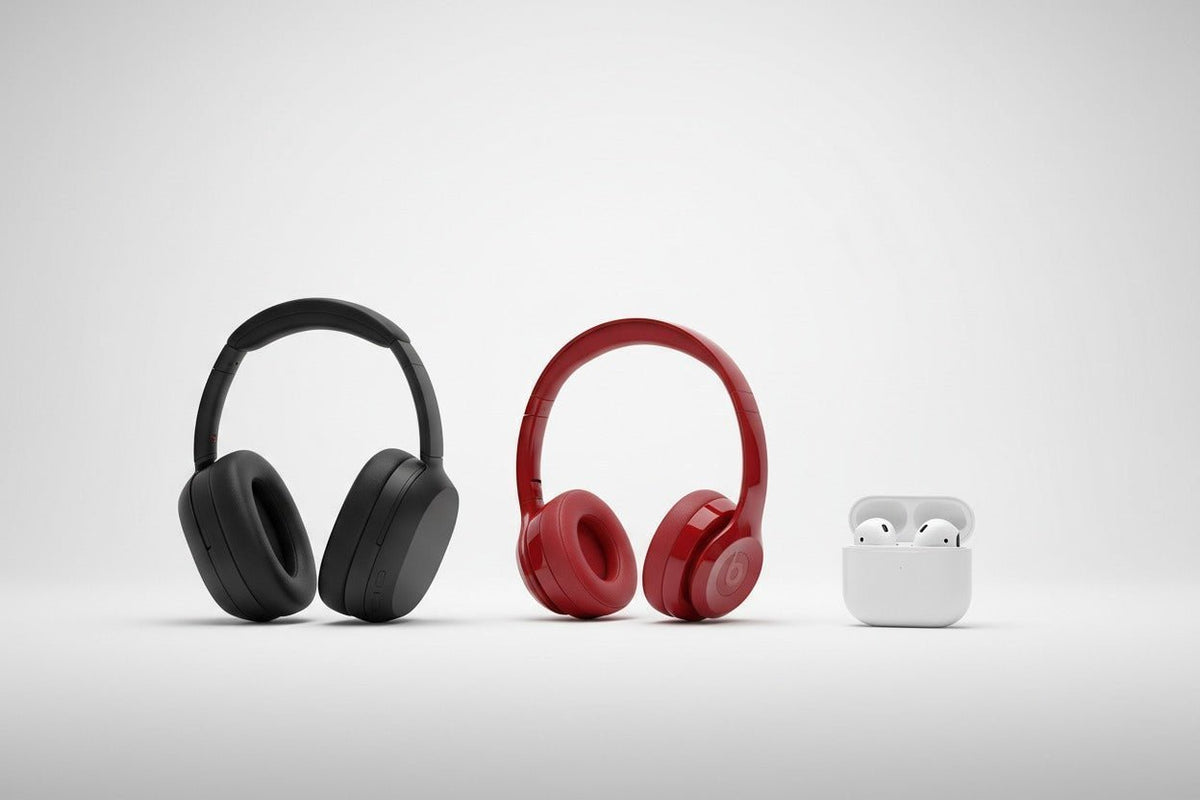
The best headphone style is the one that fits your ears, your environment, and the way you actually listen. Start with physical fit—over-ear, on-ear, in-ear, earbud, or open-ear—then evaluate enclosure, connection, noise control, microphone needs, and battery life as separate decisions.
Quick answer: choose over-ear when you value a headband fit and do not mind more bulk; on-ear when compact size matters and direct pressure on the outer ear is comfortable; in-ear when portability and a secure seal matter; non-sealing earbuds when you dislike ear tips; and open-ear designs when keeping the ear canal open is a priority. No form factor guarantees better sound quality by itself.

Start With Headphone Style, Not the Spec Sheet
Headphone labels often describe different parts of the same product. “Over-ear” describes how the earcups fit. “Open-back” describes the enclosure. “Wireless” describes the connection. “ANC” describes an electronic noise-control feature. A single pair can be over-ear, closed-back, wireless, and noise-cancelling at the same time.
If you want the broader classification system before choosing a style, Wantek’s guide to the main types of headphones separates fit, enclosure, connection, and noise control so those categories do not get mixed together.
| Style | Often a practical starting point for | Main fit check |
|---|---|---|
| Over-ear | Desk use, travel, home listening, gaming, longer sessions | Ear clearance, clamp, weight, heat, glasses contact |
| On-ear | Portable listening and people who prefer smaller headband headphones | Pressure directly on the outer ear and pad stability |
| In-ear / IEM | Commuting, exercise, travel, compact everyday carry | Tip size, seal, insertion comfort, retention |
| Earbud / open-fit | Listeners who dislike a sealed ear canal | Ear-shape compatibility and stability without a sealing tip |
| Open-ear | Running, walking, work, or daily use where an open ear canal is useful | Speaker position, hook or band fit, glasses interaction, outside-noise masking |
Independent testing from RTINGS’ comparison of over-ear, on-ear, earbuds, and in-ears also treats comfort, portability, isolation, leakage, and stability as separate trade-offs rather than assuming one style is universally best.
1. Over-Ear Headphones: Maximum Ear Coverage, More Bulk
Over-ear, or circumaural, headphones use earcups intended to surround the outer ear. Because the pads contact the head around the ear instead of sitting directly on the pinna, many listeners find this layout comfortable for longer sessions. That still depends on the actual pad opening, clamp force, weight, head shape, glasses, and temperature.
When over-ear is a strong starting point
- You listen for long periods at a desk, on a flight, or at home.
- You want large physical controls, a headband fit, or room for a boom microphone.
- You are comparing open-back and closed-back home-listening designs.
- You do not mind carrying a larger case or wearing a bulkier design.
The important limitation is that over-ear is only a form factor. It does not guarantee stronger bass, a wider soundstage, lower distortion, better ANC, or better microphone quality. Those outcomes depend on the complete design and implementation.
Open-back and closed-back are separate decisions
An over-ear headphone can be open-back or closed-back. Open-back earcups intentionally allow more acoustic exchange with the room and usually leak more sound, which makes them a poor fit for shared offices, commuting, or recording near an open microphone. Closed-back designs reduce leakage more effectively, but the amount of isolation still varies by model and seal.
2. On-Ear Headphones: Smaller Headband Design, Direct Ear Pressure
On-ear, or supra-aural, headphones place their pads directly on the outer ear. They can be lighter and easier to pack than many over-ear models, making them useful for listeners who want a conventional headband without full-size earcups.
The trade-off is contact pressure. A model can feel comfortable for one person and tiring for another because pad material, clamp force, ear shape, glasses, and headband geometry all change the pressure distribution. If you are sensitive to anything pressing on your ears, test on-ear models before treating compact size as an automatic win.
Do not use cup size as a quality score. A smaller on-ear model can sound excellent, and a large over-ear model can still be poorly tuned or uncomfortable. Fit category tells you how the product sits on your head—not how good it sounds.
3. In-Ear Headphones and Earbuds: Smallest Carry, Most Fit-Sensitive
In-ear monitors and many wireless earbuds use silicone, foam, or other tips that sit at or inside the ear canal and create a seal. That seal affects stability, isolation, and bass response, so tip size and insertion depth can change the experience substantially.

Choose in-ear when portability or stability comes first
In-ear designs are easy to carry and can work well for commuting, travel, and exercise. Sport models may add ear hooks, stabilizing wings, or other retention features, but fit is still individual. A product described as “secure fit” can still move if its geometry does not match your ears.
For running specifically, Wantek’s running-headphone fit guide separates retention, water-resistance claims, environmental awareness, controls, and battery life so a “sport” label does not substitute for checking the actual use case.
Earbuds are not always the same as sealed in-ears
Some earbuds sit at the ear opening without forming the same kind of seal as an in-ear monitor. That can feel less intrusive to listeners who dislike tips inside the canal, but isolation and low-frequency response can be more dependent on ear shape and placement. When shopping, check the physical design rather than assuming every product sold as an “earbud” fits the same way.
4. Open-Ear and Bone-Conduction Designs: Keep the Ear Canal Open
Open-ear products intentionally avoid sealing the ear canal. Some use air-conduction speakers positioned near the ear, while bone-conduction designs transmit vibration through contact points on the head. These are different technologies that share an open-ear use case.
An open ear canal can preserve more access to environmental sound than a sealed in-ear design, but it does not make every situation safe. Traffic, wind, crowd noise, playback level, and attention still matter. In loud surroundings, outside sound can also mask the audio and make the listener want to raise the volume.
If this style interests you, compare the actual wearing designs in Wantek’s open-ear headphone guide, which distinguishes clip-on, ear-hook, and wraparound formats as well as battery and water-resistance claims.
Do Not Confuse Style With Connection or Noise Control
Wired vs. wireless
Wired and wireless describe the signal path, not the fit. Over-ear, on-ear, in-ear, and open-ear products can all be wired or wireless depending on the model. Wireless adds battery, radio, pairing, and codec considerations; wired removes charging and Bluetooth from the path but reduces mobility.
For music-focused use, Wantek’s wired vs. wireless headphones guide explains why connection type changes convenience and system requirements without automatically determining sound quality.
Passive isolation vs. ANC
Passive isolation comes from physical fit, seal, pads, earcups, and construction. Active Noise Cancellation uses microphones and electronic processing to reduce some external sound. A sealed in-ear or closed-back over-ear model may isolate without ANC, while an ANC headphone still depends on physical fit and implementation.
Headphones vs. headsets
A headset is usually chosen around communication as well as listening. If calls, meetings, gaming chat, or customer service are central, microphone position, mute controls, platform compatibility, and connection path may matter more than music-first specifications. A boom mic can also change which physical style is practical.
Match the Headphone Style to Your Main Use Case
Do not ask one pair to solve every possible scenario. Pick the environment that accounts for most of your listening, then use the style as an elimination filter before comparing individual products.
| Use | Starting style | Prioritize | Check |
|---|---|---|---|
| Commuting | Closed over-ear or sealed in-ear | Fit, isolation or ANC, carry size, battery | Trip comfort and any wired fallback |
| Running | Open-ear, ear-hook, or secure in-ear | Retention, awareness, controls, IP rating | Fit, exact IP claim, phone or watch link |
| Desk calls | Over-ear, on-ear, or call headset | Comfort, mic, mute, device support | Connection and app controls |
| Home | Over-ear open-back or closed-back | Comfort, tuning, leakage, source | Whether leakage or noise rules out open-back |
| Gaming | Over-ear headset or headphones plus mic | Connection, mic, comfort, latency | PC and console support; wireless mode limits |

How to Test Headphone Fit Before You Commit
Specifications cannot tell you whether a headphone matches your anatomy. A short fit check can eliminate many bad choices before you start comparing smaller technical differences.
Wear it the way you normally listen
Use your glasses, hat, hairstyle, or normal ear-tip setup. A fit test without the things you wear every day can hide pressure points.
Check pressure and heat
For headband styles, notice clamp and pad contact. For in-ears, check canal pressure and whether the tip stays sealed without discomfort.
Move the way you normally move
Turn your head, look down, walk, or simulate exercise. Stability during normal movement matters more than how secure the product feels while sitting still.
Listen at a normal level
Do not compensate for a poor seal or noisy environment by turning the volume much higher. Re-seat the headphones or try another tip or style first.
Verify the return and replacement path
Check whether pads, tips, cables, or other wear parts are replaceable and whether the return policy gives you enough time to discover fit problems.
Specifications That Are Easy to Overvalue
- Driver diameter: a larger number does not prove better bass, detail, imaging, or distortion performance.
- Advertised frequency range: a wider published range does not tell you whether the audible response is balanced or accurate.
- Bluetooth version: the version number alone does not establish sound quality, latency, range, multipoint behavior, or microphone quality.
- Price: higher price can reflect materials, features, brand positioning, manufacturing scale, or specialized design; it is not a direct performance score.
- “Studio,” “gaming,” or “sport” labels: treat them as positioning until the exact fit, connection, microphone, water-resistance, or tuning details support the use case.
Hearing Comfort and Situational Awareness
Headphone style changes fit and isolation, but listening level and duration still matter. The World Health Organization’s safe-listening guidance emphasizes that higher sound levels reduce the amount of time that can be listened to safely and recommends well-fitted headphones and lower listening levels.
Open-ear designs can make environmental sound more accessible than sealed designs, but they do not replace attention around traffic, machinery, or other hazards. Likewise, ANC can reduce the need to overpower steady background noise in some environments, but consumer noise-cancelling headphones should not be treated as certified hearing protection unless the product is specifically designed and rated for that purpose.
Final Headphone Style Checklist
- Choose the fit category first. Over-ear, on-ear, in-ear, earbud, or open-ear should match your physical comfort and portability needs.
- Decide whether the ear should be sealed. Isolation, leakage, awareness, and fit change dramatically between sealed and open designs.
- Choose wired or wireless separately. Confirm the exact device connection instead of treating “Bluetooth” or “USB-C” as universal compatibility.
- Prioritize the real environment. Commute, desk, gym, home, studio, and gaming setups reward different trade-offs.
- Verify model-specific claims. Battery life, ANC, IP rating, microphone behavior, codec support, multipoint, and accessories must be checked on the exact product.
- Test comfort before chasing smaller spec differences. A technically capable headphone that you cannot wear comfortably is the wrong style for you.
Choosing a Headset for Work, Calls, or Gaming?
If your main use case is communication rather than music-first listening, Wantek’s finder narrows options by use case, device, connection, wearing preference, and wired or wireless format.
Frequently Asked Questions
Which headphone style is best for long listening sessions?
Many people start with over-ear designs because the pads can distribute contact around the ear, but comfort depends on clamp, weight, pad size, heat, glasses, and individual anatomy.
Are over-ear headphones always better than earbuds?
No. Over-ear models offer different fit and size trade-offs, while earbuds are more portable. Sound quality depends on the complete design, tuning, fit, seal, and listening environment.
What is the difference between in-ear and open-ear headphones?
In-ear designs usually use a tip that seals at or inside the ear canal. Open-ear designs intentionally leave the canal open and position the transducer nearby or use bone conduction.
Are open-back headphones the same as open-ear headphones?
No. Open-back describes a vented earcup enclosure, usually on a headband headphone. Open-ear describes a wearing style that intentionally avoids sealing the ear canal.
Should I choose wired or wireless before choosing the headphone style?
Usually choose the physical fit first, then select wired or wireless based on your devices, mobility needs, charging tolerance, latency requirements, and preferred features.

