
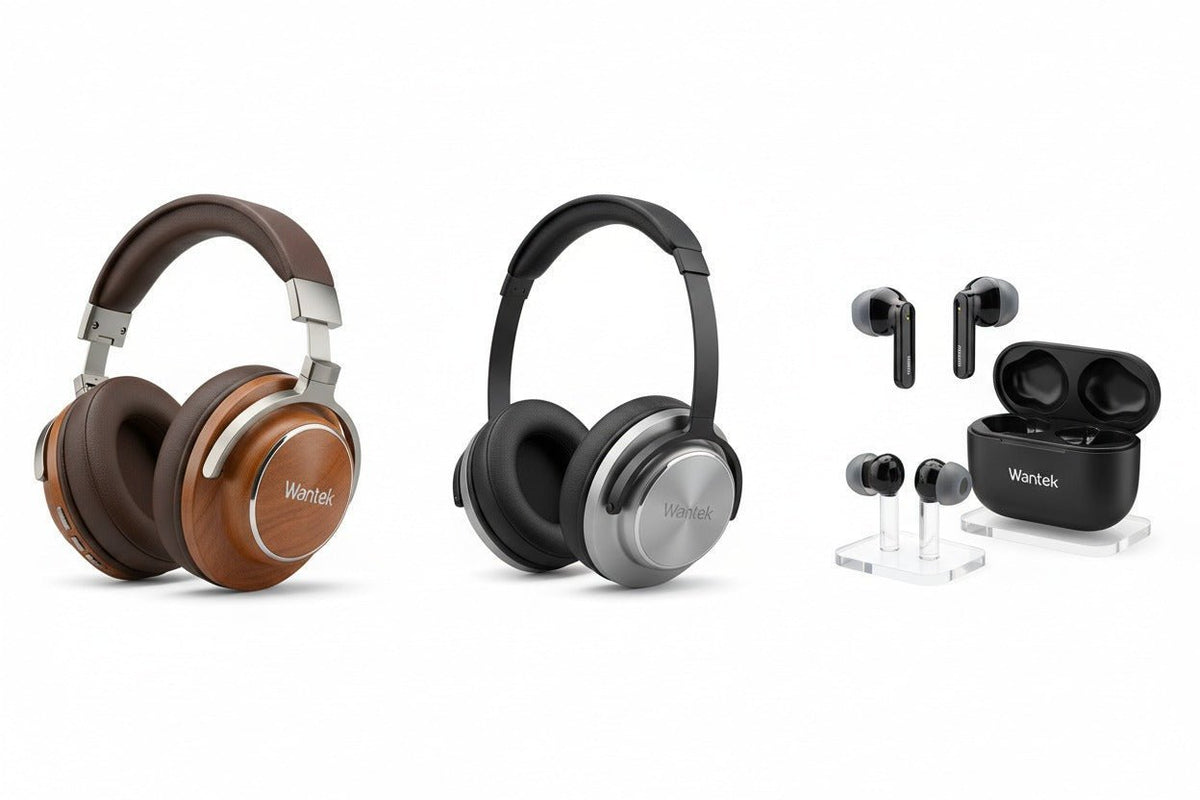
Headphone types are easiest to understand when you separate four different questions: how the headphones fit, whether the earcup is open or closed, how they connect, and how they control outside noise. An over-ear model, for example, can also be wireless, closed-back, and noise-canceling at the same time.
Quick answer: the main fit categories are over-ear, on-ear, in-ear, and non-sealing earbuds or open-ear designs. Then compare enclosure, connection, microphone needs, noise control, battery requirements, and the environment where you will actually use them.

The Main Types of Headphones by Fit
Fit is the most useful place to start because it affects comfort, portability, sealing, and how much of your ear is covered. It does not determine sound quality by itself.
| Type | Often a good fit for | Main trade-off to check |
|---|---|---|
| Over-ear | Long listening sessions, travel, home listening, studio or desk use | Bulk, heat, clamp, and whether the earcups fully clear your ears |
| On-ear | Portable listening and people who prefer smaller earcups | Pressure on the outer ear and less consistent isolation |
| In-ear | Commuting, exercise, travel, and maximum portability | Ear-tip fit, seal, hygiene, and comfort inside the ear canal |
| Earbud / open-fit | Listeners who dislike a sealed ear canal and want a lighter fit | Less isolation and a fit that can vary considerably by ear shape |
Over-Ear Headphones
Over-ear, or circumaural, headphones use earcups intended to surround the outer ear. They can distribute contact around the ear rather than directly on it, but actual comfort still depends on pad dimensions, clamp force, weight, glasses, and head shape.
Over-ear is a fit category, not a guarantee of stronger bass, wider soundstage, or better fidelity. Open-back and closed-back over-ear models can behave very differently. If you are deciding between the two headband styles, see Wantek's deeper comparison of over-ear vs. on-ear headphones.
On-Ear Headphones
On-ear, or supra-aural, headphones place the pads directly on the outer ear. They are often smaller than over-ear models and can be easier to carry, but direct pad pressure can become uncomfortable for some listeners during longer sessions.
Isolation and bass response depend heavily on the seal and the specific tuning. Treat compact size as the defining advantage, then test comfort and leakage instead of assuming every on-ear model behaves the same way.
In-Ear Headphones and IEMs
In-ear headphones use ear tips that sit in the ear canal and usually create a seal. That seal can improve passive isolation and bass consistency, but only when the tip size and insertion work for your ears. In-ear monitors, or IEMs, are a broad subgroup that can be wired or wireless and range from everyday listening products to professional monitoring systems.
Earbuds and Open-Fit Designs
Non-sealing earbuds sit at or near the ear-canal entrance instead of forming the deeper seal typical of in-ear designs. Some newer open-fit products use hooks or clips to hold a small speaker near the ear while leaving the canal open.
These designs can make outside sound easier to hear than sealed in-ears, but listening audio can still mask environmental cues. Fit security and sound consistency should be checked on the exact model.
Open-Back vs. Closed-Back: A Different Classification
Open-back and closed-back describe the earcup enclosure, not where the headphone sits on your ear. A headphone can be over-ear and open-back, or over-ear and closed-back.
- Closed-back: uses a more enclosed outer earcup and generally limits sound leakage better, making it practical for shared spaces, commuting, tracking, and other situations where isolation matters.
- Open-back: vents the rear of the driver to the room. It usually leaks more sound in both directions, so it is mainly suited to quiet, private environments.
Neither enclosure guarantees a particular soundstage, bass response, or tuning. Those results depend on the complete acoustic design. For a dedicated comparison, read the open-back vs. closed-back headphones guide.
Wired vs. Wireless Headphones
Wired and wireless describe the connection path. Both can exist across over-ear, on-ear, in-ear, and headset designs.
Wired Headphones
Wired headphones can use analog connections such as 3.5 mm or digital connections such as USB. They avoid wireless pairing and do not need a battery simply to carry an analog audio signal. For gaming, production, and device-specific work, confirm microphone support, connector wiring, USB audio support, and the behavior of any inline controls.
Wireless and Bluetooth Headphones
Wireless headphones add mobility but introduce battery, pairing, codec, and compatibility considerations. Bluetooth audio quality and latency depend on the source device, headphone implementation, codec support, connection conditions, and application.
Bluetooth LE Audio introduces the LC3 codec as part of the LE Audio architecture; support must be confirmed on the exact source and headphones rather than inferred from a Bluetooth version number alone. The Bluetooth SIG's LE Audio specifications document LC3 and the wider LE Audio framework.
Noise-Canceling vs. Passive Isolation
Noise control is another layer that overlaps with fit and connection. A wireless over-ear headphone can use active noise cancellation, while a sealed wired in-ear model may rely only on passive isolation.
Passive Noise Isolation
Passive isolation comes from the physical barrier and seal created by earcups or ear tips. Its effectiveness varies with fit, pad or tip material, frequency, and the headphone's construction.
Active Noise Cancellation (ANC)
ANC uses microphones and signal processing to reduce selected ambient sounds by generating an opposing signal. It is generally more effective against steady low-frequency noise than against rapidly changing voices or sharp transient sounds. Sony's explanation of how noise cancellation works describes this microphone-and-processing approach and its limitations.
ANC is not automatically hearing protection. NIOSH states that noise-canceling headphones or earbuds should not be considered hearing protection unless they are labeled with a Noise Reduction Rating (NRR). See the NIOSH hearing-protection guidance.
Open-Ear and Bone-Conduction Headphones
Open-ear is a broad design idea: the ear canal remains physically open rather than being sealed by a conventional ear tip. Bone-conduction headphones are one implementation. Their transducers create mechanical vibration against the side of the head while leaving the canal open.
This can be useful when ear-canal comfort or access to environmental sound matters, but it does not remove the need for situational awareness. Wantek's bone-conduction headphones guide explains the mechanism, practical trade-offs, and activity use cases in more detail.
Headphones vs. Headsets for Calls, Gaming, and Work
A headset is usually a headphone system built around voice communication, typically with a dedicated microphone or call-focused controls. That makes the distinction useful for office calls, contact centers, gaming, streaming, dispatch, and other two-way communication tasks.
Microphone design, device compatibility, mute behavior, connection path, and call controls can matter more than music-oriented features. A consumer Bluetooth headphone with a built-in mic and a business headset with a boom mic may both be wireless, but they solve different tasks.

How to Choose the Right Headphone Type
Start with where you will use them
Quiet home listening, commuting, office calls, workouts, gaming, and studio work create different priorities for leakage, isolation, microphone quality, portability, and latency.
Choose the fit before the feature list
Decide whether you prefer around-ear, on-ear, sealed in-ear, or open-fit designs. Comfort and seal are personal, so measurements and reviews cannot fully replace a fit test.
Confirm the connection
Check the actual ports, Bluetooth support, operating system, console or phone, and whether you need microphone input, call controls, multipoint, or a dedicated wireless receiver.
Add only the features your environment requires
ANC, transparency mode, water resistance, replaceable cables, charging cases, boom microphones, and spatial-audio features are useful only when they solve a real requirement.
Compare the exact models last
Once the design is right, compare verified specifications, comfort, measured performance where available, warranty, replacement parts, and compatibility rather than buying from the category label alone.
Choosing a Wantek Headset for Calls?
If your priority is office calls, remote work, mobile calling, gaming, or another microphone-first setup, the Wantek Headset Finder starts with your device, connection, use case, and wired-versus-wireless preference.
Frequently Asked Questions
What are the main types of headphones?
The main fit categories are over-ear, on-ear, in-ear, and non-sealing earbud or open-fit designs. Open-back, closed-back, wired, wireless, and ANC describe other characteristics that can overlap with those fit categories.
Are earbuds and in-ear headphones the same?
Not always. In-ear headphones usually use tips that seal inside the ear canal. Non-sealing earbuds sit closer to the canal entrance and typically provide less passive isolation.
Are noise-canceling headphones a separate headphone type?
ANC is a noise-control feature rather than a fit category. You can find noise-canceling over-ear, on-ear, and in-ear products, usually in wireless designs with built-in processing and microphones.
Do wired headphones always sound better than wireless headphones?
No. Connection type alone does not determine sound quality. Tuning, drivers, fit, amplification, codec support, source quality, and the complete headphone design all affect the result.
Do ANC headphones count as hearing protection?
Not automatically. NIOSH says noise-canceling headphones or earbuds should not be considered hearing protection unless they are labeled with an NRR. Check the product's actual protective rating for occupational noise.

