
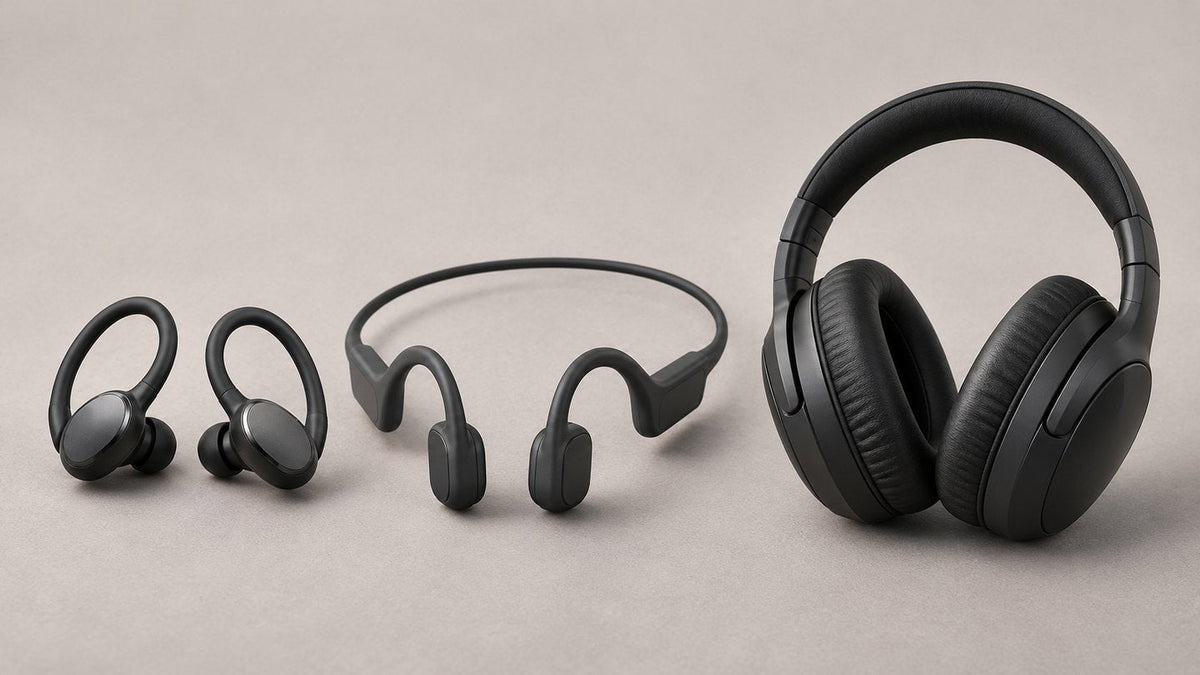
The best sports headphones are not one universal model. A runner, lifter, cyclist, HIIT athlete, and swimmer put different demands on fit, moisture protection, awareness, controls, and playback. Start with the sport you actually do, then choose a design whose documented specifications match that environment.
Quick answer: Prioritize secure fit first, then verify the exact water or dust protection, decide how much surrounding sound you need, and compare battery life in the mode you will actually use. For swimming, use a model specifically approved for water use and plan on local playback rather than ordinary phone-to-headset Bluetooth once submerged.
Match the Headphone Type to the Workout
| Activity | Useful starting formats | What to verify | Main trade-off |
|---|---|---|---|
| Running and trails | Ear hooks, secure in-ear designs, clip-on open-ear, or wraparound open-ear | Stability, moisture rating, controls, route awareness, battery | More isolation can reduce access to surrounding sound |
| Gym and strength | Secure earbuds, clip-on designs, or stable over-ear headphones for lower-movement sessions | Sweat protection, fit during benches and floor work, controls, comfort | Over-ear designs can trap more heat and may shift during dynamic movement |
| HIIT and circuits | Ear hooks, fins, or other high-retention designs | Fit under fast direction changes, sweat exposure, easy controls | A comfortable casual fit may not stay stable during explosive movement |
| Cycling and outdoor training | Open-ear designs or earbuds with a reliable transparency mode | Helmet or eyewear compatibility, local rules, awareness, wind behavior | Open designs do not guarantee that you will hear every hazard |
| Swimming | Swim-approved bone-conduction or waterproof local-playback systems | Manufacturer-approved water use, depth guidance, local storage, controls, goggle fit | Ordinary Bluetooth streaming from a phone is not dependable underwater |
1. Secure Fit Comes Before Extra Features
Sports headphones have to remain usable while your head and body move. Ear hooks add a second contact point around the ear. Fins and wings brace against the outer ear. Clip-on open-ear designs hold around the ear without sealing the canal, while wraparound open-ear headsets connect both sides with one continuous frame.
Fit is still personal. Ear shape, glasses, hats, headbands, helmets, and goggle straps can all change stability. Before a hard session, test the headphones with the same gear you normally wear and mimic the movements that matter for your sport.
For a more specific running comparison, use Wantek's running-headphone guide focused on fit, water resistance, and outdoor use.
2. Read IP Ratings Literally
An IP code classifies protection provided by an enclosure against solid particles and/or water under defined conditions. The underlying framework is standardized in IEC 60529. A higher-looking code should not be treated as a universal promise that a product is suitable for every sport or water environment.
For workout gear, verify the exact rating, which part of the product it applies to, and the manufacturer's use instructions. Earbuds and charging cases can have different protection. A splash-resistant workout model is not automatically a swimming model, and an IP rating does not replace stated depth, duration, water type, or after-use care guidance.
Do not infer a sweatproof claim from the word “sports.” If a product page does not publish a water-resistance rating, treat that specification as unknown rather than assuming protection from its form factor or Bluetooth version.
3. Decide How Much Environmental Sound You Need
Open-ear headphones leave the ear canal physically unobstructed. Transparency or ambient modes use microphones and processing to pass outside sound through earbuds that may otherwise isolate more strongly. These approaches can make environmental sound more accessible, but neither one is a safety guarantee.
Use the environment to make the decision. Isolation or ANC can be useful on a treadmill or during controlled indoor training. Outdoors, a more open design or a usable transparency mode may be preferable when traffic, cyclists, people, instructions, or other cues matter. Keep listening level in the equation as well: the World Health Organization's safe-listening guidance notes that both sound level and listening duration affect hearing risk.
4. Choose by Sport, Not by a Generic “Best” Label
Running and Trail Running
Start with retention, then compare moisture protection and awareness. A secure ear-hook or wraparound design can reduce readjustment, while open-ear formats avoid intentionally sealing the ear canal. For road or shared-path use, consider how the design affects access to surrounding sound and follow local rules for headphone use.

Gym and Strength Training
For lifting, comfort and stability through your actual exercises matter more than choosing the smallest form factor. In-ear and clip-on models can stay compact around benches and machines. Over-ear headphones can work for lower-movement sessions if they remain stable, but they often retain more heat and many general-purpose models are not documented for heavy sweat exposure.
HIIT, Circuits, and High-Movement Training
Fast direction changes and repeated jumps expose weak fit quickly. Prioritize a retention system that works for your ears, simple controls that do not require precise taps mid-set, and a documented moisture rating appropriate to your training conditions. Do not assume that a premium price or strong ANC makes a headphone workout-ready.
Cycling and Outdoor Training
Check how the headphones interact with a helmet, glasses, straps, and wind. Open-ear designs can keep the canal unobstructed, while transparency modes offer a different way to access environmental sound. Neither approach removes distraction, so volume, attention, route conditions, and applicable local rules still matter.
Swimming
Swimming changes the buying criteria. Use a headset specifically documented for water use, check the manufacturer's depth and environment guidance, and confirm how audio plays once submerged. Wantek's BC3 Pro swimming headphones combine IP68 protection with 32GB of onboard MP3 storage; the current product guidance directs swimmers to local MP3 playback because water disrupts the Bluetooth link.
This is not unique to one brand. Shokz likewise states that OpenSwim Pro uses MP3 Mode underwater because Bluetooth signal is disrupted by water. That is why storage, file transfer, physical controls, and goggle or cap compatibility can matter more than the newest Bluetooth version for lap swimming.
5. Compare Battery Life on the Same Basis
Battery numbers are easy to misread. One product may publish single-charge earbud life, another may headline earbuds-plus-case total time, and a swim model may have different battery figures for Bluetooth and local playback. Compare the mode that matches your activity rather than treating the largest number as automatically better.
For long sessions, also check charging workflow and control access. A large case-supported total is useful between workouts, but it does not extend one uninterrupted session unless you stop and recharge the earbuds.
Two Wantek Starting Points for Different Sports Needs
| Model | Documented fit and core specs | Where it makes sense to start |
|---|---|---|
| Wantek OBT030 | Open-ear clip-on design, 8.5g listed weight per earbud, Bluetooth 5.4, IPX6 water resistance, up to 8 hours per charge and up to 50 hours total with the case | Dry-land workouts and everyday listening when you prefer a lightweight open-ear clip-on format. Wantek currently lists IPX6 water resistance; follow the product's use guidance and do not immerse the earbuds. |
| Wantek BC3 Pro | Open-ear bone conduction, IP68, 32GB onboard MP3 storage, Bluetooth 5.3, 32g listed weight, up to 6 hours of rated battery life | Swimming and other situations where local stored playback and documented IP68 protection are central requirements. Use MP3 mode for underwater listening. |
The key point is that these two products solve different problems. OBT030 is a lightweight IPX6-rated open-ear clip-on option for dry-land workouts, while BC3 Pro has documented swim-oriented protection and onboard MP3 storage.
Do Not Buy on Future-Facing Features Alone
Biometric sensors, adaptive audio, AI coaching, and other advanced features can be useful when they are actually documented on the product you are considering. They should not replace the basics: stable fit, appropriate environmental protection, workable controls, battery life, and a playback method that fits the sport.
Treat concept imagery and category trends as context, not as proof that a specific headphone measures heart rate, temperature, hydration, running form, or other biometric data. Verify those functions on the exact product and regional documentation before making them part of the buying decision.
A Simple Sports-Headphone Buying Checklist
Name the primary activity
Running, lifting, HIIT, cycling, and swimming have different fit, awareness, and environmental requirements.
Choose the retention style
Compare hooks, wings, clip-on designs, wraparound frames, or conventional earbuds using your own ears and sports gear.
Verify protection claims
Read the exact IP rating and manufacturer instructions instead of assuming every sports model is sweatproof or swim-ready.
Match awareness to the environment
Decide whether you need isolation, ANC, transparency, or an open-ear format, then use an appropriate listening level.
Compare battery and playback in the correct mode
Separate single-charge life from case-supported totals, and for swimming verify local playback rather than relying on ordinary Bluetooth streaming underwater.
Prefer a Lightweight Open-Ear Option for Dry-Land Workouts?
Review the Wantek OBT030's fit, IPX6 water-resistance guidance, battery figures, and available configuration before deciding whether the clip-on design matches your routine.
Frequently Asked Questions
What should I look for in sports headphones?
Start with secure fit, then verify moisture protection, battery life, controls, device compatibility, and how much surrounding sound you need for the activity and environment.
Are open-ear headphones good for running?
They can be a good fit for runners who want the ear canal left unobstructed. Stability, water resistance, volume, route conditions, and local rules still need separate consideration.
Are over-ear headphones good for working out?
They can work for lower-movement or strength sessions if the fit is stable. Check heat buildup, sweat protection, warranty guidance, and whether they shift during benches or dynamic exercises.
Can Bluetooth headphones work while swimming?
Ordinary phone-to-headset Bluetooth is not dependable underwater. Swim-focused models commonly use onboard MP3 or other local playback once submerged, even when they also support Bluetooth on land.
Does a higher IP rating automatically mean better sports headphones?
No. An IP code describes defined enclosure protection. Fit, use conditions, depth guidance, battery, controls, and the manufacturer's activity-specific instructions still determine whether a model suits your workout.

