
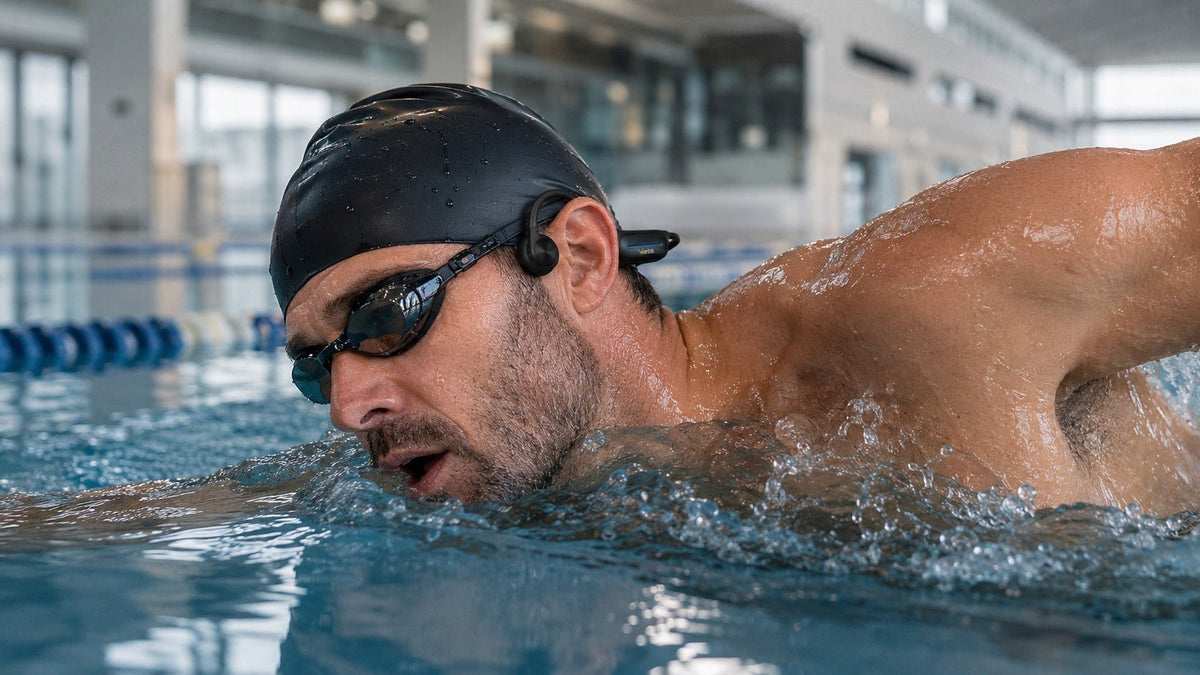
The best bone conduction headphones for swimming are the ones whose water-use guidance matches your actual swim, whose onboard playback works without a phone underwater, and whose fit stays secure with your goggles and cap. For lap swimming, local MP3 or offline playback matters more than the Bluetooth version because a normal phone-to-headset Bluetooth connection is not dependable once the headset is submerged.
For 2026, five useful specification-based starting points are Shokz OpenSwim Pro, Wantek BC3 Pro, NANK Runner Diver2 Pro, Suunto Aqua, and H2O Audio TRI 2. They cover different priorities, from pool-and-land flexibility and simple local MP3 playback to training metrics and multisport use.
How this guide was built: Manufacturer documentation was rechecked on September 19, 2026. This is a specification-based comparison, not a controlled side-by-side pool test, so the use-case descriptions below are practical editorial guidance rather than measured awards for sound quality, comfort, durability, or value.
Quick comparison: five bone conduction headphones for swimming
| Model | Useful starting point for | Water specification | Local playback | Published battery |
|---|---|---|---|---|
| Shokz OpenSwim Pro | Swimming plus ordinary Bluetooth listening on land | IP68; up to 2 m in fresh water | 32GB; MP3 Mode underwater | Up to 6 h MP3 / 9 h Bluetooth |
| Wantek BC3 Pro | A straightforward Wantek swim model with local MP3 playback | IP68; no specific immersion depth currently stated on the product page | 32GB onboard MP3 storage | Up to 6 h overall |
| NANK Runner Diver2 Pro | Swimming plus dry-land Bluetooth use | IP69 | 32GB; TF mode underwater | Up to 10 h listed |
| Suunto Aqua | Offline music plus swim-training metrics | IP68; tested to 5 m for 2 h | 32GB offline audio | About 6 h offline / up to 10 h general playback |
| H2O Audio TRI 2 | Swimming plus running, cycling, paddling, and other sports | IPX8; H2O states 12 ft / 3.6 m submersion | 8GB built-in MP3 player | Up to 6 h memory / 9 h Bluetooth |
This table is a shortlist, not a universal ranking. Water ratings do not replace each manufacturer’s depth, duration, environment, and care instructions. Battery figures also use different modes and conditions, so compare the number that matches how you will actually use the headset.

Why local playback matters more than Bluetooth underwater
Bluetooth remains useful before and after a swim, but ordinary 2.4 GHz Bluetooth links lose reliability in water. That is why swim-oriented models from Shokz, NANK, H2O Audio, Wantek, and Suunto provide onboard playback modes for use below the surface instead of relying on a poolside phone connection.
Storage capacity is only one part of the decision. Check how files are transferred, which formats the headset accepts, whether playlists or folders are practical to manage, and whether the physical controls are easy to use with wet hands. A larger storage number is not automatically more useful if the transfer workflow does not match the audio files you already own.
If you are still deciding between bone conduction and other waterproof audio formats, see Wantek’s best swimming headphones comparison.
Five swimming picks in more detail
1. Shokz OpenSwim Pro: a versatile pool-and-land option
Shokz lists OpenSwim Pro with IP68 protection, 32GB of storage, Bluetooth 5.4, and a dedicated MP3 Mode for underwater use. Its current product documentation separates battery life by mode, with up to six hours in MP3 Mode and up to nine hours in Bluetooth Mode.
OpenSwim Pro is a practical starting point when you want one headset for stored music in the pool and normal Bluetooth listening on land. Shokz states that the model can be submerged in up to two meters of fresh water and is not intended for deeper diving. The current US page contains different seawater statements in separate sections, so open-water buyers should follow the latest instructions for the exact model and region rather than extending the IP68 label beyond the manufacturer’s guidance.
2. Wantek BC3 Pro: 32GB local MP3 playback for swimming
The Wantek BC3 Pro combines IP68 protection, 32GB of onboard MP3 storage, Bluetooth 5.3 for supported dry-land listening, a built-in microphone, a 32g frame, and up to six hours of listed battery life. Wantek’s current product guidance tells swimmers to transfer MP3 files and use local playback because water disrupts Bluetooth.
BC3 Pro is best understood as a simple local-playback swim setup rather than a phone-streaming device for underwater use. Load compatible MP3 files before entering the pool, switch to MP3 mode, and use the headset’s physical controls during the swim. Wantek currently lists the overall battery figure but does not publish separate MP3-mode and Bluetooth-mode runtime, so the six-hour number should not be treated as a matched swim-mode test against competitors that publish separate modes.
Fit is still personal. Check how the wraparound frame sits with your cap and goggle straps, and make sure the transducers maintain consistent contact without creating a pressure point during turns or push-offs.
Want a straightforward Wantek swimming setup?
Review the current BC3 Pro specifications, storage, controls, color options, and transfer method before deciding whether it fits your pool routine.
3. NANK Runner Diver2 Pro: a feature-rich dual-mode option
The NANK Runner Diver2 Pro product page lists IP69 protection, 32GB of storage, Bluetooth 5.4, and up to 10 hours of battery life. NANK also states that only TF mode works underwater and lists MP3, M4A, WAV, APE, and FLAC as supported local formats.
Keep the full Runner Diver2 Pro model name when checking specifications because NANK sells related Runner Diver models with different feature sets. The IP69 label tells you the published protection class; it does not by itself establish a specific swimming depth, unlimited immersion time, or better underwater audio than another model.
4. Suunto Aqua: offline music plus swim-training metrics
Suunto Aqua combines 32GB of offline audio storage with motion-detection features intended for swim training. Suunto lists IP68 protection and says the headphones are tested to five meters for two hours. The product page also describes analysis of stroke posture, head pitch, breathing frequency, and glide time.
Battery context matters here. Suunto lists up to 10 hours of general music playback, while its user guide says offline music uses more power and provides around six hours per charge. For swimming, the offline figure is the more relevant number when the phone remains on dry land. Aqua therefore makes the most sense when training metrics are part of the purchase decision rather than an extra feature you will rarely use.
5. H2O Audio TRI 2: a multisport waterproof alternative
H2O Audio TRI 2 is positioned for swimming as well as running, cycling, paddling, surfing, and other sports. H2O lists IPX8 protection, submersion to 12 feet / 3.6 meters, an 8GB built-in MP3 player, Bluetooth 5.3, up to six hours in memory mode, and up to nine hours of Bluetooth playback.
For underwater listening, H2O explicitly directs users to MP3 mode because Bluetooth does not work underwater. TRI 2 is therefore a practical option when you want one headset across several sports and 8GB of local storage is enough for the audio library you plan to carry.
What to expect from bone conduction underwater
Bone conduction does not sound exactly the same underwater as it does on land. Submersion changes the acoustic and mechanical environment around the headset, while transducer contact can shift as you breathe, turn, and push off the wall. Those changes can affect perceived loudness, tonal balance, bass, and vibration.
Fit is therefore part of sound consistency. If the headset moves during a stroke or turn, contact at the transducers changes as well. Voice-heavy material such as podcasts and audiobooks can work well for some swimmers because intelligibility matters more than deep bass reproduction, but personal preference still matters.
Open-ear construction also does not guarantee full awareness of the pool environment. Water noise, playback volume, distance, and submersion can all reduce what you notice around you. For the underlying technology and its trade-offs, see the how bone conduction headphones work.
How to choose the right swimming bone conduction headphones
Start with the water conditions, not the rating number
Write down where you actually swim: a chlorinated pool, freshwater, seawater, or a mix. Then compare the model-specific depth, duration, environment, and after-use care instructions. An IP code is useful, but it is not a substitute for the manufacturer’s stated use conditions.
Match storage to the files you can actually transfer
Both 8GB and 32GB can hold a substantial local library depending on file size and format. More important is whether your audio exists as files the headset can accept. Offline downloads inside Spotify, Apple Music, or another streaming app are not automatically ordinary files that can be copied to a separate storage drive.
Test the fit with your goggles and cap
Judge fit with the same goggles and cap you use in the water, not with the headset alone.
Fit the goggles first
Put on your goggles normally and confirm that the seal is secure before positioning the headset.
Position the transducers
Place the headset so the transducers maintain steady contact with your head.
Add the cap if you use one
Check that cap tension does not move the headset or disturb the goggle seal.
Check pressure and controls
Look for pressure points, strap interference, and physical controls that become hard to reach.
Start with easy laps
Confirm stability before harder turns, repeated push-offs, or longer intervals.
There is no universal stacking order that works for every headset, cap, goggle design, and head shape. The goal is stable transducer contact without disturbing the goggle seal or creating uncomfortable pressure.
Compare battery life in the mode you will use
Do not compare a Bluetooth playback figure from one headset with an offline-swim figure from another and call the larger number a win. For swimming, look for MP3, memory, or offline-mode runtime when the manufacturer publishes it. If a brand gives only one general battery number, treat it as a broad estimate rather than a directly matched swim-mode result.
Prepare the headset before the first swim
Check supported file formats
Choose a few audio files and confirm that your exact model supports them.
Connect only when dry
With the headset and charging or data contacts dry, connect it using the manufacturer-supported computer, cable, dock, or powerbank workflow.
Transfer a small playlist
Copy a test playlist before filling the entire storage area.
Verify local playback
Safely eject and disconnect the headset, then confirm that stored audio plays without the phone.
Practice the controls
Learn play, pause, track change, volume, and mode switching before entering the water.
Recheck the full fit
Fit the headset with your goggles and cap and make sure the controls remain accessible.
Plan the after-swim routine
Follow the model-specific cleaning and drying instructions before reconnecting power or data.
After-swim care and charging contacts
Water protection does not eliminate the need for post-swim maintenance. Chlorine, salt, moisture, and other residue can remain on the headset and around charging contacts after use.
Follow the care instructions for your exact model. When the manufacturer recommends freshwater rinsing after pool or salt exposure, use that procedure, remove visible water, allow the headset to air-dry, and keep residue away from charging or data contacts. The charging area should be completely dry before you reconnect power or transfer files.
A magnetic or proprietary connector can make charging convenient, but it does not remove the need to keep the contact area clean and dry.

Frequently asked questions
Can Bluetooth headphones stream music underwater?
Do not rely on ordinary phone-to-headset Bluetooth while submerged. Swim-oriented models commonly use onboard MP3, memory, or offline playback below the surface and return to Bluetooth for supported use on land.
Does IP68 automatically mean a headset is suitable for swimming?
No. IP68 is a protection class, while the manufacturer still defines the tested depth, duration, environment, and care conditions. Confirm the instructions for the exact model before swimming.
How much onboard storage do swimming headphones need?
There is no universal minimum. 8GB can already hold a large local library, while 32GB gives more headroom. Supported formats, transfer workflow, playlist handling, and physical controls can matter more than capacity alone.
Can I copy Spotify or other streaming-app downloads to a swimming headset?
Not automatically. Downloads inside a streaming app are usually stored for playback within that service. A swimming headset needs transferable files in supported formats or a manufacturer-specific offline feature.
Can bone conduction headphones be worn with swimming goggles and a cap?
Often, yes, but fit is model- and swimmer-specific. Test the exact cap and goggle straps you use so the headset stays stable, the goggle seal remains secure, and the controls stay reachable.

