
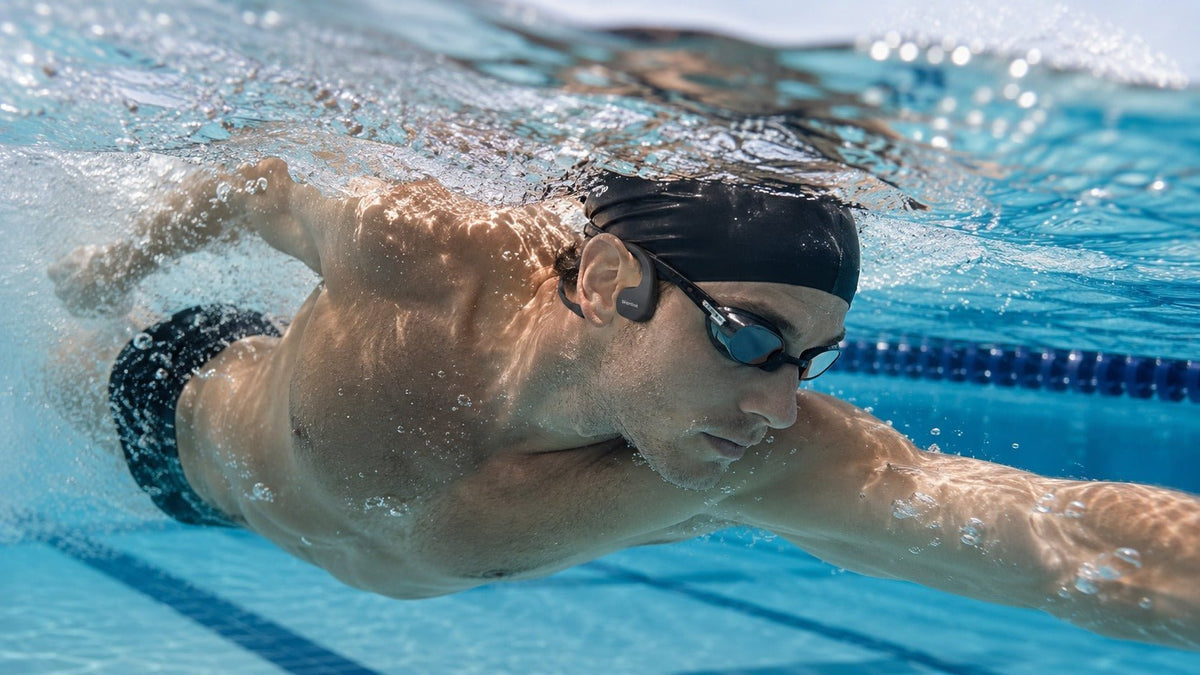
The best swimming headphones are built around what happens after your head goes underwater: reliable local playback, manufacturer-approved water use, a fit that works with your goggles and cap, and controls you can operate with wet hands. For most lap swimmers, those factors matter more than the newest Bluetooth version.
Quick answer: start with headphones that can play audio from onboard storage while submerged. Then compare the exact water-use guidance, battery life in the mode you will actually use, storage and file support, and the physical design. This guide compares five documented approaches rather than claiming a hands-on winner for sound, comfort, or durability.
Manufacturer documentation was rechecked on September 21, 2026. For a narrower shortlist limited to open-ear models, see the bone-conduction headphones for swimming comparison.

Five swimming headphones at a glance
Use the table to narrow the shortlist by playback method, water-use guidance, battery mode, and fit. The final column is an editorial starting point based on documented design and features, not a measured performance award.
| Model | Design | Water guidance |
|---|---|---|
| Wantek BC3 Pro | Open-ear bone conduction | IP68; current product page does not state a specific immersion depth |
| Shokz OpenSwim Pro | Open-ear bone conduction | IP68; Shokz states up to 2 m in fresh water |
| H2O Audio TRI 2 PRO | Open-ear bone conduction | IPX8; H2O states up to 12 ft / 3.6 m |
| Sony NW-WS623 | Sealed in-ear Walkman | IP65/IP68; Sony states up to 2 m for 30 min with swimming earbuds |
| FINIS Duo | Goggle-mounted bone conduction | IPX8; FINIS tested to 3 m for 30 min |
| Model | Local playback | Published battery |
|---|---|---|
| Wantek BC3 Pro | 32GB; local MP3 playback | Up to 6 hours overall |
| Shokz OpenSwim Pro | 32GB; MP3 Mode underwater | Up to 6 h MP3 / 9 h Bluetooth |
| H2O Audio TRI 2 PRO | 8GB MP3 + PLAYLIST+ | Up to 6 h memory / 9 h Bluetooth |
| Sony NW-WS623 | 4GB internal storage | Up to 12 h MP3 under Sony's stated conditions |
| FINIS Duo | 4GB; MP3/WMA | Up to 7 hours |
Useful starting points: BC3 Pro for straightforward high-capacity local MP3 playback; OpenSwim Pro for pool playback plus ordinary Bluetooth listening on land; TRI 2 PRO for PLAYLIST+ and multisport use; NW-WS623 for a sealed in-ear format; FINIS Duo for a dedicated goggle-mounted player.
Battery figures come from different manufacturer conditions and are not a controlled head-to-head test. An IP rating also does not replace each brand's exact depth, duration, water-type, and care instructions.
Why local playback matters more than Bluetooth underwater
Bluetooth is useful before and after a swim, but the models in this guide do not rely on a normal phone-to-headphone Bluetooth connection for repeated submerged playback. Shokz limits OpenSwim Pro underwater use to MP3 Mode, H2O Audio directs swimmers to MP3 or PLAYLIST+ underwater, and Sony states that Bluetooth does not function underwater on the NW-WS623.
That makes onboard playback the simpler starting point for lap swimming. Load compatible audio before entering the pool, switch to the device's local mode, and the headset reads audio from its own memory instead of depending on a poolside phone.
Storage capacity is only part of the decision. File formats, transfer method, playlist handling, and physical controls can matter as much as whether a headset has 4GB, 8GB, or 32GB.
1. Wantek BC3 Pro: 32GB local MP3 playback
The Wantek BC3 Pro product page lists IP68 protection, 32GB of onboard MP3 storage, Bluetooth 5.3, a 32g frame, a built-in microphone, up to six hours of battery life, and about a 1.5-hour charge time. Wantek also instructs swimmers to use local MP3 playback because water disrupts Bluetooth.
BC3 Pro is best understood as a straightforward local-playback swim setup. Its current product page identifies it for swimming, but it does not publish the same specific immersion-depth figure shown by some competitors, so the IP68 label should not be extended into an unsupported depth or duration claim.
If the main comparison is BC3 Pro versus OpenSwim Pro, the BC3 Pro vs. Shokz OpenSwim Pro comparison breaks down file support, battery conditions, weight, app features, water-use documentation, and dry-land features.
Check the current BC3 Pro specifications
Review storage, water protection, controls, color options, current availability, and the MP3 transfer workflow before deciding whether it fits your pool routine.
2. Shokz OpenSwim Pro: pool-and-land versatility
Shokz OpenSwim Pro combines IP68 protection, Bluetooth 5.4, 32GB of integrated storage, and a dedicated MP3 Mode for underwater use. Shokz currently lists up to six hours in MP3 Mode and up to nine hours in Bluetooth Mode.
Shokz also states that OpenSwim Pro can be submerged in up to two meters of fresh water. Because the manufacturer provides model-specific water guidance in addition to the IP rating, follow those current instructions rather than treating IP68 as a universal depth or environment rule.
OpenSwim Pro is a practical shortlist option when you want stored music during the swim and ordinary Bluetooth listening on land from the same headset.
3. H2O Audio TRI 2 PRO: MP3 plus PLAYLIST+
H2O Audio TRI 2 PRO combines IPX8 protection, an 8GB built-in MP3 player, Bluetooth 5.3, and PLAYLIST+. H2O Audio states that Bluetooth does not work underwater and directs swimmers to MP3 or PLAYLIST+ for submerged listening.
PLAYLIST+ is the main differentiator. H2O describes it as a way to record audio from a Bluetooth connection into the headset's memory for later offline playback. The company lists up to nine hours of Bluetooth playback and six hours in memory mode.
Consider TRI 2 PRO when the way audio gets onto the headset matters as much as raw storage capacity, or when you want one waterproof headset across swimming and several dry-land sports.

4. Sony NW-WS623: a sealed in-ear alternative
Sony NW-WS623 takes a different approach from open-ear bone conduction. Sony documents 4GB of internal storage, IP65/IP68 water protection, supplied swimming earbuds, and up to 12 hours of MP3 playback under specified conditions.
Sony states that the NW-WS623 can be submerged up to two meters for up to 30 minutes in fresh or salt water when used with the supplied swimming earbuds. It also states that Bluetooth and the remote control do not function underwater, so submerged playback depends on music stored in the device.
Consider this format if you prefer a sealed in-ear fit instead of an open-ear or goggle-mounted design.
5. FINIS Duo: a dedicated goggle-mounted player
The FINIS Duo technical sheet describes a two-piece bone-conduction player that clips to goggle straps and rests on the cheekbones. FINIS lists 4GB of storage, MP3 and WMA support, up to seven hours of battery life, and IPX8 testing at three meters for 30 minutes.
Duo is the most specialized form factor in this comparison. It makes sense to consider when you want a dedicated offline swimming player mounted directly to your goggles rather than a wraparound headset or sealed in-ear design.
How to choose swimming headphones
Start with the exact water-use guidance
Do not treat IP68 or IPX8 as a complete buying decision. Check whether the exact model is intended for swimming, the manufacturer's depth and duration guidance where provided, the permitted water type, and the required rinsing, drying, and charging routine.
Choose the underwater playback method
For ordinary lap swimming, onboard playback is the simplest option. A larger capacity gives you more room before reorganizing a library, but supported formats and the transfer workflow matter just as much as the headline storage number.
Match the design to your fit preference
Wraparound bone-conduction headsets leave the ear canal open, Sony uses swimming ear tips, and FINIS mounts to goggle straps. None is automatically more comfortable for every swimmer, so evaluate the design with the cap and goggles you actually use.
Compare battery figures in the correct mode
Use the runtime for the mode you will actually use in the pool. A Bluetooth maximum from one headset should not be compared directly with another model's MP3 or memory-mode runtime and presented as an equivalent swimming result.
Bone conduction vs. in-ear swimming headphones
Bone-conduction designs leave the ear canal open and transmit audio through contact points near the cheekbones. That can appeal to swimmers who dislike an in-ear seal, but fit and transducer contact still vary by person.
In-ear swimming models use swimming tips or another seal inside the ear canal. Some swimmers prefer that familiar in-ear format, while others prefer to keep the ear canal open. Neither design is automatically better for sound, comfort, or safety in every situation.
For a deeper comparison of open-ear swimming models, use the five-model bone-conduction swimming guide.
Which swimming headphones should you shortlist?
Choose BC3 Pro when 32GB of local MP3 storage and a straightforward Wantek open-ear setup are the priorities. Choose OpenSwim Pro when you want 32GB local playback plus a more extensively documented land-and-water feature set.
Consider TRI 2 PRO when PLAYLIST+ and flexible offline audio management matter. Consider Sony NW-WS623 when you prefer a sealed in-ear design, and FINIS Duo when a dedicated goggle-mounted player fits your swim setup better.
The useful decision is not which model has the newest Bluetooth version or the largest waterproof number. Start with approved water use and reliable submerged playback, then decide by fit, storage workflow, controls, and battery life in the mode you will actually use.
Frequently asked questions
Can Bluetooth headphones work underwater?
Do not rely on ordinary phone-to-headphone Bluetooth for continuous submerged playback. Swimming models commonly use onboard MP3, memory, or another local playback method once the headset is underwater.
Is IP68 or IPX8 enough for swimming?
No rating should be read in isolation. Confirm the exact model's approved use, tested depth and duration where published, permitted water type, and required after-use care.
How much storage do swimming headphones need?
There is no universal minimum. 4GB can cover regular training playlists, while 8GB or 32GB provides more room. File compatibility and transfer workflow can matter more than capacity alone.
Can I listen to Spotify or Apple Music while swimming?
Normal live phone streaming is not the dependable underwater method. Some headsets use transferable local files, while features such as H2O Audio PLAYLIST+ store audio for later offline playback.
Are bone-conduction headphones better for swimming?
They keep the ear canal open and avoid an in-ear seal, but they are not universally better. Fit, local playback, controls, water-use guidance, and personal preference still drive the choice.

