
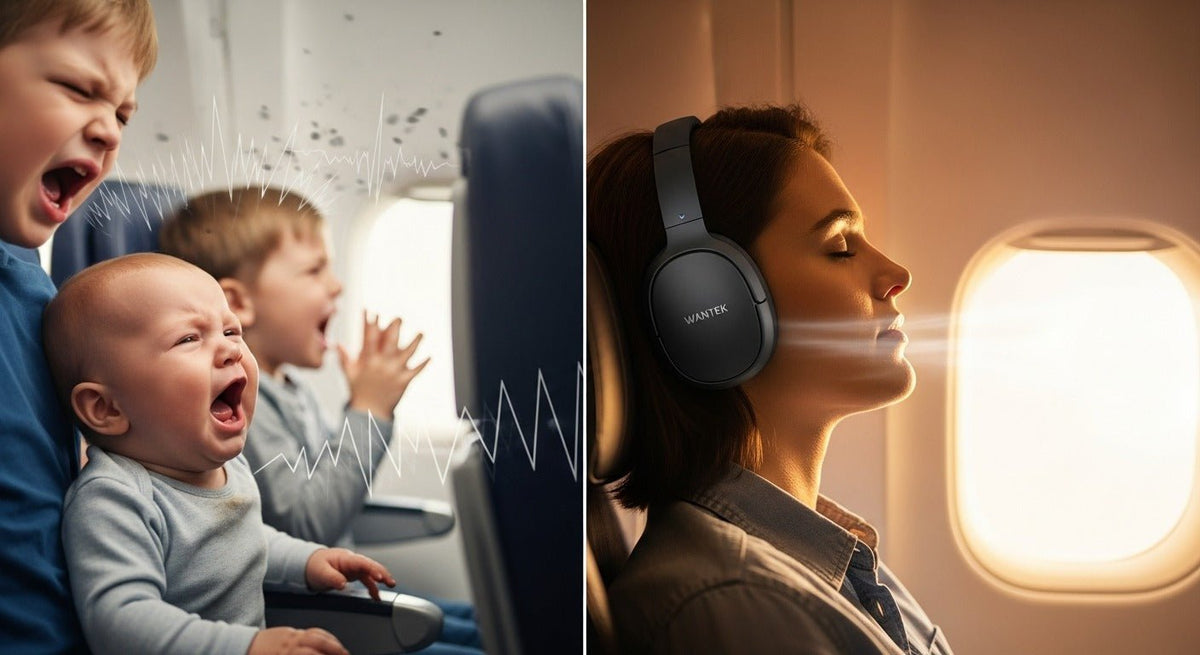
Good travel headphones are not defined by one specification. The right pair should match the way you actually travel: how much noise you face, how long you wear them, how much bag space you have, and whether you need wireless convenience, seatback audio, or clear calls along the way.
Quick answer: prioritize effective noise control, a fit you can wear for the full trip, enough battery for your longest travel day, and a form factor you will actually pack. Frequent flyers should also check wired or seatback entertainment compatibility instead of assuming every aircraft supports Bluetooth audio.

Start With the Way You Actually Travel
A long-haul flight, a daily train ride, and a weekend trip with one small bag create different priorities. Before comparing models, decide which problem the headphones need to solve most often.
| Travel scenario | Prioritize | Watch for |
|---|---|---|
| Flights | ANC, long-wear comfort, battery margin, optional wired audio | Seatback compatibility, case size, airline device rules |
| Train or bus | ANC, secure fit, transparency mode, simple controls | Announcements, crowd noise, frequent stops |
| Light packing | Compact earbuds or folding headphones | Charging case size, loose accessories, protection in a bag |
| Business travel | Comfort, microphone quality, multipoint, reliable controls | Call performance is separate from listener-side ANC |
| Walking between stops | Transparency or open listening, secure fit | Traffic, crossings, cyclists, and nearby movement |
If most of your travel is commuting rather than flying, compare the priorities in Wantek's train, plane, and bus headphone guide before you build a shortlist.
7 Things That Make Travel Headphones Good
1. Effective ANC plus a good physical seal
Active noise cancellation is especially useful against steady, lower-frequency noise such as aircraft cabin rumble, road noise, and rail vibration. It does not remove every voice, announcement, or sharp transient sound, so passive isolation still matters. Over-ear cushions need an even seal around the ear; earbuds need tips that fit securely without creating painful pressure.
Independent travel-headphone testing from RTINGS also treats noise isolation, comfort, and battery life as central travel criteria rather than judging travel performance by sound quality alone.
2. Comfort you can sustain for the whole journey
Comfort is more personal than a specification sheet suggests. Clamping force, ear-cup depth, heat buildup, headband pressure, glasses, ear-tip shape, and total weight can all change how a pair feels after an hour or more.
When possible, test the headphones for longer than a quick store demo. A model that feels soft for ten minutes can still become tiring during a long flight. For over-ear headphones, check whether your ears touch the inner cup. For earbuds, try every included tip size instead of assuming the preinstalled pair is correct.
3. Battery life that covers your longest travel day
There is no universal minimum battery target. The useful question is whether the headphones can cover your longest expected day with margin for delays, calls, ANC use, and battery aging. Manufacturer figures are maximum ratings under stated conditions, so compare the mode you plan to use rather than the largest headline number.
Fast charging can matter almost as much as maximum runtime. If your trips include short layovers or hotel-to-airport turnarounds, several hours of playback from a short charge may be more useful than a modestly larger maximum rating.
4. The right form factor: over-ear or earbuds
Over-ear headphones usually give you more room for cushioning, larger batteries, and physical controls. They are often easier to wear for long sessions if the fit suits your head, but they take more bag space.
True wireless earbuds are much easier to pocket and can work well for travelers who pack light. Their comfort depends heavily on ear-tip fit, and you also need to manage the charging case. Neither form factor is automatically better; the better choice is the one you can wear comfortably and carry consistently.
5. A realistic plan for in-flight entertainment
Bluetooth from your phone or tablet is only part of the travel setup. Seatback entertainment varies by airline and aircraft: some systems support direct Bluetooth pairing, while others still use wired audio. If seatback movies matter to you, check the exact airline and aircraft before departure.
For U.S. flights, the FAA's electronics guidance says phones and portable electronic devices should be used in airplane mode or with cellular service disabled, while airline and crew instructions still control what is allowed on a specific flight.
A detachable 3.5 mm cable can be a useful fallback when both your headphones and the seatback system support analog audio. Do not assume a wireless model can play passively through a cable unless its manufacturer explicitly lists that capability.
6. Connectivity and controls that fit your devices
A newer Bluetooth version is not, by itself, proof of better travel performance. First confirm that the headphones work cleanly with the devices you actually carry. Multipoint is useful for travelers who switch between a phone and laptop, while simple physical or touch controls matter when you need to pause quickly for an announcement.
Bluetooth codecs can affect compatibility, sound, and sometimes battery use, but both the source and the headphones must support the same codec. Do not choose a worse-fitting headphone solely because its specification sheet lists a higher-bandwidth codec.
7. Portability and durability you will notice every trip
Check how the headphones fit into your luggage, not just how they look on a desk. Folding hinges, rotating earcups, a protective case, replaceable cables, and a pocketable charging case can have more day-to-day value than cosmetic features.
If part of your trip is outdoors, verify the actual water-resistance rating instead of assuming every wireless headphone is rain-ready. Over-ear headphones often have no meaningful IP rating, while many earbuds do. Treat the exact product specification as the source of truth.
Specs That Should Not Drive the Decision by Themselves
- Driver size: a larger driver does not automatically mean better sound.
- Bluetooth version: it does not tell you the quality of ANC, fit, controls, or microphone performance.
- Maximum battery number: it is only meaningful when you know the ANC, codec, volume, and test conditions.
- Hi-Res or codec logos: useful in the right setup, but secondary to comfort, isolation, and device compatibility for most travelers.
- "Noise cancelling" wording: confirm whether the claim refers to listener-side ANC, passive isolation, microphone noise reduction, or some combination of them.
A Practical 5-Step Travel Headphone Shortlist
Define your longest and noisiest trip
Use the hardest recurring journey as the baseline, not the easiest one.
Choose the form factor
Decide whether long-session over-ear comfort or compact earbud portability matters more.
Verify noise control and awareness
Check ANC performance for motorized travel and a quick transparency option when you need announcements or nearby sound.
Check battery and connection fallbacks
Plan for the full travel day, then confirm charging, wired audio, multipoint, and seatback needs.
Test fit before extra features
If the headphones become uncomfortable after an hour, premium codecs and smart features will not rescue the purchase.
One Wantek Travel Option to Compare
If you want an over-ear Wantek option in the shortlist, the Wantek T3 ANC headphones currently list active noise cancellation, transparency mode, Bluetooth 5.3, and up to 60 hours of battery life. The product page does not state whether the 60-hour figure is measured with ANC on or off, so treat the operating condition as unknown rather than assuming an ANC-on runtime.
Compare the Wantek T3
Check the current T3 specifications, availability, and connection details before deciding whether it fits your travel setup.
Travel Headphones FAQ
Are noise-cancelling headphones worth it for travel?
They are especially useful on planes, trains, and buses where steady low-frequency noise is common. For quieter trips, a comfortable fit and good passive isolation may matter more than premium ANC.
Can I use Bluetooth headphones on a plane?
Usually, but follow the airline and crew instructions. In the U.S., use airplane mode or disable cellular service, then follow the carrier's rules for Bluetooth and onboard connectivity.
Can Bluetooth headphones connect directly to seatback entertainment?
Sometimes. Bluetooth support varies by airline, aircraft, and cabin system. If direct pairing is unavailable, a wired connection may work when both the headphones and seatback system support compatible analog audio.
Are over-ear headphones or earbuds better for long flights?
Over-ear models often favor long-session cushioning and larger batteries; earbuds save much more space. The better choice depends on your fit preference, heat tolerance, sleeping position, and bag space.
How much battery life should travel headphones have?
Choose enough runtime for your longest expected travel day with extra margin. Compare the battery figure in the mode you will actually use, especially if ANC is normally enabled.

