
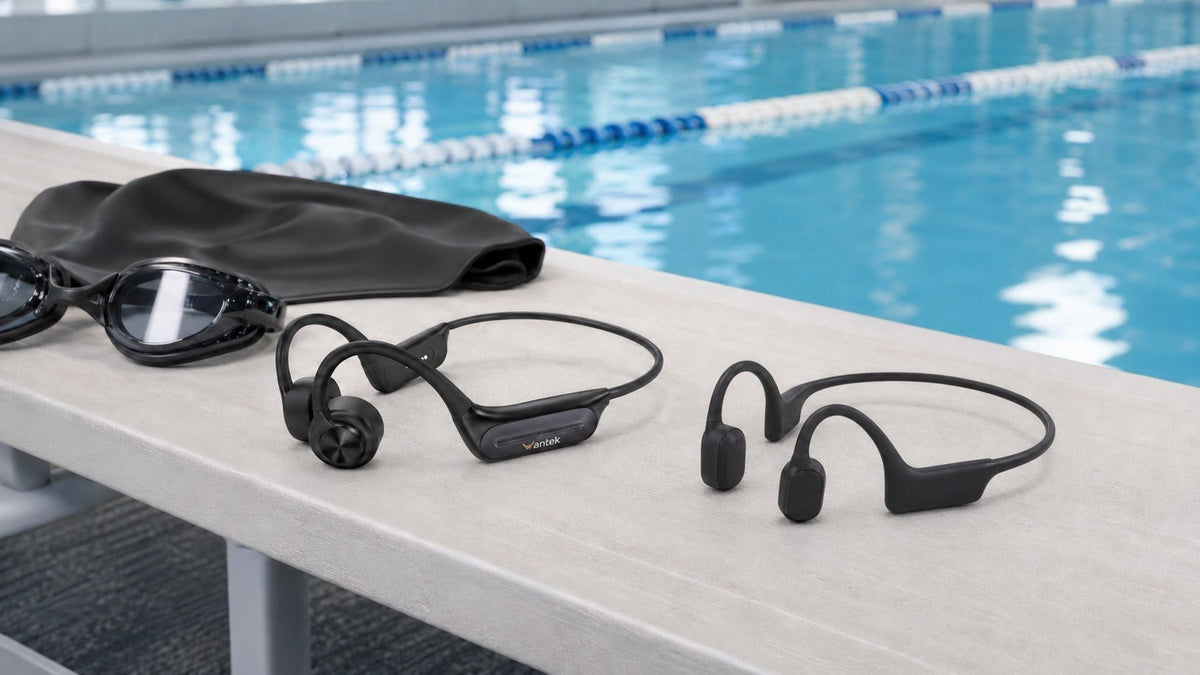
If you are comparing the Wantek BC3 Pro with the Shokz OpenSwim Pro for swimming, the overlap is substantial: both use open-ear bone conduction, both list IP68 protection, both provide 32GB of onboard storage, and both support local playback for underwater listening.
Quick answer: BC3 Pro is the simpler, lower-cost option built around MP3 storage, Bluetooth 5.3 for dry-land use, and a 32g open-ear frame. OpenSwim Pro adds broader documented file support, Bluetooth 5.4, Swimming EQ, Shokz App features, MultiPoint Pairing, a lighter 27.3g frame, and more detailed published water-use guidance.
Battery figures need careful reading. Wantek currently lists BC3 Pro at up to six hours overall but does not separate MP3-mode and Bluetooth-mode runtime. Shokz separately lists up to six hours in MP3 Mode and up to nine hours in Bluetooth Mode. Those published conditions are not matched closely enough to call the two models equal in swimming battery life.

BC3 Pro vs OpenSwim Pro: Quick Comparison
| Feature | Wantek BC3 Pro | Shokz OpenSwim Pro |
|---|---|---|
| Audio design | Open-ear bone conduction | Open-ear bone conduction |
| Water protection | IP68 | IP68 |
| Published immersion guidance | No specific depth currently stated on the product page | Up to 2 m in fresh water |
| Onboard storage | 32GB | 32GB |
| Underwater playback | Local MP3 playback | MP3 Mode |
| Bluetooth | 5.3 | 5.4 |
| Published battery life | Up to 6 hours overall; no separate MP3/Bluetooth figure published | Up to 6 hours MP3; up to 9 hours Bluetooth |
| Charging time | About 1.5 hours | About 1.5 hours |
| Weight | 32g | 27.3g |
| Documented local formats | MP3 | MP3, FLAC, WAV, AAC, M4A, APE, WMA |
| App / swimming EQ | Not currently documented | Shokz App + Swimming EQ |
| Microphone | Built-in microphone | Microphone included |
| Listed US price | $45 | $229.95 |
These are manufacturer-published specifications, not results from a controlled side-by-side pool test. For a broader shortlist, see the best bone conduction headphones for swimming guide.
Underwater Playback: Local Storage Matters More Than Bluetooth
Bluetooth is useful on land, but it should not drive an underwater buying decision. Water heavily attenuates radio signals in the 2.4GHz range used by ordinary Bluetooth connections, so a phone-to-headset stream becomes unreliable after submersion. Research on underwater 2.4GHz propagation illustrates the underlying signal-loss problem.
BC3 Pro provides 32GB of onboard storage and Wantek instructs swimmers to transfer MP3 files from a computer and use local playback in the pool. OpenSwim Pro also provides 32GB, but Shokz documents a wider format list: MP3, FLAC, WAV, AAC, M4A, APE, and WMA.
If most of your library is already MP3, both models cover the basic local-playback requirement. If you keep music in several supported formats, OpenSwim Pro offers broader documented compatibility.

Can You Stream Spotify or Apple Music Underwater?
Do not plan on normal Bluetooth streaming from a poolside phone while your head is underwater. For either model, load compatible local audio files onto the headset before swimming.
Offline downloads inside Spotify, Apple Music, and similar services are not automatically transferable MP3 files. They may remain protected inside the app, so verify that you actually have compatible local files before treating 32GB of storage as a deciding advantage.
Waterproofing: Same IP68 Label, Different Published Guidance
Both models list IP68, but an IP code does not replace model-specific instructions. Wantek markets BC3 Pro for swimming and lists IP68 protection, while its current product page does not state a specific immersion depth.
Shokz publishes more detailed limits for OpenSwim Pro, including submersion up to 2 meters in fresh water. Its current US page also includes specific after-use care language for open-water or salt exposure and separately advises against deeper diving. Follow the current instructions for the exact region and model rather than extrapolating from the IP68 label alone.
This supports a narrow conclusion: OpenSwim Pro currently has more explicit published water-use guidance. It does not by itself prove better long-term durability.
For the underlying technology and fit trade-offs, see the bone conduction headphones guide.
Storage: Both Have 32GB, but File Support Differs
Storage capacity is a tie on paper: both products list 32GB. The more useful distinction is what each manufacturer actually documents about file compatibility.
BC3 Pro currently documents MP3 transfer and playback. OpenSwim Pro documents seven formats: MP3, FLAC, WAV, AAC, M4A, APE, and WMA. Shokz also publishes song-count estimates for its own 32GB storage, but those numbers should not be copied to another device because usable capacity, bitrate, format, and track length all change the result.
Battery Life: Similar Numbers, Different Published Conditions
Wantek lists BC3 Pro at up to six hours with an approximately 1.5-hour charge time. The current specification does not split that six-hour figure into MP3 and Bluetooth modes.
Shokz publishes separate OpenSwim Pro ratings: up to six hours in MP3 Mode and up to nine hours in Bluetooth Mode, also with about a 1.5-hour full charge.
That means the nine-hour Shokz Bluetooth figure should not be compared with BC3 Pro's general six-hour figure as though both describe swimming. It also means the available manufacturer data does not establish equal six-hour swimming runtime under matched test conditions.
Weight, Fit, and Dry-Land Use
OpenSwim Pro is lighter on the published specifications: 27.3g versus 32g for BC3 Pro, a 4.7g difference. That number alone cannot tell you which headset will stay more comfortable or secure during push-offs and turns.
Fit depends on head shape, transducer position, goggles, caps, hair, and pressure tolerance. Both are open-ear wraparound designs, so the practical test is whether the transducers maintain stable contact without creating pressure points in your normal swim setup.
For dry-land use, BC3 Pro provides Bluetooth 5.3 and a built-in microphone. OpenSwim Pro adds Bluetooth 5.4, Shokz App controls, Swimming EQ, playlist management, firmware functions, MultiPoint Pairing, and a separate nine-hour Bluetooth battery rating. Those extras matter more if the same headset will also be used for running, gym sessions, or everyday listening.
Price and Value: Compare the Features You Will Actually Use
On September 18, 2026, Wantek listed BC3 Pro at $45 and Shokz listed OpenSwim Pro at $229.95 in the US. Prices and availability can change, so treat those figures as dated observations rather than permanent specifications.
The price difference does not make the two products feature-equivalent. OpenSwim Pro adds lower weight, broader file support, Swimming EQ, app controls, MultiPoint Pairing, a separate Bluetooth battery rating, and more detailed water-use documentation.
BC3 Pro's value case is simpler: 32GB of local MP3 storage, IP68 protection, Bluetooth for dry-land use, and a much lower listed purchase price. The decision comes down to whether the additional OpenSwim Pro features matter to your routine.
Which One Fits Your Swim?
Consider BC3 Pro if you prioritize:
- 32GB of local MP3 storage
- Open-ear bone conduction for swimming
- Bluetooth 5.3 for dry-land listening
- A straightforward local-playback workflow
- A substantially lower current listed price
Consider OpenSwim Pro if you prioritize:
- A lighter 27.3g frame
- Broader documented local file support
- Swimming EQ and Shokz App controls
- Explicit freshwater immersion guidance
- MultiPoint Pairing and a longer published Bluetooth-mode runtime
For pool laps, the two products overlap on several essentials: open-ear bone conduction, 32GB of onboard storage, IP68 protection, and local playback. OpenSwim Pro has the broader documented feature set; BC3 Pro has the simpler feature set and the lower current listed price. Manufacturer specifications alone cannot determine a universal winner for comfort, sound preference, stability, or durability.
Frequently Asked Questions
Does Bluetooth work underwater with BC3 Pro or OpenSwim Pro?
Do not rely on normal phone-to-headset Bluetooth while submerged. Both products provide onboard storage so compatible files can play directly from the headset during swimming.
Which headset has more storage?
Neither. Both list 32GB of onboard storage. BC3 Pro documents MP3 playback, while OpenSwim Pro documents MP3, FLAC, WAV, AAC, M4A, APE, and WMA.
Which has longer battery life for swimming?
Shokz rates OpenSwim Pro for up to six hours in MP3 Mode. Wantek lists BC3 Pro at up to six hours overall without a separate MP3 figure, so the swimming-mode ratings are not directly matched.
Which headset is lighter?
OpenSwim Pro is listed at 27.3g, while BC3 Pro is listed at 32g. The published difference is 4.7g, but fit and comfort still depend on the individual swimmer.
Does OpenSwim Pro support more audio formats?
Yes. Shokz lists seven local formats, while Wantek's current BC3 Pro documentation specifically confirms MP3 playback rather than the same multi-format list.
Is OpenSwim Pro worth the higher price?
That depends on your use case. Its documented extras include lower weight, broader file support, Swimming EQ, app controls, MultiPoint Pairing, explicit depth guidance, and longer Bluetooth-mode runtime.

