
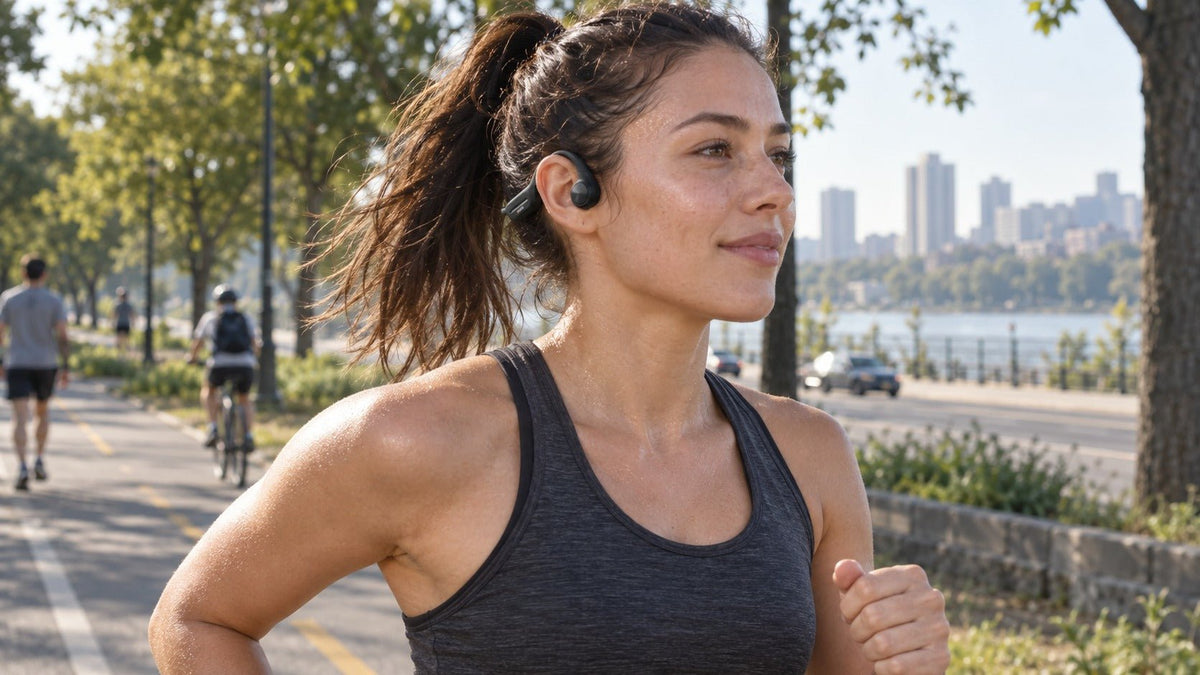
The best running headphones stay in place, handle the sweat or rain you expect, and work with your phone or watch. Where you run matters, too. On roads and shared paths, consider how much outside sound you need to hear; on a treadmill, you may prefer more isolation.
This guide compares headphone designs and published manufacturer specifications. The product comparisons are based on those sources, not hands-on running tests.
Choose the fit style first
Start with how you want the headphones to sit on your ears or head. Battery life, codecs, and app features matter less if the fit or level of isolation doesn't suit your run.
| Where or how you run | A design to consider | What matters here |
|---|---|---|
| Roads and shared paths | A design to consider: Open-ear or bone-conduction headphones | What matters here: An open ear canal can make surrounding sounds easier to hear than strongly isolating earbuds. |
| Gym or treadmill | A design to consider: Secure in-ear sport earbuds | What matters here: A stable seal and stronger isolation may help when hearing your surroundings is less central. |
| Long outdoor runs | A design to consider: A lightweight design that stays in place | What matters here: Check comfort, controls, and whether one charge will cover the run. |
| Rain or heavy sweating | A design to consider: A sport model with documented water protection | What matters here: Read the manufacturer's IP rating and use instructions for the conditions you expect. |
Open-ear headphones still require attention outdoors. Volume, surrounding noise, and route conditions affect what you hear and notice.

1. Check what holds the headphones in place
Each stride adds movement. Sweat and jaw motion can change the fit, too. A "sport" label tells you less than the parts that actually hold the headphones on your ears.
- Ear hooks add support around the outside of the ear.
- Wings or fins brace an in-ear design against the outer ear.
- Wraparound bands can steady open-ear or bone-conduction headsets.
- Clip-on designs grip part of the outer ear while leaving the canal open.
- In-ear tips need the right size and shape to form a comfortable seal.
Fit is personal. Ear shape, head size, glasses, hats, hair, and running motion can all affect comfort and stability. If you can't try a pair before buying, check the return policy.
2. Read the IP rating alongside the care instructions
An IP rating describes protection against ingress under defined test conditions. The manufacturer's use instructions explain how that rating applies to the product.
Sweat, splashes, rain, temporary immersion, and swimming are different exposures. A higher IP number alone doesn't establish that headphones are suitable for all of them.
For example, Shokz lists the OpenRun Pro 2 with IP55 protection, up to 12 hours of battery life, and a weight of approximately 30.3 g. Use those figures when comparing models, then check Shokz's water-use guidance for the conditions you have in mind.
For more on moisture exposure and care, see our guide to choosing sweat-resistant workout headphones.
3. Decide how much outside sound you need to hear
Roads and shared paths
Open-ear and bone-conduction headphones leave the ear canal unobstructed. That can make nearby sounds easier to hear than with earbuds that create a tight seal.
The two designs deliver sound differently. Bone-conduction headphones use transducers that vibrate against the side of the head. Many other open-ear designs use small air-conduction speakers outside the ear canal. Our open-ear earbuds vs. bone-conduction guide explains the differences.
You still need to account for wind and traffic noise. Music or podcasts can compete with those sounds, and turning up the volume can affect what you notice.
Treadmills and indoor runs
In a gym, you may prefer sealed earbuds or active noise cancellation (ANC) to reduce distracting background sound. ANC performance varies by model. Passive isolation comes from the ear tips' seal; ANC uses active processing to reduce what you hear.
Microphone noise reduction serves a separate purpose: it reduces noise in the voice captured during calls. A product that advertises this feature doesn't necessarily have ANC for listening.
4. Check whether one charge covers your run
Battery figures are easy to misread when one product lists earbud runtime and another leads with the charging-case total.
- Single-charge playback tells you how long the earbuds or headset can run without recharging.
- A charging-case total includes extra use after you put the earbuds back in the case to charge.
- Calls, playback volume, ANC, transparency mode, codecs, and other settings can affect runtime.
For daily runs, a convenient charging routine may matter more than the largest battery claim. For a long training session, allow some margin below the manufacturer's maximum.
5. Make sure you can use the controls while moving
Touch controls can be convenient, though sweat, gloves, and movement may make them harder to use. Physical buttons can be easier to find by feel. The better option depends on which controls you find reliable.
Check how you pause playback, adjust volume, and use any other functions you need during a run. You shouldn't have to reach for your phone every time.
Running headphone designs compared
| Design | Typical advantage | What to check |
|---|---|---|
| Bone-conduction headset | Typical advantage: An open ear canal with a wraparound band for support | What to check: Band fit, contact pressure, battery life, IP guidance, and how well you can hear playback in noisy areas |
| Open-ear clip-on or ear-hook headphones | Typical advantage: An open canal without a rear neckband | What to check: Outer-ear comfort, stability, speaker position, water protection, and single-charge runtime |
| Sealed sport earbuds | Typical advantage: More passive isolation and potentially stronger bass | What to check: Tip fit, hooks or wings, IP rating, controls, and whether isolation suits your route |
| ANC earbuds | Typical advantage: Less distracting background sound in controlled settings | What to check: Fit, transparency options, battery life with ANC, and whether you need to hear more of your surroundings |
Two Wantek options to compare
The OBT030 and BC3 Pro use different open-ear designs. Compare their fit, stated water protection, and battery figures against your usual runs.
Wantek OBT030: a lightweight clip-on design
The OBT030 clips onto the outer ear and leaves the ear canal open. Its listed specifications include a built-in microphone and up to 8 hours of earbud playback. The 50-hour total includes recharging with the case.
- Design: Open-ear clip-on
- Listed weight: 8.5 g
- Bluetooth: 5.4
- Earbud playback: Up to 8 hours
- Total with case: Up to 50 hours
- Microphone: Built in
The product specifications used for this guide do not list an IP rating. Before choosing it for rain or heavy sweating, check the latest water- and sweat-use guidance.
Wantek BC3 Pro: a wraparound bone-conduction headset
The BC3 Pro has a wraparound band, a published IP68 rating, and onboard MP3 storage. Its listed weight is 32 g, with up to 6 hours of rated battery life.
- Design: Wraparound bone conduction
- Weight: 32 g
- Water protection: IP68
- Bluetooth: 5.3
- Onboard storage: 32 GB for MP3 playback
- Battery: Up to 6 hours
If water protection is a priority, the BC3 Pro gives you a documented rating to check against the manufacturer's use instructions. Also weigh its wraparound fit and shorter rated runtime against the OBT030's lighter clip-on design.
Our bone-conduction headphones guide explains how the technology works and what to expect from it.
Claims to check before you buy
- An IP rating covers defined test conditions. Follow the manufacturer's guidance for the water exposure you expect.
- Open-ear headphones leave your ears clear, but volume, attention, traffic, and route conditions still affect awareness.
- ANC reduces sound heard by the wearer. Microphone noise reduction changes the voice signal captured for calls.
- Bluetooth version alone doesn't tell you latency, range, multipoint support, or sound quality. Check the model's specific features.
- A "sport" label can't guarantee fit for your ears or head.
- A charging-case total includes recharging. Use single-charge runtime when planning one uninterrupted run.
How to narrow your shortlist
Work through the requirements that could rule a pair out before comparing extra features.
- Choose a fit style: wraparound, clip-on, ear hooks, stabilizing wings, or conventional in-ear tips.
- Check that the documented sweat and water guidance covers your expected conditions.
- Decide how much outside sound you need to hear and whether an open canal or a sealed fit suits the route.
- Compare single-charge runtime with your longest uninterrupted training session.
- Verify compatibility with your phone or watch, including any operating system, app, codec, or connection requirements you rely on.
- Check the remaining details: controls, weight, replacement parts, warranty, care instructions, and return policy.
Frequently asked questions
Are bone-conduction headphones good for running?
They can suit runners who prefer a wraparound fit and an open ear canal. Comfort varies, and the lack of isolation means nearby noise can make music or podcasts harder to hear.
What IP rating should running headphones have?
There is no single requirement for every run. Look for manufacturer guidance that covers your expected sweat, rain, or splash exposure. A sport label or general water-resistance claim doesn't establish suitability for swimming.
Are ANC earbuds good for running?
ANC can be useful on a treadmill or in other controlled settings where background noise is distracting. Outdoors, consider how reducing that noise affects your ability to hear what's happening around you.
Do ear hooks stop earbuds from falling out?
Ear hooks can improve stability, but fit still depends on the hook shape, ear tips, product weight, and your ears. Glasses and running movement can also affect how securely they sit.
Are open-ear headphones better for outdoor running?
They can make surrounding sounds more accessible than strongly isolating earbuds. That doesn't guarantee awareness: volume and attention still matter, and noisy surroundings can make playback difficult to hear.
Does a 50-hour battery claim mean 50 hours of continuous playback?
If the figure includes a charging case, it includes time gained by recharging the earbuds. Check the single-charge earbud figure to see how long they can play during one uninterrupted run.
Choose for the runs you actually do
Start with a fit that stays comfortable and secure, water-use guidance that matches your conditions, and enough battery for the full session. Then compare controls and sound features. Open-ear designs deserve consideration on outdoor routes where you need to hear nearby activity; a secure sealed fit or ANC may suit treadmill runs.
If you also cycle, check that use separately. Helmet fit and wind introduce different considerations. Our cycling headphones guide covers those details alongside controls and riding conditions.
Related Wantek guides
Sources
- IEC 60529: Degrees of protection provided by enclosures (IP Code) explains the scope of IP classifications.
- Shokz OpenRun Pro 2 provides the manufacturer's specifications for the example above.
- Wantek OBT030 lists weight, Bluetooth version, microphone, and battery specifications.
- Wantek BC3 Pro lists the IP rating, Bluetooth version, weight, onboard storage, and battery specifications.

