
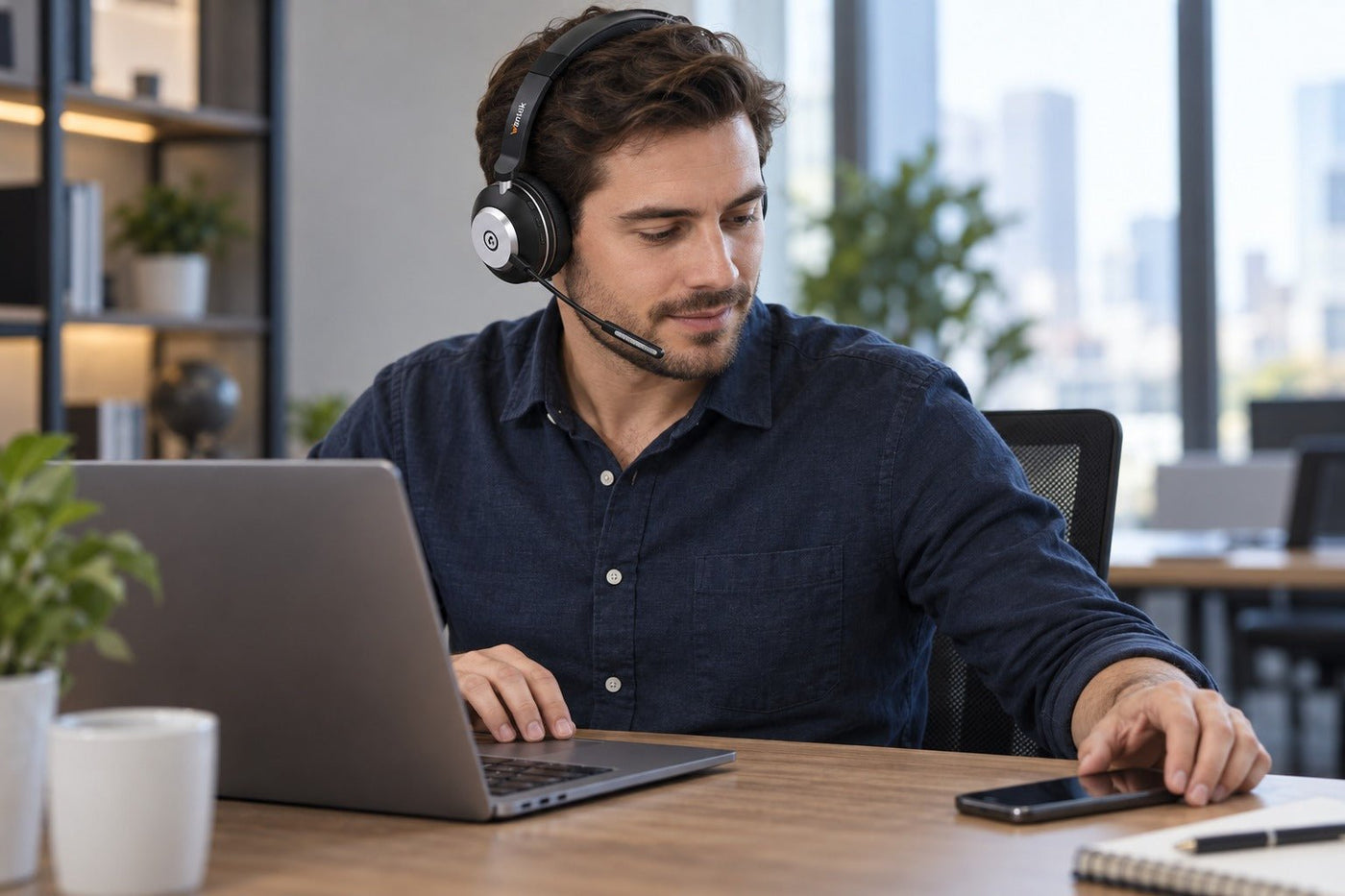
Multipoint Bluetooth headphones can keep your laptop and phone connected to one headset, reducing the need to disconnect and pair again between tasks. For work, the useful question is how that connection behaves during a meeting, an incoming call, and a return to laptop audio.
Start with a headset that supports your two-device setup, then check microphone design, noise control, fit, and meeting-app compatibility. A long list of remembered devices does not establish that two can stay connected at once. A USB receiver also does not automatically mean the receiver and your phone work simultaneously.
This guide compares five work-oriented options using manufacturer product pages and manuals. It is a specification-based comparison, not a hands-on ranking. We have not measured their switching speed, microphone performance, or comfort side by side.

Compare five headsets for laptop and phone use
Use the table to narrow your shortlist by connection needs. The use cases are editorial suggestions, rather than measured performance awards.
| Headset | Consider it for | Connection detail | Noise control for the wearer |
|---|---|---|---|
| Wantek 186BTC | Consider it for: An over-ear design with a boom microphone | Connection detail: Marketed as multipoint; confirm the exact connection route and matching manual | Noise control for the wearer: Passive isolation listed |
| Jabra Evolve2 65 | Consider it for: An on-ear office headset without ANC | Connection detail: Two simultaneous Bluetooth connections; Link 380 adapter configurations | Noise control for the wearer: Passive isolation; no ANC |
| Poly Voyager Focus 2 | Consider it for: Boom-mic calls with adjustable ANC | Connection detail: Two active connections, including a USB Bluetooth adapter | Noise control for the wearer: Three ANC settings |
| Logitech Zone Wireless 2 | Consider it for: A multipoint headset with hybrid ANC | Connection detail: Multipoint supported; choose the appropriate receiver or native-Bluetooth configuration | Noise control for the wearer: Hybrid ANC |
| EPOS ADAPT 660 USB-C | Consider it for: An over-ear headset with integrated microphones | Connection detail: Two Bluetooth connections; USB-C BTD 800 adapter | Noise control for the wearer: Adaptive ANC |
These models are not interchangeable versions of the same product. Check the exact SKU, included receiver, and meeting-app requirements before ordering. In particular, the EPOS entry here is the ADAPT 660 USB-C, article number 1001373.
What multipoint does—and what it does not do
Three different capabilities often get mixed together:
- Remembered pairings: devices the headset can reconnect to later.
- Active connections: devices that can remain connected at the same time.
- Audio mixing: hearing two sources together, which multipoint alone does not promise.
For a laptop-and-phone workflow, look for two active connections and read the switching instructions. Google’s multipoint guidance explains switching media by stopping playback on one connected device before starting it on the other. Device controls and call priority still depend on the headset and software.
Do not assume that a phone call will always interrupt a laptop meeting, that ending the call will always resume a video, or that two calls can be merged. Treat these as separate behaviors to verify. If you need to hear computer audio and a phone conversation simultaneously, ask specifically about audio mixing.
The five options in more detail
Wantek 186BTC: check the connection mode before choosing
Wantek lists the 186BTC as an over-ear multipoint work headset with an adjustable headband, boom microphone, and passive isolation.
Its product page links a BT-186 user guide that describes connecting two Bluetooth devices. The same guide says the 2.4 GHz dongle and Bluetooth modes cannot stay connected simultaneously. Because the identifiers in the listing and guide differ, confirm which instructions apply to your configuration before relying on laptop-receiver-plus-phone connectivity.
Choose this option after confirming the connection route you need. Also check the selected dock option and included accessories.
Jabra Evolve2 65: an on-ear option without ANC
The Evolve2 65 specifications list two simultaneous Bluetooth connections and eight remembered devices. It has a boom microphone and passive noise isolation, but no active noise cancellation.
Consider it if you prefer an on-ear work headset and do not require ANC. Check whether you need a USB-A or USB-C Link 380 package and the appropriate UC or Microsoft Teams variant. Those configuration choices matter when matching the headset to a company laptop and its meeting software.
Poly Voyager Focus 2: adjustable ANC for calls
The Voyager Focus 2 product page describes a boom microphone with Acoustic Fence processing and three ANC settings. Its user guide states that it can connect to two devices at a time, counting the USB Bluetooth adapter as a device.
Consider it when adjustable listening-side noise reduction and a boom mic suit your workday. Confirm the BT700 connector and package you need. Connecting a desk phone may require a different base setup; laptop-and-phone multipoint should not be treated as universal desk-phone compatibility.
Logitech Zone Wireless 2: check the receiver and app requirements
Logitech’s Zone Wireless 2 specifications list multipoint connectivity and hybrid ANC. The product range includes different connection configurations, so check whether the version you are ordering includes a receiver or is intended for native Bluetooth use.
This is worth considering if you want ANC alongside a work headset’s microphone controls. Match the configuration to your operating system and conferencing app: requirements for native-Bluetooth Microsoft Teams functionality are more specific than simply having Bluetooth on the laptop.
EPOS ADAPT 660 USB-C: over-ear with integrated microphones
The ADAPT 660 USB-C fact sheet lists two simultaneous Bluetooth connections, adaptive ANC, and the BTD 800 USB-C adapter. It uses an over-ear form with integrated microphones rather than a projecting boom.
Consider it if that microphone layout and an over-ear fit suit your mix of meetings and listening. Compare the exact USB-C model, rather than carrying specifications across older ADAPT 660 listings or other packages with a similar name.
How to choose for your workday
Start with the laptop connection
Write down your laptop model, operating system, available USB ports, and phone model. Decide whether you will use the laptop’s built-in Bluetooth or a manufacturer-supplied receiver.
A receiver may provide a documented connection route for a business headset, but check what it supports with that exact model. A proprietary 2.4 GHz receiver is not automatically a Bluetooth multipoint connection. If the laptop is managed by your employer, confirm whether its Bluetooth settings, USB devices, or headset software are restricted.
Separate microphone noise reduction from ANC
ANC reduces noise you hear through the headset. Microphone noise reduction targets the sound sent to the person on the call. Passive isolation comes from the physical fit and seal. These features solve different problems.
For a shared office, evaluate both sides: can you hear the caller comfortably, and can they understand you over nearby conversation? A boom mic or an ANC label alone cannot establish the result. Ask a colleague to listen to a short sample recorded in the room where you actually work.
Compare fit and call battery under matching conditions
An on-ear headset rests on the ears; an over-ear design surrounds them. Try the headset with your glasses, normal mic position, and typical meeting length. Check pressure, heat, adjustment, and whether the controls are easy to find without looking.
For battery life, compare talk time with talk time, using the same ANC setting where possible. Music-playback figures, busy-light settings, and extra voice-processing features can change the comparison. This guide avoids a single battery ranking because the published figures are not all measured under matching conditions. Allow charging time around your real meeting schedule.
Verify the controls you use most
List the functions you need: answering calls, muting, adjusting volume, and reconnecting after sleep. Then check support for your exact meeting app and connection method. A headset can pass audio while its answer button behaves differently across applications.
If you are still deciding whether wireless is useful for your desk, see our wired vs. wireless office headset guide.
Set up and test laptop-to-phone switching
Use the model’s own pairing instructions; button combinations and app settings vary. For a general starting point, our laptop and phone pairing guide covers the device menus.
- Connect the first device. Pair the headset with your laptop, or set up the supported receiver, following the manual.
- Add the phone. Enter the documented second-device pairing mode. Enable multipoint in the manufacturer’s app if the model requires it.
- Confirm both connections. Check that adding the phone has not disconnected the laptop. Remember that a mixed receiver/Bluetooth route may have different rules.
- Select meeting audio. In the laptop’s sound settings and your meeting app, choose the intended headset microphone and speaker.
- Try a media handoff. Play a short clip on the laptop, pause it, then start audio on the phone. Repeat in the other direction.
- Try a call handoff. In a test session, check what happens when the phone rings during laptop audio. Check microphone routing, mute, and return to laptop sound after the call.
- Check reconnection. Put the laptop to sleep, wake it, and verify that the headset returns to the intended devices.
Keep a short pass/fail note for these tasks. A headset that reconnects cleanly in your actual setup is more useful than a broad compatibility claim that leaves your call workflow uncertain.
Troubleshoot common switching problems

The phone connects but the laptop drops. Check the headset’s active-device limit, whether multipoint is enabled, and whether another remembered device has reconnected. Confirm that the selected receiver and Bluetooth modes can operate together.
Both devices connect, but the second stays silent. Stop media on the first device, then start it on the second. Check whether an open calling app is still using the microphone and whether audio is routed to the headset.
People cannot hear you in a meeting. Check mute on the headset and inside the app. Select the correct microphone in both the operating system and the app, then make a test recording.
Music quality drops when the microphone is active. Apple explains that Bluetooth audio quality can change when an app uses the headset microphone. After the call, close apps still using the mic and reselect the headphones if needed. On Windows, supported LE Audio setups can provide stereo audio while the microphone is active, but Microsoft specifies compatible hardware, drivers, and Windows requirements. Do not assume every Bluetooth laptop and headset support that capability.
The headset buttons do not control the meeting app. Use the app’s controls while checking the manufacturer’s compatibility guidance for your SKU and connection method. Audio connectivity and remote call-control support are separate checks.
Frequently asked questions
Can multipoint headphones play laptop and phone audio together?
Multipoint by itself does not guarantee mixed playback. It lets supported devices remain connected; the model’s rules determine which source is heard. Look for explicit audio-mixing support if you need both sources at once.
Will a phone call always interrupt a laptop meeting?
Do not assume it will. Call priority and controls vary with the headset, connection route, and applications. Test an incoming phone call during a practice meeting before relying on that behavior.
Do I need a USB Bluetooth adapter?
That depends on your headset and laptop. Check the manufacturer’s supported setup and your meeting app’s requirements. A supplied adapter may be part of that setup; it is not a universal requirement for multipoint.
Is a newer Bluetooth version enough to confirm multipoint?
No. Look for an explicit statement about simultaneous connections and a pairing procedure for two devices. The version number alone does not tell you how the headset handles laptop-and-phone switching.
Can I answer two calls at the same time?
Do not treat two device connections as a conference bridge. Holding, rejecting, or switching between calls depends on the headset and apps. Use a conferencing service if you need participants combined into one call.

