
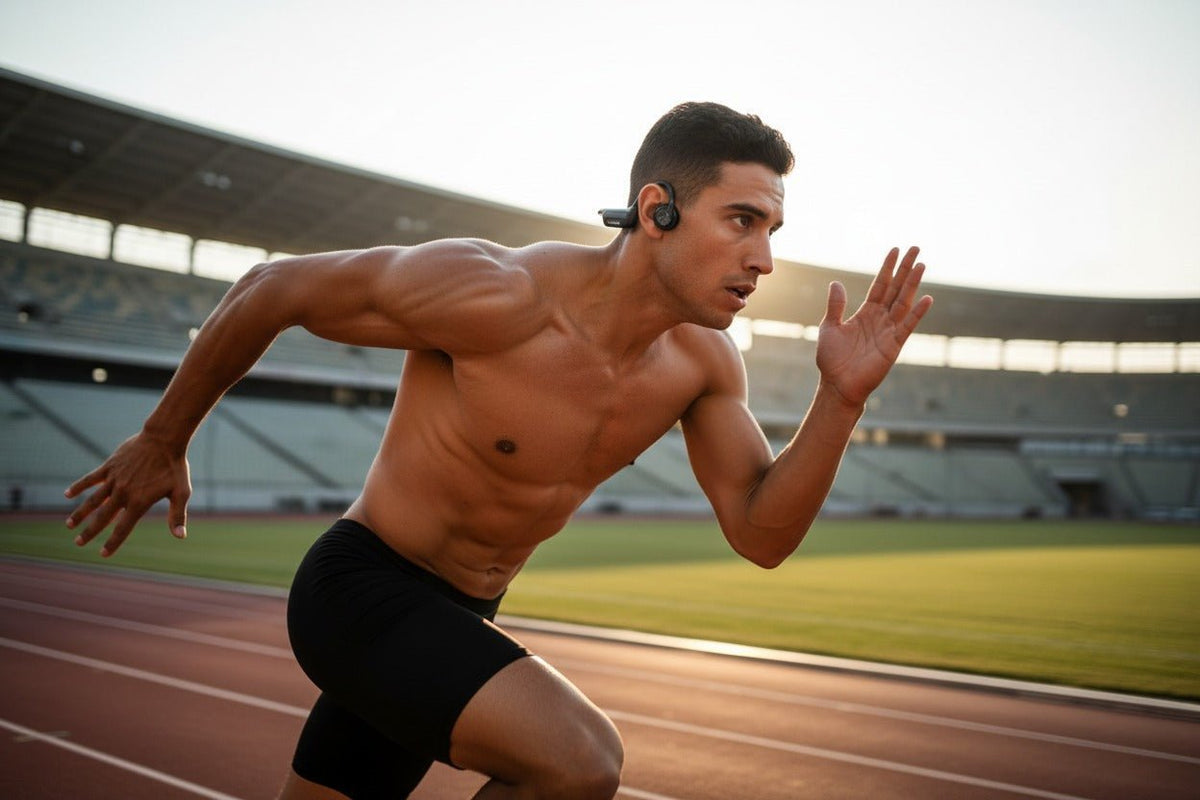
Bluetooth headphones are a practical choice for running because they remove the cable between your ears and your phone or watch. But Bluetooth by itself does not make a pair secure, sweat-resistant, safer outdoors, or better sounding. For runners, fit, environmental awareness, documented water protection, battery life, controls, and device compatibility matter more than the version number printed on the box.
Quick answer: choose Bluetooth for cable-free movement, then judge the actual headphones by how they fit your ears, how much outside sound you need to hear, what the manufacturer says about sweat or water exposure, and whether the battery and controls match your training.

Why Bluetooth Works Well for Running
The clearest advantage is simple: there is no audio cable running from the headphones to the source device. That removes one thing that can catch on clothing, swing during arm motion, or require a phone to stay in a specific pocket.
Bluetooth also gives runners more freedom to choose a source device. Many phones, tablets, and GPS watches can send audio wirelessly, although compatibility and control support vary by device. If watch playback matters, check the watch and headphone documentation rather than assuming every Bluetooth pair will work the same way.
Wireless convenience does have trade-offs. Bluetooth headphones need power, and some features such as active noise cancellation, transparency modes, calls, or certain codec modes can change real-world battery life. For a deeper buying framework, see Wantek's running-headphone guide for fit, protection, awareness, and compatibility.
Bluetooth Does Not Decide Outdoor Awareness
Whether you can hear traffic, cyclists, other runners, or trail users depends mainly on the headphone design, listening level, and your attention—not on Bluetooth itself.
Open-ear and bone-conduction designs leave the ear canal physically open, which can make surrounding sound easier to hear than strongly isolating earbuds. Transparency or ambient modes take a different approach by using microphones and processing to mix outside sound into the listening experience. Neither design guarantees complete situational awareness.
If you are comparing those formats, Wantek's bone-conduction guide explains how the technology works and why an open ear is not the same thing as full attention.
Listening level also matters. The World Health Organization's safe-listening guidance notes that risk depends on both sound level and exposure time, and recommends keeping personal-device volume no higher than 60% of maximum as a practical precaution.
Fit Matters More Than a “Sport” Label
Running adds repeated impact, head motion, sweat, and jaw movement. A useful design must stay in place without creating pressure that becomes distracting over time.
- Ear hooks add mechanical support around the ear.
- Wings or fins brace an in-ear design against the outer ear.
- Clip-on open-ear designs sit outside the canal and use the ear itself for retention.
- Wraparound bone-conduction designs use a band to hold the transducers against the sides of the head.
No specification can guarantee a secure fit for every runner. Ear shape, glasses, hats, hair, and personal comfort all affect retention, so return policy and fit options can matter as much as a feature list.
Check the Documented Water Protection
Sweat and rain are common running conditions, but marketing words such as “sport,” “sweatproof,” and “waterproof” are not interchangeable. The IEC 60529 IP Code classifies tested ingress protection under defined conditions. A rating should be read together with the manufacturer's own use instructions and limits.
Do not infer swimming suitability, rinsing instructions, or long-term sweat resistance from a generic photo or from a higher-looking number alone. If a product page does not publish an IP rating or water-use scope, treat that protection level as unknown.

A water-themed image is not evidence of a specific IP rating. Verify the exact model's published specification and care instructions before exposing it to rain, sweat, rinsing, or immersion.
Bluetooth Version and Codecs: What Actually Matters
A newer Bluetooth version can support newer capabilities, but the version number alone does not prove better audio quality, lower latency, longer range, multipoint, or a more stable running connection. Those outcomes depend on the complete headphone and source-device implementation.
For example, Bluetooth LE Audio introduced the LC3 codec and a new audio architecture, but a product must actually implement the relevant features and the source device must support them. The Bluetooth SIG's LE Audio overview is a better reference than assuming that every Bluetooth 5.x product has the same feature set.
For running, prioritize verified compatibility and stable everyday behavior over chasing the highest Bluetooth number. If you use a watch for offline music, confirm that specific watch/headphone combination before buying.
Match the Headphone Style to Where You Run
| Running situation | Useful starting design | What to verify |
|---|---|---|
| Roads and shared paths | Open-ear or bone-conduction | Fit, usable volume, route awareness, battery life |
| Treadmill or controlled gym | Secure in-ear or open-ear | Retention, comfort, controls, optional ANC |
| Rain or heavy-sweat training | Sport model with documented protection | Exact IP rating, manufacturer water-use limits, care instructions |
| Long-distance sessions | Lightweight secure-fit design | Single-charge runtime, charging method, comfort over time |
What to Check Before You Buy
- Fit first: choose the retention style that matches your ears and running conditions.
- Decide how open you want the ear canal: outdoor routes and indoor treadmills can justify different priorities.
- Verify the exact water-use claim: do not substitute a generic “sport” label for an IP rating and manufacturer instructions.
- Match battery life to the longest session: compare single-charge runtime, not only charging-case totals.
- Confirm source compatibility: especially if you want to leave your phone behind and play audio from a watch.
- Check controls while moving: button or touch layouts should be usable with sweat, gloves, or a hat if those conditions matter to you.
A Wantek Open-Ear Option for Workouts
The Wantek OBT030 uses an open-ear clip-on design and is positioned for workouts, commuting, calls, and everyday listening. Its current product page lists Bluetooth 5.4, an 8.5 g weight, an 8-hour battery specification for the earbuds, a built-in microphone, and up to 50 hours of total battery life with the charging case.
The current OBT030 page does not list an IP rating in its specifications, so do not assume a particular level of sweat or water protection from the workout positioning alone.
Check the OBT030 Specifications
Review the current fit, battery, microphone, compatibility, price, and availability details before deciding whether the open-ear clip-on format fits your training routine.
Frequently Asked Questions
Are Bluetooth headphones better than wired headphones for running?
They are usually more convenient because there is no source cable to manage. That does not make every Bluetooth model better for running; fit, awareness, water protection, and battery life still decide suitability.
What Bluetooth version is best for running headphones?
Do not choose on version number alone. Confirm the features and source-device compatibility you actually need, because Bluetooth version by itself does not establish sound quality, range, latency, or multipoint support.
Are open-ear headphones good for outdoor running?
They can make surrounding sound easier to hear because they do not seal the ear canal. Listening volume and attention still matter, so an open-ear design does not guarantee complete situational awareness.
What IP rating do running headphones need?
There is no universal rating for every runner. Match the manufacturer's documented protection and care instructions to the sweat, rain, splash, or immersion conditions you actually expect.

