
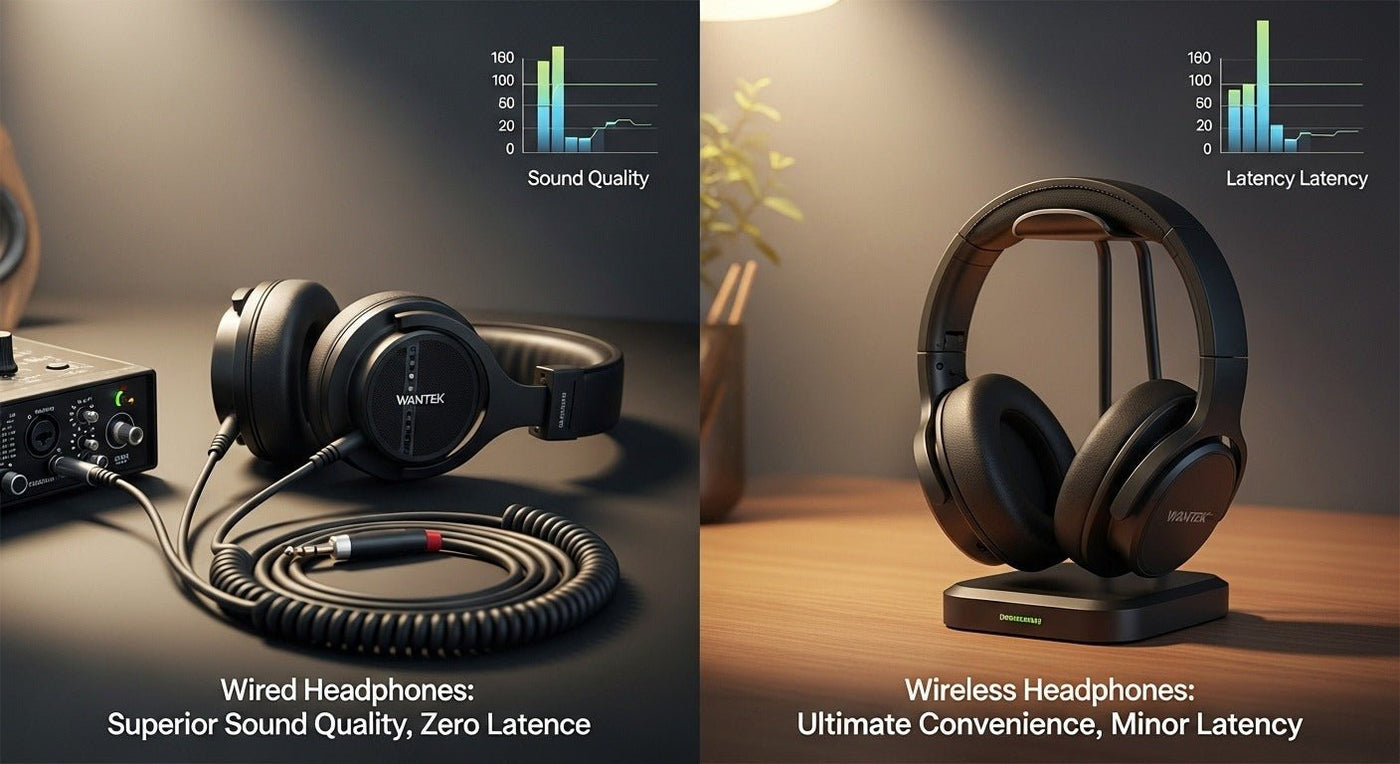
“Professional headphones” can mean studio monitoring, location recording, live production, broadcast, office calls, or remote work. Wired versus wireless only becomes useful after the job is defined.

Quick answer: choose wired when you need a predictable direct connection and do not need mobility. Choose wireless when movement and device switching matter more than avoiding batteries and radio links. For communication work, microphone placement and call controls may matter more than either label.
Wired vs. wireless at a glance
| Work pattern | Wired usually fits | Wireless usually fits |
|---|---|---|
| Studio monitoring | Direct signal path, no charging, easy integration with interfaces and headphone amps. | Useful only when the monitoring system explicitly supports the required wireless workflow. |
| Editing at a desk | Simple for a fixed computer or interface. | Useful if you move between devices or around the room. |
| Office calls | Predictable USB or 3.5 mm connection and no battery. | Mobility, laptop/phone switching, charging dock options. |
| Live or field work | Useful where cable routing is controlled and a direct monitor feed is required. | Useful only when the complete professional wireless system is designed for the task. |
Where wired professional headphones make sense
Wired headphones are a natural fit when the source already provides a headphone output and the user stays near the workstation. Recording interfaces, mixers, headphone amplifiers, desktop computers, and some controllers can all support direct monitoring paths, but the connector and required level still need to match the device.
Advantages of a direct connection
- No headphone battery to charge or age.
- No Bluetooth pairing or radio congestion to troubleshoot.
- Easy to keep one stable workstation setup.
- Common in monitoring workflows where a cable is acceptable.
The tradeoff is physical tethering. Cable length, strain relief, connector type, and routing become part of the setup.
Where wireless professional headphones make sense

Wireless is useful when the person needs to stand, move between work areas, or switch between supported devices. In office communication, Bluetooth or dedicated wireless headsets can reduce cable clutter and make it easier to take calls away from a fixed desk.
Wireless is not one technology or one behavior. A Bluetooth headset, a DECT office headset, and a proprietary low-latency production system solve different problems. Confirm the complete connection path rather than treating “wireless” as a universal compatibility claim.
For calls, the microphone changes the decision
Music-focused headphones and communication headsets overlap, but they are not identical. For frequent calls, a positioned boom microphone can keep mouth-to-mic distance more consistent than a microphone built into an ear cup. Physical mute, answer/end controls, and device switching can also be more valuable than music-oriented specifications.
For an office-specific comparison, Wantek’s wired vs. wireless office headset guide focuses on computer, desk-phone, and mobility requirements.
Comfort is a professional requirement
A technically capable headset still fails the job if it becomes uncomfortable during the longest normal session. Compare clamp, total weight, pad contact, heat buildup, headband adjustment, glasses clearance, and whether the cable or boom microphone interferes with movement.
How to choose by workflow
- Identify the source: audio interface, computer, phone, desk phone, mixer, or other system.
- Decide whether the user must move while listening or talking.
- Confirm the exact wired or wireless connection supported by the source.
- Separate monitoring needs from communication needs.
- Check microphone, controls, battery, and charging only when they matter to the job.
- Evaluate comfort for the longest realistic session.
Frequently asked questions
Are wired headphones always better for professional audio?
No. Wired is common because it is direct and battery-free, but the right choice depends on the source, mobility requirement, monitoring system, and the exact job.
Are Bluetooth headphones suitable for professional calls?
They can be. For call-heavy work, check microphone placement, mute controls, device switching, battery, and compatibility with the calling platform rather than Bluetooth alone.
Do professional headphones need active noise cancellation?
Not necessarily. ANC is useful in some noisy listening environments, while studio monitoring or communication work may prioritize isolation, microphone behavior, or connection reliability instead.

