
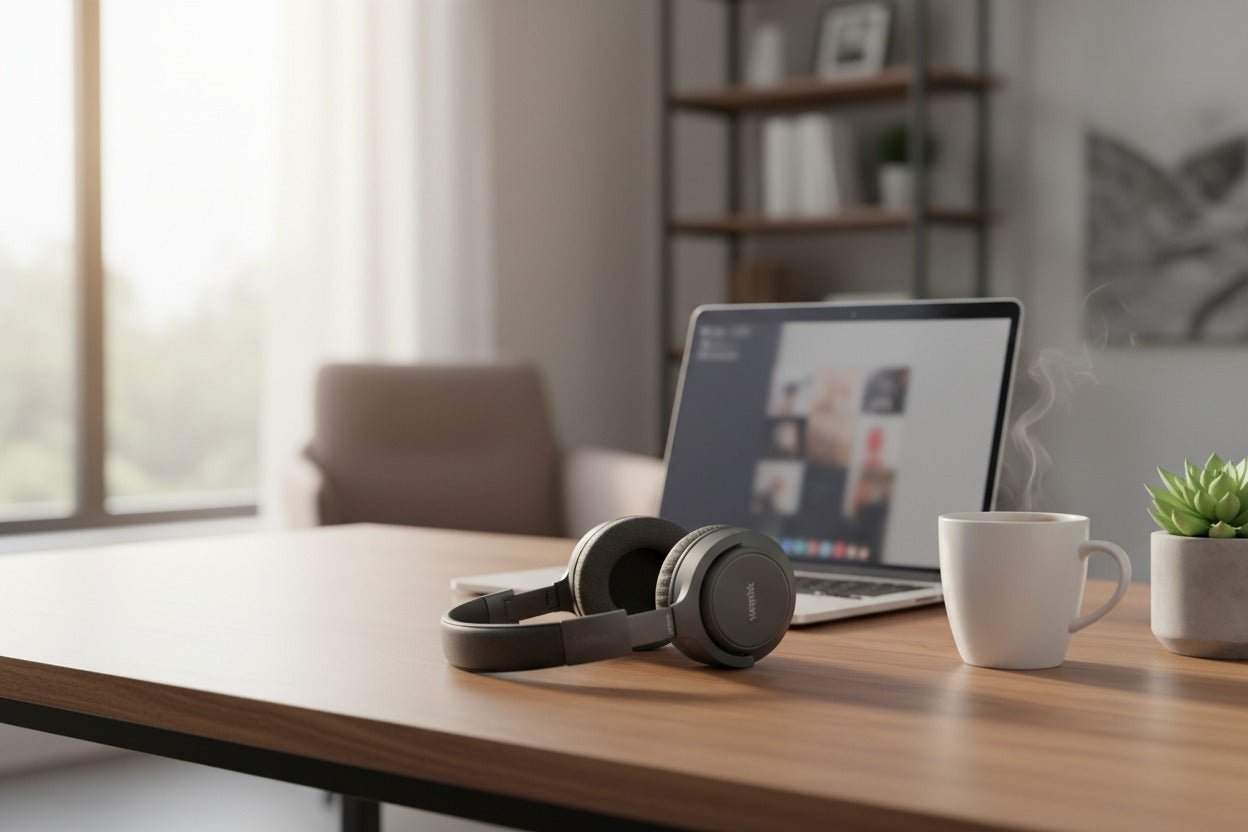
In hybrid and remote work, a headset can affect how clearly you communicate, how well you manage distractions, and how comfortable you remain during long calls. The right choice depends less on finding one universally superior model and more on matching the headset to your work pattern, devices, environment, and priorities.
For buyers comparing noise cancelling headphones for office, four factors deserve the most attention:
- Noise management: Passive isolation, active noise cancellation, and microphone noise reduction solve different problems.
- Communication clarity: Microphone placement, array processing, and software compatibility affect what other people hear.
- Long-term comfort: Fit, weight distribution, clamping pressure, heat, and ear-cup design are highly individual.
- Ecosystem integration: Connection type, platform certification, controls, and device switching determine daily convenience.
Your work pattern should establish the priority:
- Frequent collaborator: Prioritize microphone performance, platform compatibility, and accessible call controls.
- Focus-driven knowledge worker: Prioritize effective ANC, passive isolation, and wearing comfort.
- Hybrid mobile professional: Prioritize multi-device connectivity, portability, and predictable performance across locations.
If your starting question is what are the best noise cancelling headphones for office?, the answer depends on whether you need to reduce what you hear, reduce the noise your caller hears, or accomplish both.

Part 1: Understanding Headset Technologies
Understanding the underlying technologies helps separate useful features from vague marketing language.
1.1 Active vs. Passive Noise Control
Noise management has two primary layers: passive isolation and active noise cancellation. They work differently and should not be treated as interchangeable.
Passive Noise Isolation
Passive noise isolation is created by the physical barrier between your ears and the environment. Its effectiveness depends on:
- Ear-cup shape and depth
- Cushion material
- Seal consistency
- Head and ear anatomy
- Clamping pressure
- Whether glasses, hair, or headwear break the seal
Over-ear headphones can provide substantial isolation when their cushions form a consistent seal around the ears. On-ear models may allow more environmental sound through, but performance varies by design. Cushion material alone does not determine isolation quality.
Passive isolation is particularly important for higher-frequency and irregular sounds such as speech, keyboard activity, and office movement.
Active Noise Cancellation
Active noise cancellation uses microphones and signal processing to generate phase-inverted anti-noise that reduces selected ambient frequencies.
Common ANC configurations include:
- Feedforward ANC: Uses microphones outside the ear cup to detect incoming noise.
- Feedback ANC: Uses microphones inside the ear cup to measure sound near the listener’s ear.
- Hybrid ANC: Combines external and internal microphones.
ANC is generally most effective against sustained, low-frequency sounds such as HVAC systems, engine noise, and traffic rumble. Rapidly changing sounds and nearby speech are more difficult to reduce consistently. For office use, strong passive isolation remains important even when ANC is present.
Adaptive ANC systems can change their processing according to detected noise or fit conditions. However, effectiveness varies by model, frequency, fit, and environment. Comparative attenuation measurements are more useful than broad claims such as “best-in-class ANC.”
Transparency and Hear-Through Modes
Transparency mode uses external microphones to reproduce surrounding sound through the headphones. This can help users hear colleagues, announcements, or traffic without removing the headset.
Because transparency modes process environmental audio electronically, their naturalness, delay, and wind-noise performance differ across models.
1.2 Microphone Design and Call Clarity
A headset can reduce what you hear while still transmitting substantial background noise to the other person. ANC for the listener and microphone noise reduction for the caller are separate functions.
Beamforming and Microphone Arrays
Microphone-array beamforming can emphasize speech arriving from a target direction while suppressing some off-axis noise. Commercial headsets may combine beamforming with stationary-noise reduction, voice detection, and other processing.
Performance depends on:
- Number and placement of microphones
- Distance between the microphone and the mouth
- Beamforming design
- Voice-detection accuracy
- Background-noise type
- Wind and room reverberation
- Software and firmware
Proprietary systems such as Poly Acoustic Fence combine microphone placement and digital processing, but buyers should still evaluate independent call recordings recorded under comparable conditions.
Boom Microphones vs. Integrated Microphones
A boom microphone places the microphone closer to the mouth. This can improve the ratio between the user’s voice and environmental noise, especially in open offices and contact centers.
Integrated microphones can also perform well, but they depend more heavily on array processing because they are farther from the mouth. Some consumer headphones deliver clear calls in quiet spaces yet struggle with competing voices, wind, or reverberant rooms.
Neither design guarantees better performance. Comparable microphone recordings are more useful than the number of microphones alone.
Wideband Audio
ITU-T G.722 wideband audio supports approximately 50–7,000 Hz speech, providing a broader transmitted frequency range than traditional narrowband telephony.
“HD Voice” is a broader industry term rather than one universal codec. Actual call quality depends on the headset, application, connection, codec, network, and device at both ends of the call.
1.3 Connectivity: Wired, Bluetooth, and DECT
Connection type affects mobility, battery requirements, compatibility, and operational reliability.
| Connection | Best suited to | Key considerations |
|---|---|---|
| Wired USB-A, USB-C, 3.5 mm, or device-specific connection | Fixed workstations, contact centers, shared desks, and users who want to avoid charging or pairing | Wired connections remove battery and wireless-pairing dependencies. USB audio still involves digital conversion and processing, so “zero latency” is inaccurate. Verify connector, operating-system, phone, and application compatibility. |
| Bluetooth | Laptops, smartphones, tablets, and mobile work | Verify multipoint support, supported codecs, adapter requirements, platform controls, and operating-system compatibility for the exact model. Bluetooth version alone does not guarantee these features. |
| DECT | Offices requiring a dedicated base station, desk-phone integration, or extended mobility | Actual range depends on the headset, region, base station, building layout, walls, and interference environment. DECT should not be described as universally immune to congestion or dropouts. |
Bluetooth Multipoint
Multipoint allows a compatible headset to maintain connections with more than one device. A common use case is listening through a laptop while remaining available for calls on a phone.
Implementation varies. Some headsets pause computer audio when a phone call begins, while others require manual switching. Multipoint may also affect codec availability or application controls. Confirm the exact behavior in the manufacturer’s documentation.
DECT Headsets
DECT office headsets typically communicate with a dedicated base station connected to a computer, desk phone, or both. Examples include models in the Jabra Engage and EPOS IMPACT 5000 families.
The HP Poly Voyager Focus 2 should not be classified as DECT; it is a Bluetooth office headset.
1.4 Comfort and Ergonomics
Comfort is subjective and cannot be determined reliably from weight or product descriptions alone.
Wearing Style
- Over-ear: Surrounds the ear and can distribute pressure around it. Larger cups may retain more heat.
- On-ear: Rests directly on the ear and is often more compact, but may create pressure during extended sessions.
- In-ear: Offers portability and minimal headband pressure, but comfort and seal vary significantly by ear shape.
- Mono headset: Leaves one ear uncovered and may suit reception, sales, or support roles that require environmental awareness.
Physical Design
Useful features include:
- Adjustable, padded headbands
- Swiveling ear cups
- Replaceable cushions
- Stable weight distribution
- Controls that can be located by touch
- A microphone boom that remains in position
- Materials that tolerate regular cleaning
Weight should be evaluated together with balance, clamping force, cushion contact area, and heat buildup. A lighter headset is not automatically more comfortable.
Clamping Pressure and Seal
Clamping pressure must be strong enough to maintain a stable fit without creating excessive pressure. Glasses can affect both comfort and acoustic sealing.
When possible, test the headset for a complete work session rather than judging comfort after a few minutes.
Part 2: Match the Headset to Your Work Profile
Profile A: Frequent Collaborator or Call-Centric Professional
Typical activities:
- Back-to-back meetings
- Client and sales calls
- Customer support
- Contact-center work
- Regular use of Zoom, Microsoft Teams, or Google Meet
Primary priority: Clear outgoing voice transmission.
What to Evaluate
Microphone performance
Look for a boom microphone or a well-tested array system. Evaluate recordings with competing speech, keyboard noise, HVAC noise, and room reverberation.
Platform certification
Microsoft Teams-certified personal peripherals can support functions such as mute synchronization, volume control, call control, and Teams-button actions.
Certification applies to specific variants, connection methods, and software environments. A headset family may include both certified and non-certified versions.
Zoom certification should likewise be verified for the exact model and variant.
Accessible mute controls
A physical mute control can be valuable during frequent calls. Confirm whether the headset provides:
- A dedicated mute button
- Boom-to-mute functionality
- An audible mute reminder
- Synchronized software and hardware mute status
- A visible busy light
Suitable Product Archetype
A Bluetooth or DECT office headset with a boom microphone and dedicated call controls.
Examples include:
- Jabra Evolve2 75
- HP Poly Voyager Focus 2
- Models from the EPOS IMPACT 5000 family for DECT-based installations
These examples represent different connection systems and configurations. Certification and compatibility must be checked for the exact version.
Profile B: Focus-Driven Worker in a Noisy Environment
Typical activities:
- Coding
- Writing
- Research
- Analysis
- Editing
- Learning through podcasts or recorded material
Primary priority: Reducing distraction without sacrificing comfort.
What to Evaluate
Measured ANC and passive isolation
Prioritize products with credible attenuation measurements across multiple frequencies. ANC is useful for steady low-frequency noise, while passive isolation often contributes more against speech and irregular office sounds.
Battery life under relevant conditions
Compare battery ratings with ANC enabled rather than using the highest advertised figure. Call time, music playback, codec, volume, and transparency mode can produce different results.
Sound quality
Driver diameter alone does not establish sound quality. Evaluate:
- Frequency response
- Distortion
- Channel consistency
- Equalization options
- Speech intelligibility
- Performance at moderate listening levels
A neutral or slightly warm tuning may be comfortable for some users, but listening fatigue depends on volume, fit, sound signature, and individual sensitivity.
Suitable Product Archetype
An over-ear ANC headphone or an office headset combining ANC with a strong microphone system.
Examples include:
- Sony WH-1000XM5
- Bose QuietComfort Ultra Headphones
- Sennheiser Momentum 4 Wireless
These models represent different generations and feature priorities. Verify current availability, specifications, and model generation before buying.
Profile C: Hybrid and Mobile Professional
Typical activities:
- Working between home and corporate offices
- Using co-working spaces
- Commuting or traveling
- Switching between a laptop and phone
Primary priority: Consistent operation across devices and locations.
What to Evaluate
Multi-device connectivity
Confirm:
- Number of remembered devices
- Number of simultaneous connections
- Call-switching behavior
- Whether a USB adapter is required
- Compatibility with the work computer’s security policy
- Whether platform controls work over native Bluetooth
Portability
A folding design and protective case can reduce transport damage, but neither is universally required. Evaluate the packed size, hinge design, cable storage, and availability of replacement parts.
Transparency and adaptive noise control
Transparency mode can improve situational awareness when walking, commuting, or speaking with colleagues. Adaptive ANC may improve convenience, but manual controls are useful when automatic behavior does not match the environment.
Suitable Product Archetype
A portable Bluetooth office headset, folding over-ear ANC headphone, or business-oriented true wireless earbud with verified softphone support.
Consumer earbuds should not automatically be treated as office headsets. Confirm microphone performance, computer compatibility, mute controls, and softphone support before relying on them for professional calls.

Part 3: Purchasing Checklist
Battery and Charging
- Compare battery life with ANC enabled.
- Distinguish music playback time from talk time.
- Check full charging time and fast-charge conditions.
- Confirm whether the headset can be used while charging.
- Verify whether charging requires USB-C, a stand, or a proprietary cable.
- Treat published battery figures as controlled estimates rather than guaranteed real-world results.
Controls and Software
Confirm whether the headset provides:
- Physical mute, volume, and call controls
- EQ adjustment
- ANC and transparency settings
- Firmware updates
- Device-management software
- Configurable sidetone
- Audible mute and battery notifications
Application features can change, so verify compatibility with the current operating system and software version.
Compatibility
Check compatibility with every device and platform you use:
- Windows or macOS computer
- Smartphone or tablet
- Microsoft Teams, Zoom, Google Meet, or another softphone
- Desk phone
- USB-A or USB-C ports
- Bluetooth restrictions imposed by corporate IT
- Required USB adapters or interface cables
A connector that physically fits does not necessarily guarantee full call-control support.
Durability and Serviceability
Look for:
- Replaceable cushions
- Available charging cables and adapters
- Documented firmware support
- Stable hinges and boom mechanisms
- Accessible warranty terms
- Replacement-part availability
A two-year warranty is not universal and should not be treated as proof of product quality. Compare the actual coverage, exclusions, service process, and regional terms.
Independent Testing
Manufacturer specifications are useful for compatibility and feature verification, but independent testing can provide additional evidence for:
- Noise attenuation
- Microphone performance
- Frequency response
- Latency
- Comfort
- Battery endurance
Use recordings and measurements conducted under comparable conditions. A microphone sample recorded in a quiet studio does not predict performance in an open office.
Frequently Asked Questions
Are active noise-cancelling headphones safe for daily office use?
ANC itself is not the primary hearing-risk factor. Listening level and exposure duration matter more.
The World Health Organization’s safe-listening guidance recommends keeping volume controlled, reducing time spent listening to loud audio, and using well-fitted noise-cancelling headphones to reduce the need to increase volume in noisy environments.
ANC can create a pressure-like sensation for some people, although this does not mean the technology is changing physical air pressure around the ear. If discomfort develops, reduce the ANC level, adjust the fit, use transparency mode, or take a quiet break.
Can consumer headphones serve as a primary office headset?
Yes, provided their microphone, controls, and compatibility meet your requirements.
Consumer ANC headphones often emphasize listening quality and environmental noise reduction. Dedicated office headsets may provide advantages such as:
- A boom microphone
- Platform-certified variants
- Hardware mute controls
- Busy lights
- USB adapters
- Sidetone controls
- Centralized device management
These are category tendencies, not universal rules. Compare exact models rather than assuming every office headset will outperform every consumer headphone on calls.
Are wired headsets more reliable than wireless headsets?
Wired headsets avoid charging, pairing, radio interference, and wireless range limitations. That can make them easier to manage for fixed workstations and critical call environments.
Bluetooth and DECT headsets offer mobility but introduce additional variables, including:
- Battery state
- Pairing
- Adapter compatibility
- Radio conditions
- Firmware
- Device switching
Modern wireless headsets can provide reliable professional calls, but neither Bluetooth nor DECT should be described as lossless or immune to dropouts.
How important are UC certifications?
Certification is valuable when you rely heavily on one communications platform. Certified variants may support synchronized mute status, call controls, volume controls, notifications, or dedicated platform buttons.
Certification does not guarantee:
- Identical functionality on every operating system
- Support through every connection method
- Superior microphone performance in every environment
- Hardware-level noise suppression
- Compatibility with unrelated platforms
Verify the exact model number, variant, adapter, software platform, and operating system.
How long should an office headset last?
There is no reliable universal lifespan. Service life depends on:
- Usage frequency
- Handling and storage
- Cushion and headband wear
- Hinge and boom construction
- Battery condition
- Cable stress
- Firmware support
- Replacement-part availability
Cushions and headband padding often show visible wear before the electronics fail. Wireless batteries gradually lose capacity, while wired models avoid battery aging but can develop cable or connector damage.
Repairable designs and available replacement parts can extend practical service life.
Does a larger driver produce better sound?
Not necessarily. Driver diameter is only one design variable. Sound quality also depends on the driver material, enclosure, acoustic tuning, damping, distortion, digital processing, and fit.
A 40 mm driver should not be treated as proof of higher fidelity, neutral tuning, or reduced listening fatigue.
Final Verdict
Choosing a headset for office work is a matching problem, not a search for one universal winner.
Conduct a Work Audit
Review a typical week and determine:
- How much time you spend on calls
- How much uninterrupted focus time you need
- Which background noises cause problems
- Whether the problem is what you hear or what callers hear
- Which devices and communication platforms you use
- Whether you need mobility away from your desk
Establish Your Primary Requirement
Choose one leading priority:
- Communication: Microphone performance and call controls
- Concentration: ANC, passive isolation, and comfort
- Convenience: Multipoint, portability, and intuitive controls
- Compatibility: Reliable operation with required devices and platforms
No headset maximizes every category equally.
Test the Complete Workflow
When return terms allow, test:
- Comfort over a full work session
- Microphone performance in your real environment
- Mute synchronization
- Device switching
- ANC against your actual noise sources
- Battery behavior
- Call controls in your primary application
For users comparing the best noise cancelling headphones for office, the strongest choice is the model that solves the dominant workplace problem without creating new compatibility or comfort issues.
A structured comparison is more reliable than rankings built around one feature. Start with your devices, environment, and call pattern, then use verified specifications and realistic testing to narrow the options. If a practical office or call-focused headset better matches those requirements, review the current options from Wantek.
Check Your Desk Phone Before You Choose
Confirm your phone model and connection path before selecting an RJ9 or USB headset.
- 1 Enter the phone brand and exact model.
- 2 Identify where calls happen and which connection you see.
- 3 Review the appropriate compatibility path before ordering.
Office Headset Resource Hub
Choose an Office Headset Around the Way You Work
Compare practical buying paths for daily calls, remote work, and video meetings, then move to current Wantek office options.
Browse Wantek Office Headsets →
