
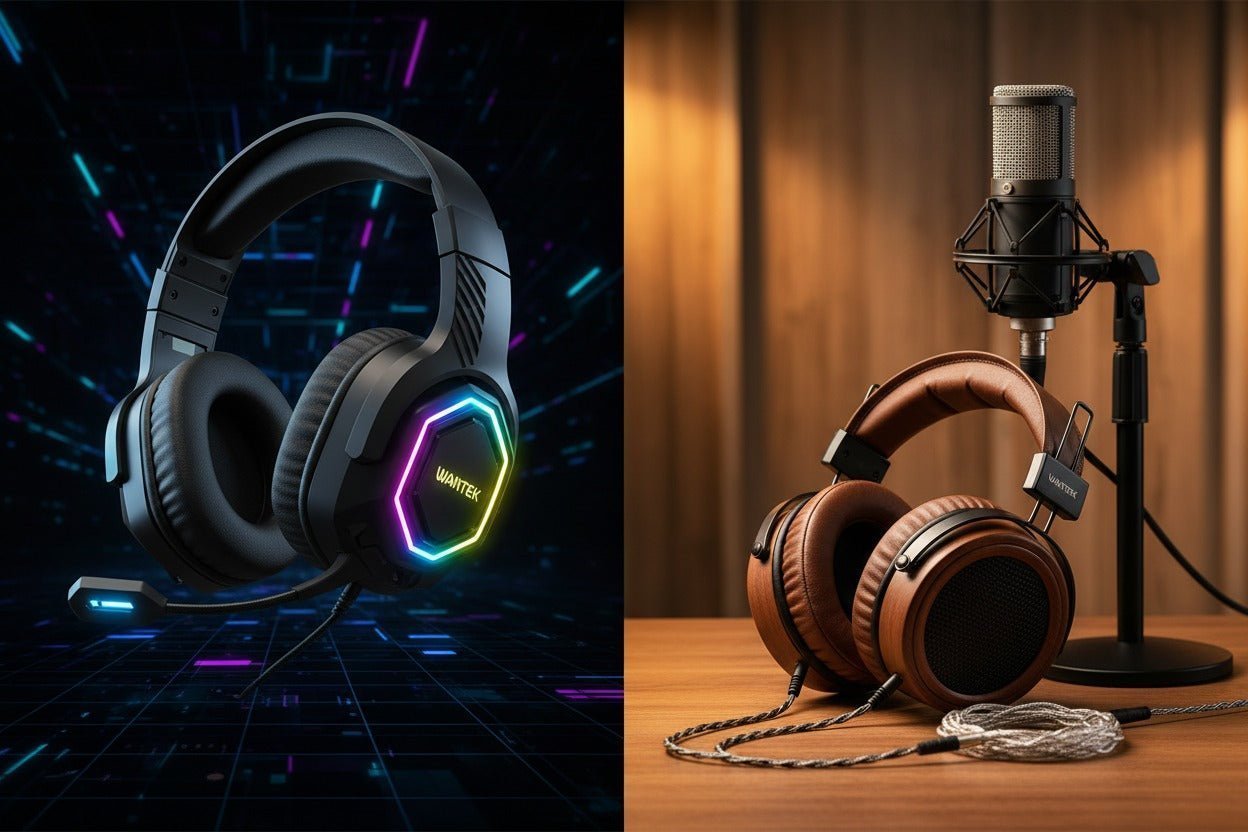
La decisión entre unos auriculares para juegos y una configuración de auriculares + micrófono dedicado es una elección fundamental entre la conveniencia y un rendimiento de nivel audiófilo. Los auriculares para juegos ofrecen una solución todo en uno, "plug-and-play" con funciones integradas como el sonido envolvente virtual y micrófonos con cancelación de ruido, ideal para jugadores que buscan simplicidad y un diseño unificado. Por el contrario, combinar auriculares de alta fidelidad (a menudo abiertos para una escena sonora superior) con un micrófono USB o XLR independiente ofrece una claridad de audio inigualable, una precisión posicional exacta y una captura de voz con calidad de transmisión, aunque con un mayor coste, complejidad y requisitos de espacio en el escritorio. Su elección debe guiarse por el caso de uso principal, el presupuesto y si prioriza la facilidad integrada o la fidelidad de audio modular de primer nivel.
Por qué su configuración de audio para juegos es un periférico de rendimiento crítico

En el universo inmersivo de los juegos modernos, la fidelidad visual a menudo acapara el protagonismo. Sin embargo, jugadores profesionales, ingenieros de audio y entrenadores de esports coinciden universalmente: el audio de alta calidad no es simplemente una mejora, es una necesidad competitiva. Una configuración de audio precisa proporciona retroalimentación táctil, conciencia espacial y señales ambientales críticas que pueden significar la diferencia entre la victoria y la derrota. Más allá de la competición, eleva las experiencias narrativas, haciendo que los mundos virtuales se sientan tangibles y vivos.
El debate central —auriculares para juegos frente a auriculares y micrófono— va más allá de una simple elección de accesorios. Representa una bifurcación filosófica en el camino: ¿optar por una herramienta especializada e integrada, o ensamblar un sistema modular de alto rendimiento a partir de componentes de primera clase? Esta guía completa desglosará cada faceta de esta decisión, empleando un análisis rico en entidades y una estructuración SEO semántica para proporcionarle el conocimiento para invertir sabiamente en su ecosistema de audio para juegos.
Parte 1: El auricular para juegos integrado – Una sinfonía de comodidad
Un auricular para juegos es un periférico de audio diseñado desde cero para el entretenimiento digital interactivo. Integra transductores para reproducción y captura en una sola unidad, a menudo con un lenguaje de diseño y software adaptados explícitamente para la comunidad de jugadores.
Entidades clave y marco tecnológico
-
Filosofía de diseño y marcas clave: La arquitectura prioriza la durabilidad ergonómica para largas sesiones, la conectividad unificada (USB/3.5mm/inalámbrica) y la estética centrada en el jugador (iluminación RGB, diseños angulares). Los líderes del mercado incluyen HyperX (HP), SteelSeries, Razer, Logitech G, Corsair y Astro Gaming (Logitech). Cada marca cultiva una firma de audio distinta; por ejemplo, HyperX es reconocida por su comodidad y sonido equilibrado, mientras que Razer a menudo enfatiza una respuesta de bajos agresiva.
-
Tecnología de micrófono integrada: El micrófono de brazo es una entidad definitoria. Las implementaciones modernas presentan patrones de captación unidireccionales o cardioides para aislar la voz del usuario. Los modelos avanzados incorporan algoritmos de cancelación de ruido (como el ClearCast de SteelSeries o el HyperClear de Razer) y monitorización de micrófono (tono lateral), lo que le permite escuchar su propia voz para evitar gritar.
-
Audio espacial y ecosistemas de software: La mayoría de los auriculares de gama media a alta vienen con software de audio inmersivo o lo admiten. Esto incluye soluciones a nivel de plataforma como Dolby Atmos para auriculares, DTS Headphone:X y Windows Sonic, así como suites propietarias como SteelSeries Sonar, DTS 7.1 de Logitech G Hub y THX Spatial Audio. Estas soluciones de procesamiento de señal digital (DSP) manipulan el audio estéreo para simular un entorno multialtavoz, con el objetivo de mejorar las señales de audio posicionales.
-
Protocolos de conectividad: Los auriculares inalámbricos utilizan principalmente RF de 2.4GHz de baja latencia a través de un dongle USB-A/C para un audio casi sin pérdidas adecuado para juegos. Bluetooth a menudo se incluye para la conectividad móvil, pero puede introducir una latencia inadecuada para el juego competitivo. Los códecs de alta fidelidad como aptX LL (baja latencia) pueden mitigar esto en dispositivos compatibles.
Ventajas: El caso de la integración
- Simplicidad "Plug-and-Play" inigualable: Una única conexión gestiona todas las entradas y salidas de audio. Esto es invaluable para jugadores de consola (PlayStation, Xbox), usuarios de computadoras portátiles o cualquiera que busque un escritorio sin desorden.
- Eficiencia de costos en niveles de entrada y medios: Por un presupuesto inferior a 150 $, un auricular para juegos suele ofrecer una mejor funcionalidad general (micrófono + audio + funciones) que los componentes separados al mismo precio total.
- Sintonización acústica optimizada: Los drivers a menudo se ajustan para acentuar los rangos de frecuencia críticos de los juegos: agudos nítidos para los detalles de los pasos, medios pronunciados para la claridad vocal y graves impactantes para las explosiones.
- Integración de funciones sin interrupciones: Funciones como ruedas de equilibrio de audio de chat/juego, controles en la oreja y sincronización RGB integrada funcionan sin esfuerzo con el software nativo del dispositivo.
Desventajas: Los compromisos de un diseño unificado
- Ley de rendimientos decrecientes en fidelidad de audio: En precios más altos (superiores a 200 $), la calidad de audio a menudo se estanca, ya que los costos de I+D se dividen entre los drivers de los auriculares y el subsistema de micrófono. Raramente se encuentran drivers de auriculares que igualen la respuesta transitoria o el rango de frecuencia de los auriculares audiófilos dedicados en el mismo rango de precios.
- Techo del micrófono: Aunque suficientes para Discord, TeamSpeak o VOIP en el juego, los micrófonos integrados tienen dificultades para igualar la calidez de cuerpo completo, el rango dinámico y la supresión de ruido profesional de un condensador de diafragma grande o un micrófono dinámico dedicado.
- Versatilidad y ruta de actualización limitadas: El sistema es monolítico. No se puede actualizar el micrófono independientemente de los auriculares, y la firma de sonido es fija, lo que puede no ser ideal para la escucha crítica de música, la mezcla de audio o la producción de podcasts.
Parte 2: La potencia modular: Auriculares + Micrófono dedicado
Este enfoque trata la entrada y salida de audio como dos tareas distintas y especializadas. Implica seleccionar un par de auriculares de referencia o audiófilos y combinarlos con un micrófono independiente, creando un sistema donde cada componente sobresale en su función principal.
Entidades principales y ecosistema de componentes
1. Los auriculares: Instrumentos de escucha de precisión
Los auriculares para juegos se dividen en distintas categorías acústicas, definidas por su diseño físico:
-
Auriculares abiertos: El estándar de oro para los juegos competitivos y los paisajes sonoros inmersivos. Modelos como el Sennheiser HD 560S, el Beyerdynamic DT 900 Pro X, el Audio-Technica ATH-R70x y el HiFiMan Sundara cuentan con almohadillas perforadas. Este diseño permite que el aire y el sonido pasen, lo que resulta en una escena sonora amplia y natural, la anchura y profundidad percibidas de la imagen de audio. La imagen (la precisión de la localización de los sonidos dentro de esa escena) es típicamente excepcional, lo que permite una precisión milimétrica en el seguimiento de los movimientos enemigos en títulos de FPS como Counter-Strike 2 o VALORANT.
-
Auriculares cerrados: Modelos como el Audio-Technica ATH-M50x, el Beyerdynamic DT 770 Pro y el AKG K371 tienen almohadillas selladas. Proporcionan aislamiento pasivo del ruido, bloqueando el sonido externo y evitando la fuga de audio. Esto los hace ideales para entornos ruidosos, juegos nocturnos o géneros donde se prefieren los graves impactantes y aislados, como los RPG para un solo jugador o los juegos de ritmo.
-
Drivers planar-magnéticos: Una tecnología premium que se encuentra en auriculares como el Audeze LCD-GX o las ofertas de HiFiMan. Utilizan un diafragma delgado y plano para ofrecer una respuesta transitoria increíblemente rápida y una baja distorsión, revelando pequeños detalles de audio que pueden proporcionar una ventaja competitiva.
2. El micrófono: Comunicación con calidad de transmisión
-
Micrófonos USB: La piedra angular del auge del streamer y creador de contenido. Contienen un convertidor analógico-digital (ADC) interno, que se conecta directamente a su PC. Las entidades clave incluyen:
- El caballo de batalla dinámico: Rode PodMic USB, excelente rechazo de ruido, ideal para habitaciones sin tratar.
- El condensador versátil: Blue Yeti, Elgato Wave:3, Rode NT-USB, ofrecen múltiples patrones de captación (cardioide, omnidireccional, etc.) para mayor flexibilidad.
- El todoterreno premium: Shure MV7, un micrófono híbrido USB/XLR con el legendario pedigrí vocal de Shure.
-
Micrófono XLR + interfaz de audio: El estándar de estudio profesional. Un micrófono XLR (por ejemplo, Shure SM7B, Rode Procaster, Electro-Voice RE20) se conecta a una interfaz de audio (como un Focusrite Scarlett 2i2, Universal Audio Volt o Motu M2). Esta configuración proporciona:
- Preamplificadores superiores: Ganancia más limpia con menos silbido.
- Control avanzado: Perillas de ganancia de hardware, alimentación fantasma y mezcla de monitores.
- Expansibilidad: Soporte para múltiples micrófonos, instrumentos y monitores de estudio.
3. Infraestructura de soporte
- Amplificación: Los auriculares de calidad pueden requerir un amplificador de auriculares o un combo DAC/Amp (por ejemplo, de Schiit Audio, JDS Labs o FiiO) para alcanzar su máximo potencial en rango dinámico y control del driver.
- Suite de software: Aunque carece de software de "gaming" de marca, esta configuración aprovecha herramientas potentes como Voicemeeter Banana para un enrutamiento de audio avanzado, Equalizer APO para un ecualizador en todo el sistema y NVIDIA Broadcast o RTX Voice para la eliminación de ruido con IA.
Ventajas: La cúspide del rendimiento
- Fidelidad de audio sin concesiones: Experimenta juegos, música y películas tal como los concibieron los creadores, con un detalle, equilibrio y claridad que los auriculares integrados no pueden igualar.
- Captura de voz de calidad profesional: Esencial para transmisiones en Twitch/YouTube, podcasting o videoconferencias profesionales. Su voz adquiere presencia, profundidad y autoridad.
- Modularidad total y preparación para el futuro: Los componentes se pueden actualizar de forma independiente. Empiece con un micrófono USB y auriculares de gama media, y luego añada una interfaz de audio y un micrófono XLR sin reemplazar sus auriculares.
- Utilidad multiplataforma: Destaca en producción musical, edición de audio, composición de películas y escucha crítica, proporcionando un valor mucho más allá de los juegos.
Desventajas: El coste de la complejidad
- Barrera de entrada más alta: Una configuración de calidad (por ejemplo, Sennheiser HD 560S + Elgato Wave:3) comienza en torno a los 250-300 $, con sistemas de gama alta que superan fácilmente los 1000 $.
- Espacio en el escritorio y gestión de cables: Requiere espacio para un micrófono (a menudo en un brazo articulado), su cable y, posiblemente, una interfaz/amplificador. Esto puede provocar un desorden de cables.
- Sobrecarga de configuración: Equilibrar los niveles de audio entre el juego, el chat y el micrófono requiere una configuración inicial en la configuración de sonido de Windows, los menús de audio del juego y las aplicaciones de comunicación.
Comparación crítica: Una matriz de decisión basada en datos
Para ir más allá de la preferencia subjetiva, evalúe sus necesidades frente a estos factores empíricos:
| Factor de decisión | Auriculares para juegos | Auriculares + Micrófono dedicado | Implicaciones técnicas y prácticas |
|---|---|---|---|
| Fidelidad y detalle de audio | Bueno a muy bueno. A menudo con forma de V (graves/agudos potenciados). | Excelente a grado de referencia. Neutro o ajustado a las preferencias. | Los drivers dedicados en los auriculares se centran únicamente en la precisión de la reproducción, lo que conduce a una mejor linealidad de la respuesta de frecuencia. |
| Calidad del micrófono | Adecuado para la comunicación. | Muy bueno a calidad de transmisión. | Los micrófonos dedicados utilizan cápsulas más grandes y mejores componentes, lo que da como resultado una relación señal-ruido (SNR) superior y un control del efecto de proximidad. |
| Audio posicional (Escena sonora/Imagen) | Dependiente del software (Sonido envolvente virtual). | Definido por hardware (especialmente abierto). | Un estudio de Acoustic Research sugiere que un diseño abierto bien implementado proporciona señales de diferencia interaural de tiempo (ITD) más consistentes que el procesamiento virtualizado en controladores restringidos. |
| Configuración y facilidad de uso | Extremadamente sencillo. A menudo, un solo cable/dongle inalámbrico. | De moderado a altamente complejo. Múltiples dispositivos, cables y puntos de software. | La conveniencia es la principal propuesta de valor del auricular, reduciendo la carga cognitiva para el usuario. |
| Costo total de propiedad | Menor costo inicial para funcionalidad integrada. | Mayor inversión inicial para un rendimiento equivalente. | La combinación por separado ofrece un mejor valor a largo plazo gracias a la capacidad de actualización independiente. |
| Perfil de usuario ideal | Jugadores casuales/competitivos, jugadores de consola, aquellos con espacio/presupuesto limitado. | Audiófilos, profesionales de e-sports, streamers, creadores de contenido, usuarios híbridos de trabajo/juegos. | Se alinea con usuarios cuya identidad o profesión está ligada a la calidad de audio/voz. |
Cómo elegir: alinear la configuración con el perfil del usuario y la intención de búsqueda

Tu decisión debe satisfacer tu intención de búsqueda principal y alinearse con un perfil de usuario realista.
Elige un auricular gaming premium si:
- Tu perfil: El Competidor Plug-and-Play o el Entusiasta de las Consolas.
- Intención principal: Buscas una solución de audio sencilla, fiable y completa para juegos multijugador.
- Escenario: Juegas en una PlayStation 5 o una Xbox Series X, valoras una conexión inalámbrica, necesitas controles sencillos de mezcla de chat y no quieres hardware adicional en tu escritorio.
- Ruta recomendada: Invierte en un auricular inalámbrico de 2,4 GHz de buena reputación con un micrófono con función de silenciar al voltear y compatibilidad con audio espacial específico de la plataforma (por ejemplo, Tempest 3D AudioTech en PS5).
Elige un combo de auriculares + micrófono dedicado si:
- Tu perfil: El Streamer Aspirante, Jugador Audiófilo o Usuario de Estación de Trabajo Híbrida.
- Intención principal: Maximizar el rendimiento de audio para la creación de contenido, la ventaja competitiva y la versatilidad multimedia.
- Escenario: Juegas títulos FPS competitivos en PC, produces un podcast de gaming, utilizas tu configuración para reuniones de Zoom y aprecias la reproducción de música de alta calidad.
- Ruta recomendada: Comienza con un micrófono USB en un brazo articulado y un par de auriculares de respaldo abierto con ajuste neutro. Agrega una interfaz de audio y un amplificador de auriculares a medida que tu presupuesto lo permita.
La perspectiva de los e-sports competitivos:
Una encuesta de listas de equipos de equipos profesionales de e-sports revela una tendencia reveladora. Si bien el patrocinio a menudo dicta los periféricos, muchos profesionales, cuando se les da la opción, optan por auriculares de respaldo abierto y ligeros (como los Beyerdynamic DT 990 Pro o los IEMs personalizados) usados sobre los auriculares intrauditivos para las comunicaciones del equipo, o combinados con un micrófono independiente proporcionado por el equipo. Esto subraya la importancia primordial de las señales de audio precisas al más alto nivel de juego.
Veredicto final y conclusiones prácticas
El discurso sobre auriculares gaming vs. auriculares y micrófono no se resuelve en una cuestión de cuál es universalmente "mejor", sino de qué sistema se alinea óptimamente con tus necesidades, comportamientos y aspiraciones específicas.
Preguntas frecuentes avanzadas
¿Qué son exactamente los "auriculares gaming" y en qué se diferencian de los auriculares normales?
El término “auriculares gaming” es ambiguo. Puede significar (1) la parte de los auriculares de un set de auriculares gaming, o (2) auriculares tradicionales comercializados para —o bien adaptados a— el gaming debido a una amplia escena sonora, imagen precisa y comodidad a largo plazo. En este último sentido, los verdaderos auriculares gaming suelen ser simplemente excelentes auriculares audiófilos de respaldo abierto o de respaldo cerrado bien ajustados. Generalmente carecen de un micrófono incorporado, pero ofrecen el rendimiento acústico que realmente importa para un juego inmersivo.
Para la conciencia espacial, ¿es Dolby Atmos para auriculares mejor que un buen par estéreo de respaldo abierto?
Este es un debate central de ingeniería de audio. Dolby Atmos para auriculares es una solución de software basada en HRTF que puede añadir señales de altura y traseras convincentes al contenido codificado con Atmos. Con juegos o medios nativos de Atmos, puede mejorar unos auriculares capaces. Sin embargo, en auriculares con una escena sonora natural débil, puede sonar artificial. Unos auriculares de respaldo abierto de calidad proporcionan una imagen estéreo más natural y precisa. Para contenido que no sea Atmos, los de respaldo abierto son generalmente menos agotadores y más precisos durante largas sesiones.
Tengo un presupuesto ajustado. ¿Cuál es el mejor camino para obtener un mejor audio gaming por menos de 100 $?
Por menos de 100 $, un auricular gaming con cable suele ofrecer el mejor valor. Busca opciones probadas de HyperX (Cloud Stinger Core) o Corsair (serie HS). Dicho esto, está surgiendo una fuerte alternativa: IEMs como el Truthear x Crinacle Zero: RED combinado con un micrófono lavalier de pinza (por ejemplo, Fifine). Este combo puede ofrecer una excelente precisión posicional y de detalle por menos de 100 $, aunque la comodidad y el aislamiento difieren de los auriculares de diadema.
¿Qué tan crítico es un DAC/amplificador para una configuración de auriculares + micrófono, y cuándo debería considerar uno?
Un DAC/amplificador se vuelve importante cuando los auriculares tienen una alta impedancia (250 ohmios+), baja sensibilidad, o cuando el audio integrado introduce silbidos, ruido EMI o volumen insuficiente. Muchas interfaces de audio USB utilizadas para micrófonos incluyen un DAC y un amplificador de auriculares competentes, resolviendo ambos problemas a la vez. Considera actualizar si escuchas ruido de fondo, no puedes alcanzar un volumen cómodo o si el sonido carece de control y claridad.
¿Puedo usar eficazmente un micrófono independiente en un entorno ruidoso y compartido?
Sí, si eliges correctamente. Usa un micrófono dinámico (por ejemplo, Shure MV7 o Rode PodMic) en lugar de uno de condensador. Los micrófonos dinámicos rechazan el ruido ambiental mucho mejor, especialmente cuando se montan en un brazo articulado y se colocan cerca de tu boca. Combínalo con software de supresión de ruido como NVIDIA Broadcast o Krisp para obtener los mejores resultados.
Crea una configuración de juego que se parezca a la tuya
El Wantek V10 combina una conexión con cable de 3,5 mm y un micrófono de brazo con un estilo de orejas de gato e iluminación en las almohadillas. Es adecuado para jugadores que desean chat de voz integrado y una configuración de escritorio más expresiva.
Centro de recursos de audio para juegos
Elige una ruta de audio para juegos y luego verifica la plataforma
Explora la selección enfocada en micrófonos, la compatibilidad inalámbrica con Xbox y un caso de uso de PS5 con cable antes de buscar auriculares gaming.
Explora los auriculares gaming Wantek →
