
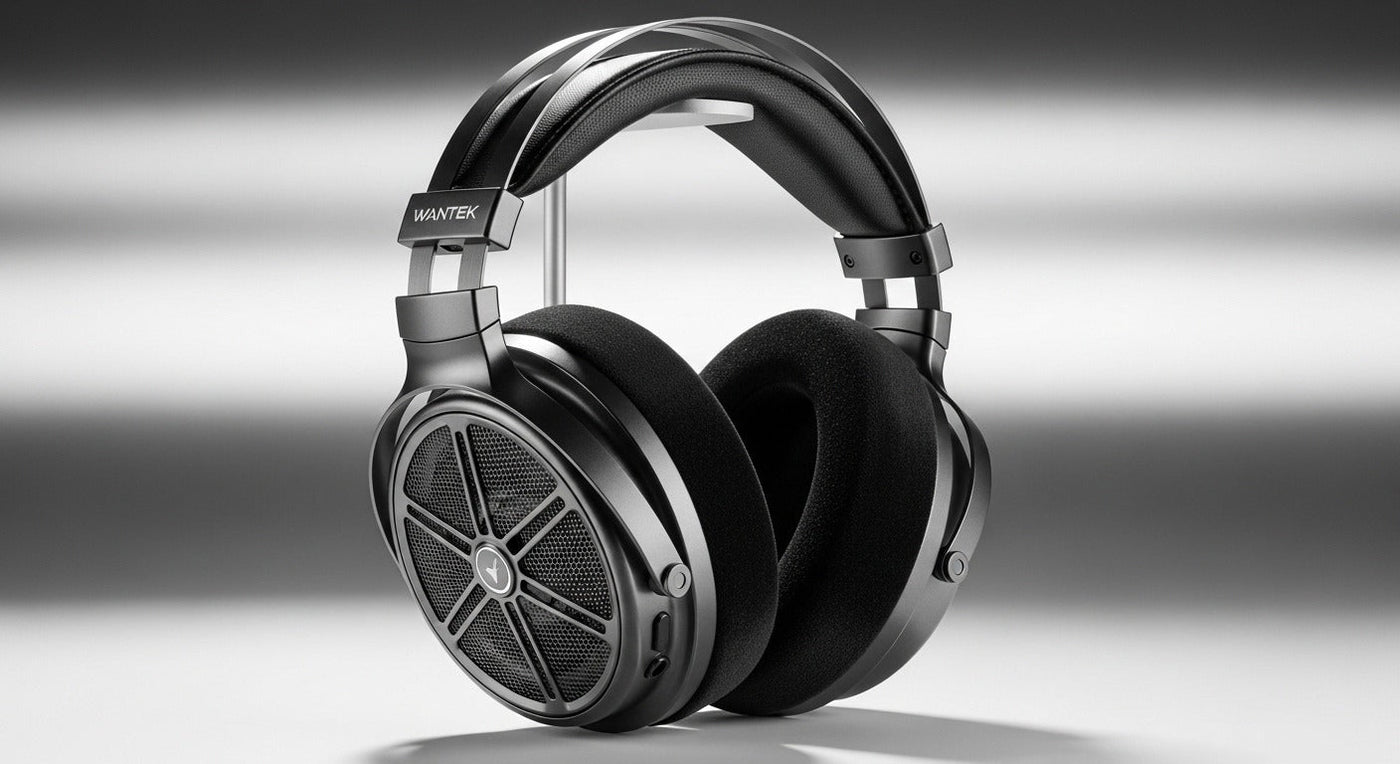
Open-back headphones have vented or perforated earcups that let sound pass between the drivers and the room. They can be an appealing choice for music listening, gaming, or mixing in a quiet space, but they also leak audio and offer little isolation from outside noise.
Quick answer: Choose open-back headphones if you listen mainly in a quiet, private room and want to consider a spacious presentation. Choose closed-back headphones for commuting, shared offices, recording near microphones, or any situation where privacy and isolation matter. Neither design guarantees better sound quality.

What Makes Headphones Open-Back?
The back of each earcup is acoustically open instead of enclosing the driver inside a largely sealed chamber. Sound can escape through the rear grille, while everyday sounds in the room can reach your ears. The open construction describes the earcup, not the driver quality, cable, Bluetooth capability, or price.
A visible grille is a clue, but appearance alone cannot confirm how a specific headphone is designed. Check the manufacturer's stated acoustic design. Also distinguish open-back over-ear headphones from open-ear earbuds: open-ear products usually leave the ear canal unobstructed and are a different form factor.
Some headphones are marketed as “semi-open.” That label does not guarantee a halfway point in leakage or isolation: these models can still let substantial sound in and out. If you share a listening space, check model-specific leakage and isolation results rather than assuming semi-open headphones solve the privacy problem.
| Decision area | What to check | Why it matters |
|---|---|---|
| Room | Quiet private room versus office, commute, shared bedroom, or recording booth | Open designs are easiest to use when outside noise and leakage are not major problems. |
| Purpose | Critical listening, mixing, casual music, tracking, gaming, or calls | The right design depends on whether openness or isolation is more important for the task. |
| Source and fit | Impedance, sensitivity, connector, amplifier guidance, weight, pads, and clamp | Open-back describes the cup design; it does not tell you how hard a specific model is to drive or wear. |
Open-Back vs. Closed-Back: The Differences You Will Notice
Sound leakage and isolation
Open-back headphones let sound pass through their earcups, so people nearby may hear your music, especially at higher volumes, while room noise can interrupt your listening. Closed-back headphones generally leak less and provide more passive isolation, but the result depends on the model and ear-pad seal. A closed-back design does not necessarily include active noise cancellation (ANC); ANC is a separate feature that electronically reduces some outside sounds. For shared offices, commuting, or recording near a live microphone, check model-specific leakage and isolation rather than relying on the enclosure label alone.
For a fuller explanation of the differences, see RTINGS' open-back versus closed-back comparison. If you need to keep audio private or hear subtle details in a noisy environment, enclosure design is often a more important first filter than soundstage claims.
Soundstage, imaging, and tonal balance
Many listeners value open-back models for a spacious presentation, but an open earcup does not guarantee a wider soundstage, better imaging, flatter frequency response, or lower distortion. Those outcomes depend on the entire headphone design and the listener's fit and perception. Compare measurements and reliable model-specific reviews where available, then listen for the balance you prefer.
Bass also depends on the driver, acoustic tuning, and fit. Do not assume that every closed-back headphone has excessive bass or that every open-back headphone lacks deep bass.
Comfort and portability
Some open-back designs feel less enclosed, but that does not automatically make them lighter, cooler, or more comfortable. Pad material, clamping force, headband pressure, cup depth, and glasses clearance matter over a long session. Their limited isolation also makes most open-back models less practical for planes, buses, and busy workplaces.
When Are Open-Back Headphones a Good Choice?
Music listening at home
A quiet room where you will not disturb anyone is the clearest starting point. An open-back model is worth comparing if you enjoy hearing separation between instruments and want to explore a more spacious presentation. Still judge the exact model's tonal balance, comfort, and connection requirements; the enclosure alone does not tell you whether you will like the sound.
Gaming in a quiet room

Open-back headphones can work well for gaming if background noise is low and leakage is acceptable. Check stereo imaging, connection compatibility, and the microphone setup rather than assuming the open design delivers a competitive advantage. If you use a separate desk microphone, test whether headphone playback is audible in your recording.
Mixing, mastering, and recording
Open-back models are often considered for editing, mixing, and critical listening in quiet environments. They are less suitable for tracking vocals or instruments close to a live microphone because playback can bleed into the recording. Shure's studio headphone guide explains why isolation matters during tracking.
For production decisions, reference familiarity, tonal accuracy, consistent fit, and checks on other playback systems matter more than an open-back label. Closed-back headphones can also be useful for mixing.
Shared offices, calls, and travel
In a shared office, the other person's ability to hear your music is as important as your own ability to hear it. For calls, the microphone and room noise introduce another variable. A closed-back headset with an appropriate microphone is generally the more practical starting category when voice communication is the main task. Open-back headphones are usually a poor fit for transit and other noisy public spaces.
How to Choose an Open-Back Headphone
1. Check the actual listening environment
Ask whether other people will be close enough to hear leakage and whether the room is quiet during normal use. If either answer is a problem, compare closed-back models first. Wantek's closed-back headphones guide provides examples organized by listening task.
2. Compare sound and fit, not just the enclosure
Look for model-specific information about frequency response, bass extension, imaging, distortion, weight, replacement pads, and clamp. If possible, listen to familiar music at comparable volume levels. A comfortable headphone with a tonal balance you enjoy may be a better purchase than one advertised as having the widest possible soundstage.
3. Check the connector and source power
Verify the plug and cable supplied with the exact model, then check the output on your laptop, phone adapter, audio interface, or DAC/amp. Impedance is only part of the equation; sensitivity and the source's available output also matter. A separate amplifier is useful when the source cannot drive the headphones cleanly to the listening level you need, not simply because the model is open-back.
4. Match the purchase to your budget and intended use
Consider serviceable cables and ear pads, return terms, and long-session comfort alongside sound. If you are comparing actual wired open-back models, Wantek's open-back audiophile headphone comparison documents differences in weight, driver design, and source requirements. Those specifications help narrow a shortlist; they do not establish a listening-quality ranking.
A Practical Check Before You Commit
- Listen in the intended room. If background noise masks quieter passages, a closed-back model may work better.
- Check leakage at your normal volume. Ask someone nearby whether your music is distracting; do not judge leakage from the wearer position alone.
- Wear the headphones long enough to assess fit. Look for pressure at the temples, ears, or top of the head, especially if you wear glasses.
- Test your actual source and microphone workflow. Confirm connection, adequate clean volume, and whether leaked sound enters any live mic.
The simplest decision rule is to settle the room and leakage question first. Only then compare individual open-back headphones for sound, fit, and electrical compatibility.
Frequently Asked Questions
Can people hear open-back headphones?
Often, yes. Sound escapes through the earcups, and people nearby may hear your music, especially at higher volumes. Actual leakage depends on the model, listening level, and distance.
Do open-back headphones block outside noise?
Usually very little. Their open earcups allow background sound to reach your ears. If you need privacy or isolation, start with closed-back headphones rather than relying on an open-back design.
Are open-back headphones better for gaming?
Not automatically. Some can provide a spacious presentation, but accurate imaging, connection latency, ambient noise, and microphone leakage matter more than the enclosure label alone.
Are open-back headphones always better for mixing?
No. They can suit quiet-room mixing, but tonal accuracy and consistent monitoring must be evaluated by model. Closed-back designs remain useful for tracking and can also serve mixing workflows.
Do all open-back headphones need an amplifier?
No. Check the specific headphone's impedance and sensitivity against your source's output capability. Add a dedicated amplifier only when the source cannot provide the clean volume and headroom you need.

