
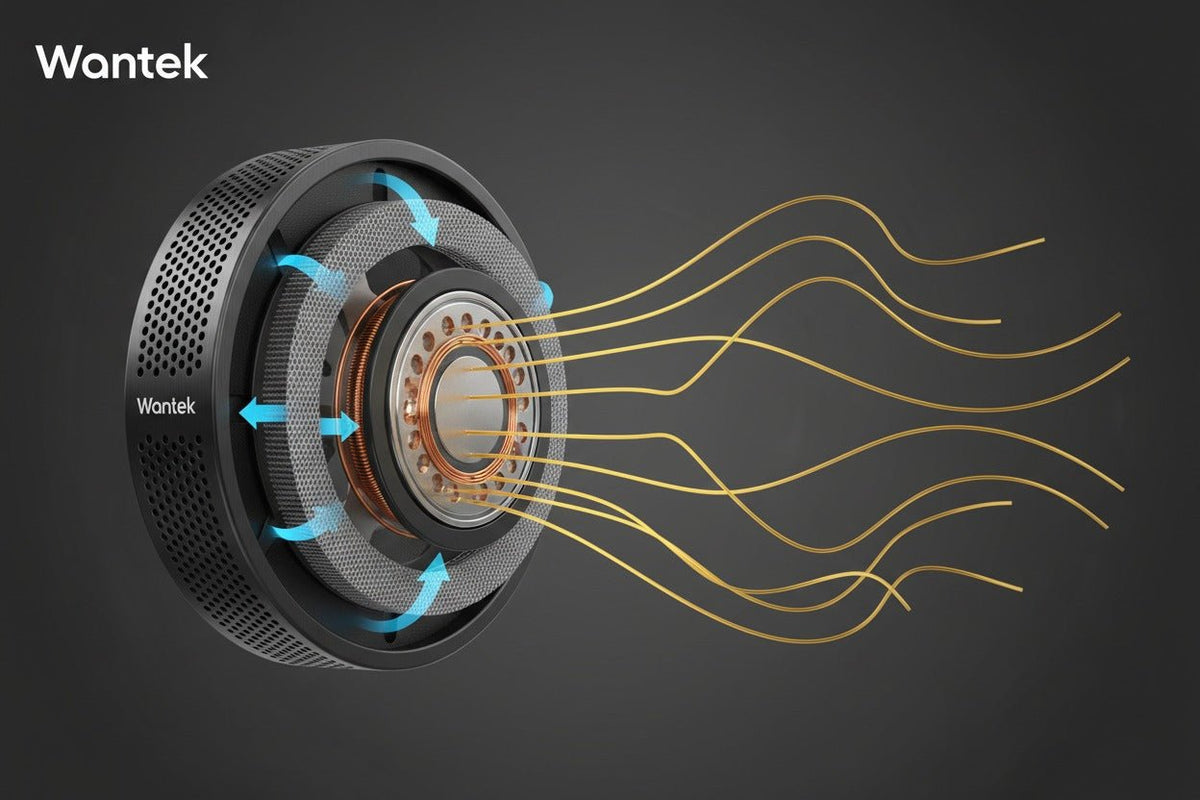
Wireless open-back headphones are still a small category, but the 2026 market is much clearer than it was a year ago. For audiophile-oriented listening, the models worth comparing are true open-back designs that support Bluetooth, Wi-Fi, or a removable wireless module—not closed-back gaming headsets or wired wood headphones mislabeled as wireless.
Quick answer: HIFIMAN now offers the HE1000 WiFi and Arya WiFi for high-resolution Wi-Fi, Bluetooth, and USB Audio listening; Audio-Technica's new ATH-AL5NC adds a lighter, long-battery Bluetooth option; HIFIMAN's ANANDA-BT and DEVA Pro remain established planar choices; and the Grado GW100x is a true open-back Bluetooth model, although current availability can vary.
Choose by wireless path, listening environment, battery requirements, and whether you want an integrated wireless system or a removable Bluetooth module. Open-back construction still means sound leakage and weak isolation, so these headphones make the most sense in quiet, private spaces.

What counts as a wireless open-back headphone?
Two separate design choices matter here. Open-back describes the acoustic enclosure: the rear of the earcup is vented or open, so sound and air can move through the housing. Wireless describes the signal path: Bluetooth, Wi-Fi, or another radio link replaces at least part of the cable connection.
That distinction matters because a wireless headphone is not automatically open-back, and an open-back headphone is not automatically wireless. If you are still deciding between enclosure types, Wantek's open-back vs. closed-back headphone guide explains the isolation and leakage trade-offs in more detail.
This guide was fact-checked against manufacturer specifications and current product pages on September 20, 2026. Availability and pricing can change by region.
Wireless open-back headphones worth comparing in 2026
| Model | Wireless path | Battery rating | Distinctive angle |
|---|---|---|---|
| HIFIMAN HE1000 WiFi | Wi-Fi, Bluetooth, USB Audio | 6.5–7.5 hr Wi-Fi; 23 hr Bluetooth | Flagship planar model with high-resolution network streaming |
| HIFIMAN Arya WiFi | Wi-Fi, Bluetooth, USB Audio | 6.5–7.5 hr Wi-Fi; 23 hr Bluetooth | Lower-priced HIFIMAN Wi-Fi planar option |
| Audio-Technica ATH-AL5NC | Bluetooth; 3.5 mm wired fallback | Up to 75 hr with ANC off; 50 hr with it on | New 2026 dynamic open-back model with LDAC, multipoint, and ANC |
| HIFIMAN ANANDA-BT | Bluetooth, USB Audio | About 10 hr | Integrated Bluetooth planar design with LDAC and aptX HD |
| HIFIMAN DEVA Pro + Bluemini R2R | Bluetooth module, USB-C, 3.5 mm | 6–7 hr for Bluemini R2R | Modular planar design that can switch between wireless and conventional wired use |
| Grado GW100x | Bluetooth, 3.5 mm | 46 hr at 50% volume | On-ear dynamic open-back Bluetooth design with aptX Adaptive |
HIFIMAN HE1000 WiFi
The HIFIMAN HE1000 WiFi is a planar magnetic headphone built around three operating modes: Wi-Fi, Bluetooth, and USB Audio. HIFIMAN lists PCM support from 44.1 kHz through 768 kHz, native DSD64 through DSD512, Bluetooth codecs including LDAC and aptX HD, and a 452 g net weight.
Its battery rating changes with the wireless path: 6.5–7.5 hours in Wi-Fi mode and 23 hours in Bluetooth mode. Independent launch coverage from SoundGuys identifies the HE1000 WiFi and Arya WiFi as open-back models. This is the model to examine when the priority is HIFIMAN's highest-priced current wireless open-back implementation rather than portability or maximum battery life.
HIFIMAN Arya WiFi
The HIFIMAN Arya WiFi uses the same three connection modes—Wi-Fi, Bluetooth, and USB Audio—and the same published battery figures as the HE1000 WiFi. HIFIMAN also lists the same Bluetooth codec set: SBC, AAC, aptX, aptX HD, and LDAC.
The practical distinction is product tier and driver implementation rather than connection format. For a buyer specifically interested in high-resolution network streaming through an open-back planar headphone, Arya WiFi is the direct lower-tier alternative to HE1000 WiFi in HIFIMAN's 2026 lineup.
Audio-Technica ATH-AL5NC
Audio-Technica released the ATH-AL5NC in September 2026 as an open-back wireless model with 53 mm dynamic drivers, Bluetooth, LDAC, AAC, SBC, multipoint, a low-latency mode, and a 3.5 mm wired option. The company lists a weight of about 240 g.
Its unusually long battery specification is up to 75 hours with noise reduction off or 50 hours with it on. Audio-Technica also provides a sound-leakage-reduction mode, but the physical design remains open-back. Treat those electronic features as aids rather than substitutes for the isolation of a sealed closed-back headphone.
HIFIMAN ANANDA-BT
The HIFIMAN ANANDA-BT is an integrated wireless planar model rather than a conventional headphone with an external transmitter base. HIFIMAN's current manual lists Bluetooth 5.1, LDAC, aptX HD, aptX, AAC, SBC, USB Audio support, roughly 10 hours of playback, and a 469 g weight.
ANANDA-BT remains relevant because it provides a simpler Bluetooth-first path than HIFIMAN's newer Wi-Fi models. Its shorter battery rating and heavier chassis are important trade-offs to compare against newer products rather than details to hide behind a generic “audiophile” label.
HIFIMAN DEVA Pro with Bluemini R2R
The HIFIMAN DEVA Pro takes a modular approach. The headphone can operate as a wired open-back planar model, while the Bluemini R2R module adds Bluetooth and USB-C operation. HIFIMAN's manual lists Bluetooth 5.0, LDAC, aptX HD, aptX, AAC, SBC, a 6–7 hour battery rating, and a built-in microphone in the module.
The headphone itself is listed at 360 g, while the Bluemini R2R module adds 25 g. This setup makes sense for listeners who value switching between conventional wired use and a removable wireless module instead of keeping all wireless electronics permanently built into the earcups.
Grado GW100x

The Grado GW100x is a true open-back Bluetooth headphone with 44 mm dynamic drivers, Bluetooth 5.2, aptX Adaptive, AAC, SBC, a 3.5 mm cable option, and a published 46-hour battery figure measured at 50% volume.
It is also the most availability-sensitive model in this comparison: Grado's own product page was showing the GW100x as sold out when checked in September 2026. That does not mean no retailer has stock, but it does mean buyers should verify current regional availability before treating it as an immediately purchasable option.
Three headphones that do not belong in a true wireless open-back list
The previous version of this page mixed genuine open-back wireless products with models that do not meet both criteria. These are useful reference points, but they should not be presented as equivalent options.
| Model | What it actually is | Why it is excluded here |
|---|---|---|
| Audeze Maxwell | Wireless planar gaming headset; closed-back | Audeze's own specifications identify Maxwell as an over-ear closed-back design. |
| Sennheiser RS 175 | 2.4 GHz wireless TV headphone; dynamic closed-back | Sennheiser lists the transducer principle as “Dynamic, Closed.” |
| Audio-Technica ATH-WB LTD | Analog wired wood headphone; closed-back | Audio-Technica describes it as an analog wired model and lists its type as closed dynamic. |
How to choose the right wireless open-back headphone
- Start with the room, not the codec. Open-back headphones leak sound both ways. If you listen on trains, flights, in shared offices, or beside someone who needs quiet, a closed-back design is usually more practical.
- Choose the wireless path you will actually use. Bluetooth works directly with phones, tablets, and most computers. Wi-Fi can support higher-resolution network streaming, but it adds setup requirements and depends on the manufacturer's software and network implementation.
- Compare battery life in the correct mode. HIFIMAN's Wi-Fi models publish different runtimes for Wi-Fi and Bluetooth. Audio-Technica publishes different ATH-AL5NC figures with ANC on and off. Compare the mode you expect to use.
- Decide whether you want integrated or modular electronics. ANANDA-BT, Arya WiFi, HE1000 WiFi, ATH-AL5NC, and GW100x integrate their wireless systems. DEVA Pro can remove its Bluemini module and return to a conventional wired configuration.
- Do not treat “wireless” as a sound-quality score. Driver design, tuning, fit, DSP, source compatibility, and the listening environment still matter. Wantek's wired vs. wireless headphones for music guide explains why the connection type alone does not determine fidelity.
- Check your broader fit and feature requirements. Weight, pad shape, source devices, microphone needs, latency, replaceable parts, and wired fallback can matter more in daily use than a headline codec. Use Wantek's headphone selection framework if you need to compare those factors systematically.
Bluetooth vs. Wi-Fi for open-back listening
Bluetooth is the more universal wireless path. It pairs directly with phones and computers, and models in this guide support combinations of LDAC, aptX-family codecs, AAC, and SBC. The exact codec used still depends on both the headphone and the source device.
HIFIMAN's HE1000 WiFi and Arya WiFi add network streaming on top of Bluetooth. Their official specifications list PCM up to 768 kHz and native DSD up to DSD512 in supported operating modes, while Bluetooth remains available for simpler device pairing. That makes Wi-Fi a different transport option, not a guarantee that every listener or recording will sound better.
Where wireless open-back headphones still make poor sense
- Commuting and air travel: the open enclosure lets environmental noise in and music out.
- Shared quiet spaces: nearby people may hear your audio, especially at higher levels.
- Competitive low-latency gaming over ordinary Bluetooth: latency varies by codec, source, and implementation; a dedicated 2.4 GHz gaming link may be more appropriate.
- Buyers who never want to manage batteries or firmware: a conventional wired open-back headphone is simpler.
FAQ
Are there true wireless open-back headphones in 2026?
Yes. Current examples include HIFIMAN's HE1000 WiFi, Arya WiFi and ANANDA-BT, Audio-Technica's ATH-AL5NC, Grado's GW100x, and the modular HIFIMAN DEVA Pro with Bluemini R2R.
Are wireless open-back headphones good for commuting?
Usually not. Open earcups allow outside sound in and your music out, so a closed-back wireless headphone with good isolation is normally more practical for public transport and flights.
Can open-back wireless headphones have noise reduction?
Yes. Audio-Technica's ATH-AL5NC combines an open-back design with active noise cancellation, but it remains physically open and should not be expected to isolate like a sealed ANC headphone.
Is Wi-Fi automatically better than Bluetooth for sound quality?
No. Wi-Fi can carry higher-data-rate streams, but audible results still depend on the headphone's DAC, amplifier, drivers, tuning, source material, software, and listening conditions.
Can these headphones still work with a cable?
Many can. HE1000 WiFi and Arya WiFi support USB Audio; ANANDA-BT supports USB Audio; DEVA Pro supports wired use; GW100x and ATH-AL5NC include analog wired options.

