
Inside this Article:
- Decoding the Phantom: The Anatomy of Acoustic Echo
- The Digital Exorcism: How Acoustic Echo Cancellation Actually Works
- The Ecosystem of Silence: Software vs. Hardware AEC
- The Integrated Frontier: A Deep Dive into Acoustic Echo Cancellation Windows 11
- Cultivating Clarity: A Tactical Guide to Your Audio Setup
- The Horizon: Adaptive, Invisible, and Intelligent
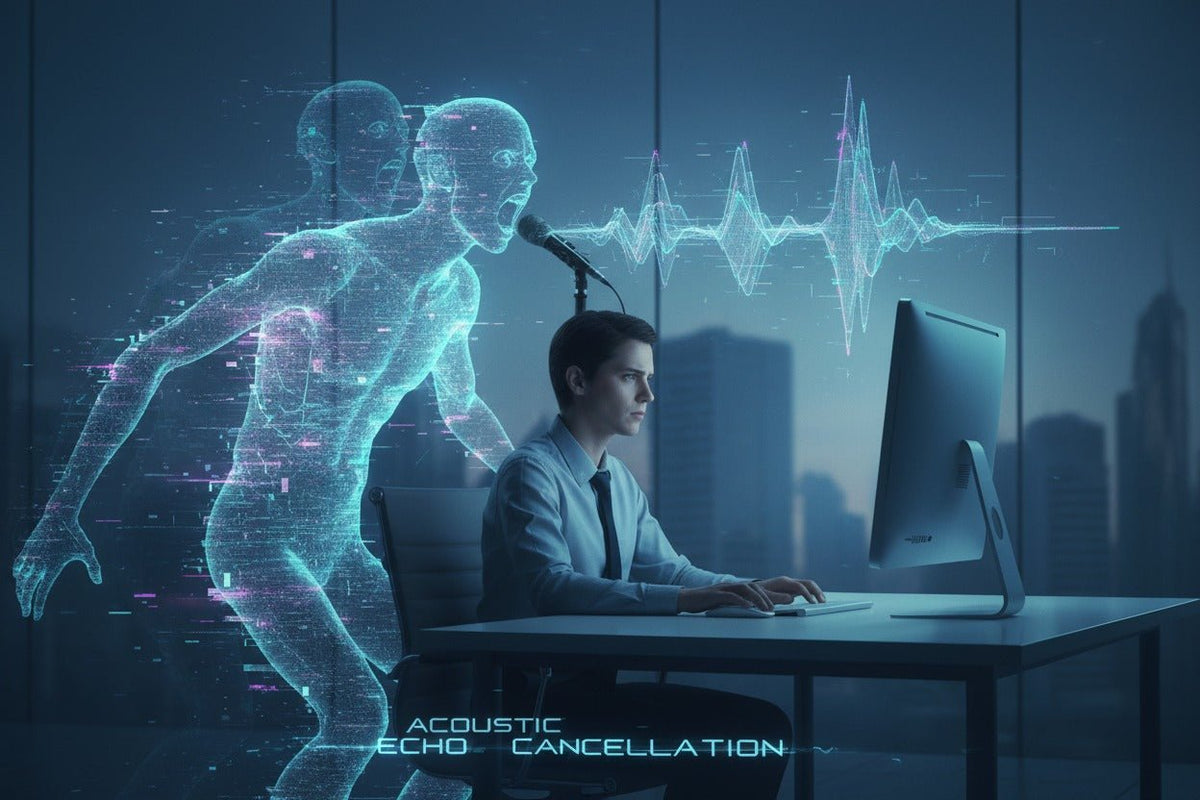
The faint, spectral copy of your own voice looping back to you isn't just a technical glitch. It’s a rupture. One moment you’re locked in, presenting a quarterly review or sharing a vulnerable thought with a friend. The next, you’re derailed by a tinny, delayed version of your last sentence. “Is there an echo?” someone asks. Your confidence deflates. The connection severs. In our hybrid reality, where so much of our professional credibility and personal intimacy is conveyed through packets of audio, this failure isn’t minor. It’s a fundamental breakdown. The villain of this piece is acoustic echo. The hero, working tirelessly in the background, is a signal processing marvel called acoustic echo cancellation.
I’ve spent countless hours dissecting audio streams, and I can tell you this isn’t just for engineers. It’s the invisible scaffold holding up modern communication. From the critical investor pitch to the chaotic multiplayer gaming session to the quiet bedtime story read over video, audio fidelity is the currency of trust. Poor audio makes people seem less competent, less engaged, less real. So, let’s pull back the curtain. Let’s explore how echo hijacks our conversations, how acoustic echo cancellation software performs its daily magic, and why the native implementation of acoustic echo cancellation Windows 11 offers might just be the most impactful upgrade you haven’t fully appreciated.
Decoding the Phantom: The Anatomy of Acoustic Echo
First, a crucial distinction. This isn’t the “line echo” of your childhood landline—that sharp, metallic repeat born of electrical impedance. That was a circuit problem. Acoustic echo is an environmental haunting. It’s physics in action, and understanding it is half the battle.
Here’s the play-by-play of a typical digital haunting. Your voice enters your microphone. That signal rockets across the internet to your colleague’s machine. It bursts from their speakers. In an ideal, anechoic chamber, it would stop there. But we live in the real world of drywall, glass, and hardwood. That sound wave radiates out, colliding with every surface in their room. Each bounce steals a little energy, adds a tiny delay, and funnels a degraded remnant of your voice directly back into their microphone. Their system, dutiful to a fault, packages this acoustic ghost and sends it right back to you.
The result? You hear yourself, but not as you are. You hear a decayed, distorted shadow with a delay of maybe 50 to 300 milliseconds. It’s maddening. For the listener on the other end, the effect is even worse. They’re trying to focus on your live voice while a faint, out-of-sync replica chatters in the background. It induces cognitive fatigue, forcing the brain to work overtime to separate signal from noise. Conversation becomes laborious. Trust in the technology—and by uncomfortable extension, in you—begins to erode. It’s the audio equivalent of trying to read a document with the text slightly blurred.

The Digital Exorcism: How Acoustic Echo Cancellation Actually Works
Calling acoustic echo cancellation a “filter” is like calling a symphony orchestra a “noise maker.” It’s a profound undersell. This is active, adaptive, real-time algorithmic prediction. It’s your computer building and constantly refining a virtual model of your physical space to antisocially anticipate its own sonic reflections.
I visualize it as a hyper-vigilant, digital bodyguard for your audio. Its sole purpose is to identify and eliminate impostors. Here’s how the protection detail operates, step by intricate step.
- The Reference. The AEC system is granted a direct tap. It receives the “far-end” reference signal—the exact audio packet being sent to your speakers. This is the blueprint of the potential ghost.
- The Prediction. Using sophisticated adaptive algorithms (often based on recursive least-squares or normalized least-mean-squares frameworks), the software constructs a mathematical simulation of your room’s acoustic response. It asks, “If I play this specific sound out of the speaker, what will the echo sound like when it slinks back into the microphone?” It generates a precise, digital doppelgänger of the anticipated echo.
- The Subtraction. Now it listens to the actual microphone input. This signal is a messy cocktail: your beautiful near-end voice, plus any background noise, plus the actual, real-world echo. In a brilliant stroke of digital subtraction, it removes the predicted echo copy from this live mic signal.
- The Purification. If the model is accurate—and modern models are scarily good—the echo is erased. What remains is (mostly) your clean voice, ready for transmission. Any residual noise is often handed off to a separate noise-suppression algorithm for final polishing.
The adaptive component is the genius. Your room is a living entity. You open a window. You shift your USB microphone six inches to the left. Your cat knocks a picture frame off the wall. Each event alters the echo path. Legacy, static filters would fail instantly. Modern acoustic echo cancellation software updates its internal model thousands of times per second, a continuous calibration to the chaos of your environment. When it works, it’s silent and invisible. When it stumbles, you get the infamous “chopping” artifact or a sudden burst of robotic echo—a moment where the digital bodyguard briefly mistakes your voice for the intruder.
The Ecosystem of Silence: Software vs. Hardware AEC
The philosophical divide in the acoustic echo cancellation world is location, location, location. Where does the processing live? This decision shapes your experience, your budget, and your system’s capabilities.
For decades, high-quality AEC was the exclusive domain of dedicated hardware. Think of the DSP chips inside a Poly conference phone or a Jabra Speak series speakerphone. These are specialists. They have raw processing power reserved solely for audio cleansing, offering robust, consistent performance. They’re the armored cars of the audio world—expensive, single-purpose, and extremely effective.
The revolution has been the rise of acoustic echo cancellation software. This runs on your computer’s general-purpose CPU, transforming every machine into a potential audio studio. This democratization is profound.
- Application-Native AEC: Every major communication platform—Zoom, Microsoft Teams, Google Meet, Discord—has its own integrated software AEC. It’s tuned for voice intelligibility and works in concert with noise suppression and automatic gain control within that app’s walled garden. It’s convenient but non-portable.
- System-Wide Gatekeepers: This is where standalone applications like Krisp, NVIDIA RTX Voice/ Broadcast, or even some driver suites operate. They install as virtual audio devices, processing all sound entering and leaving your computer. This is a paradigm shift. You can now have pristine, echo-cancelled audio in a legacy video editor, a Twitch stream, or a Steam game chat that has no built-in processing. This is the purest form of versatile acoustic echo cancellation software.
- The Operating System Layer: Enter acoustic echo cancellation Windows 11. This represents the latest evolution: baking advanced audio processing directly into the core of the operating system. Microsoft’s “Voice Clarity” feature is the flagship here. It’s not just an app; it’s a low-level audio effect applied at the driver level, available to any application that uses the standard Windows audio pipeline.
The software advantage is ubiquity and flexibility. The trade-off is computational overhead and potential variability. In a benign environment, software AEC is miraculous. In an extreme acoustic hellscape—a sparse kitchen with tile floors and granite counters—dedicated hardware might still hold a slight edge. But that gap is closing fast, driven by AI and deeper OS integration.
The Integrated Frontier: A Deep Dive into Acoustic Echo Cancellation Windows 11
Windows 11’s aesthetic changes grabbed headlines, but its audio stack overhaul is, in my opinion, its sleeper hit. For years, managing audio on Windows felt like archaeology—digging through legacy Control Panel applets, managing third-party driver conflicts, and wrestling with obscure settings. Windows 11 attempts to civilize this frontier, and its approach to acoustic echo cancellation is a central pillar of this effort.
The magic happens in Settings > System > Sound > [Your Input Device] > Properties. Here, you find toggles for features like “Voice Clarity.” This isn’t a mere marketing checkbox. When enabled, it applies a suite of AI-powered audio enhancements, including robust acoustic echo cancellation, at the Windows Audio Engine level. The implication is massive.
Consider this scenario. You need to join a webinar using a dated, proprietary client built in 2015. It has no modern audio processing. In the past, you’d be a vector for echo. With acoustic echo cancellation Windows 11 features active, the operating system intervenes. It cleans your microphone stream before the ancient application even lays hands on it. The echo is eradicated at the source. It’s a silent guardian, a watchful protector for your audio reputation. This is democratization in action—raising the floor for audio quality across every interaction on the system.
Gaming is another revelatory use case. You’re immersed in an open-world game, audio pouring from your speakers. You’re also on a Discord call with your squad. Without system-wide AEC, your microphone faithfully picks up the game’s explosions and soundtrack, creating a chaotic, echoing mess for your friends. With Windows 11’s native processing, that speaker audio is identified as a reference signal and canceled from your mic feed. Your friends hear your call-outs, not your game’s score. It’s not infallible—crank your speakers to window-rattling levels and you’ll find its limits—but for standard desktop use, its efficacy is startling.
A critical, often-overlooked caveat: the “stacking” problem. Enabling acoustic echo cancellation at multiple points—Windows 11, Discord, and a hardware webcam—can create a destructive interference pattern. The algorithms, layered atop one another, start canceling parts of your clean voice signal, leading to a thin, watery, or artificially clipped sound. My rule? One strong AEC source is enough. Typically, you choose the one closest to the physical microphone or the one with the most processing headroom. For many now, that’s wisely becoming the OS itself.
Cultivating Clarity: A Tactical Guide to Your Audio Setup

Technology is an amplifier, not a miracle worker. To extract the full potential from any acoustic echo cancellation software, you must become an active participant in your audio chain. Think of it as gardening. You’re creating the conditions for clarity to thrive.
- The Proximity Principle. This is the non-negotiable foundation. Get your microphone close to your mouth. A quality USB condenser mic or a headset positioned a fist’s width from your lips captures a strong, direct vocal signal. This dramatically raises the ratio of your voice to any room echo or noise, making the AEC’s job trivial. It’s the single most effective upgrade, often surpassing the microphone’s price tag in importance.
- The Headphone Hedge. The most perfect acoustic echo cancellation is physical. Using headphones (even basic earbuds) severs the acoustic feedback loop entirely. No sound from your speakers can possibly enter your microphone. It’s a 100% effective, zero-latency solution. I recommend this for any critical call where professionalism is paramount.
- Environmental Taming. Your room is an instrument. Hard, reflective surfaces (glass, bare walls, empty desks) are your enemy. Soft, absorptive materials (curtains, rugs, upholstered furniture) are your allies. A bookshelf with irregularly sized books acts as a superb sound diffuser. Sometimes, the best audio upgrade is a well-placed blanket or a tapestry.
- The Ritual of Testing. Never assume. Use the audio setup wizards. Enlist a patient friend for a echo check. Speak, then pause deliberately to listen for your own voice returning. Applications like Teams have excellent “test call” features that provide recorded feedback. This two-minute ritual saves you from the silent judgment of a dozen colleagues on your next all-hands call.
- Knowing When to Disable. AEC is engineered for the single-talker scenario—you in your room. It breaks down in complex acoustic situations. If you’re recording a podcast with two people in the same room on separate mics, or collaborating on a live music session, AEC must be turned off. It will mistakenly try to cancel the other person’s voice, causing havoc. In these scenarios, proper mic technique, acoustic treatment, and careful monitoring are your only tools.
The Horizon: Adaptive, Invisible, and Intelligent
The trajectory of this technology points toward utter seamlessness. We are already entering the era of AI-native acoustic echo cancellation software. These systems employ machine learning models trained on millions of hours of audio. They don’t just model rooms; they learn to intrinsically understand the spectral fingerprint of human speech versus noise, of a true echo versus desired double-talk.
The “double-talk” dilemma has historically been a thorny challenge. When both parties speak simultaneously, how does the algorithm avoid canceling out the far-end speaker’s voice? Next-gen AEC uses deeper neural networks to perform this separation more gracefully, preserving the natural flow of interruption and agreement that defines real conversation.
The integration seen with acoustic echo cancellation Windows 11 is the dominant trend—pushing high-fidelity processing into the substrate of our devices. The goal is ambient computing for audio: technology that senses, adapts, and corrects without ever demanding our attention. We should no more have to configure our echo cancellation than we have to manually adjust the fuel injection in our cars. It just works, fading into the infrastructure. We’ll only notice its absence, in that jarring moment when a hollow echo reminds us of the digital ghosts we’ve quietly banished.
Ultimately, this isn’t about bits and algorithms. It’s about human presence. In a fractured world, clear communication is the glue. It’s the vehicle for ideas, empathy, and execution. Acoustic echo cancellation is a humble, powerful tool that removes a barrier. It quiets the digital echo and amplifies the human signal. It lets you come through, undistorted and unequivocally yourself. And in an age of remote everything, that’s not a small thing. It’s everything.
Frequently Asked Questions
What is Acoustic Echo Cancellation (AEC)?
Why is echo a problem in audio communication?
How does AEC differ from simple noise cancellation?
What are common applications for Acoustic Echo Cancellation?
"Tired of Being 'That Person' With the Echo?"
You've just learned how acoustic echo cancellation works—now experience it in hardware designed for flawless performance. Wantek's professional headset line features advanced AEC chipsets, noise-isolating microphones positioned for optimal pickup, and plug-and-play compatibility with Windows 11's Voice Clarity features. No configuration headaches. No audio stacking conflicts. Just crystal-clear presence on every call. Our UC headsets are trusted by 50,000+ remote professionals who refuse to compromise on audio quality.
[Shop Professional Headsets →] | 30-Day Perfect Audio Guarantee
Read more
📖 Top Headphones for Flying – Noise Cancelling & Comfort
📖 3.5mm to Headphone Jack: The Complete Adapter Guide
📖 How to Use Bluetooth Headphones with TV – Easy Guide
📖 Green Headphones Guide: Top Picks from Beats to Sony Wireless
📖 What is Cyber Monday? History, Dates & Best Deals
📖 How to Set Up Call Forwarding on iPhone (Verizon & More)
📖 Discover the Best Cat Ear Headphones: Ultimate Wireless and Bluetooth
📖 Best Wired Noise Cancelling Headphones 2025 – Top Picks
📖 Best Noise Cancelling Earbuds for Airplane Travel: An In-Depth Review
📖 Best Gym Headphones 2025 – Top Wireless & Sweatproof Picks