
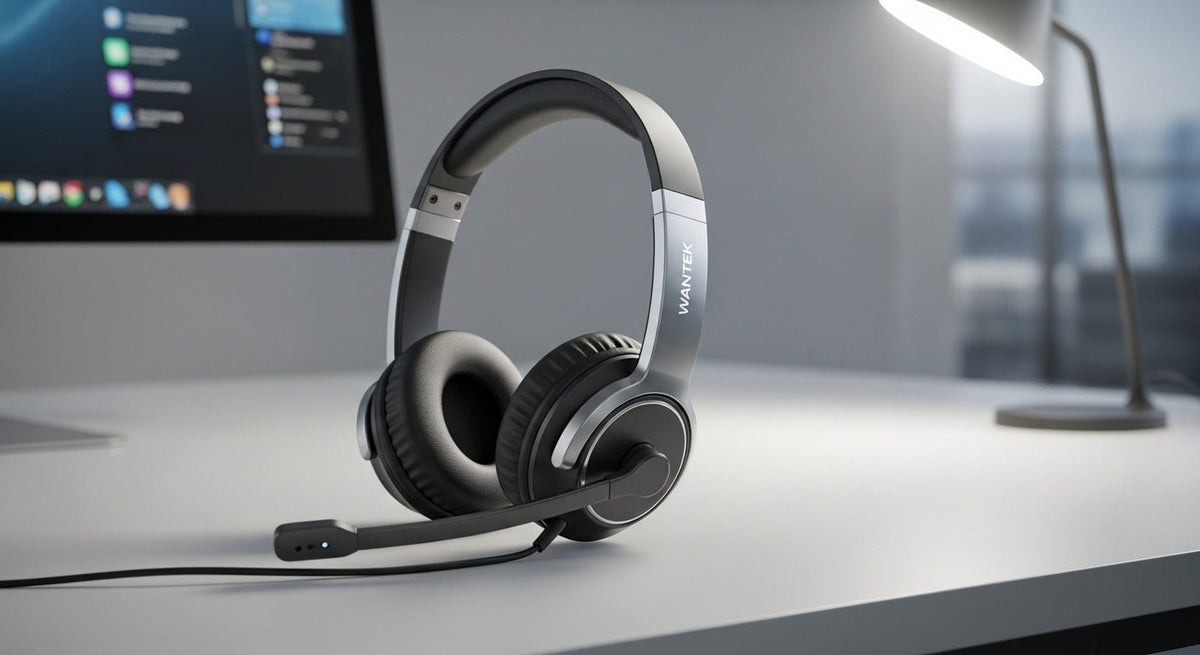
No Bluetooth headset can promise “noise-free” calls in every environment. Clearer calls come from matching microphone placement, outgoing noise reduction, connection behavior, controls, battery, and wearing style to the place where you actually work.

Quick answer: for call-heavy work, start with a boom microphone and the connection path you need. Then compare microphone noise reduction, mute controls, multipoint, comfort, and battery. ANC is a separate listener-side feature and should not be treated as proof of microphone performance.
For a broader breakdown of microphone placement, Bluetooth behavior, and call clarity, see our Bluetooth headphones with microphone guide.
What makes a Bluetooth headset good for calls?
| Feature | Why it matters | What to verify |
|---|---|---|
| Microphone position | A boom can keep the microphone closer to the mouth. | Fixed vs. adjustable boom and comfortable placement. |
| Outgoing noise reduction | Processing may reduce some background sound sent to the other caller. | Manufacturer description and the environments it is intended for. |
| Mute control | Fast muting is important in meetings and customer calls. | Physical button, indicator behavior, and app/platform support. |
| Multipoint | Useful for workers who alternate between a laptop and phone. | Whether the exact model supports the switching behavior you need. |
| Battery | Call-heavy work can consume more power than casual listening. | Talk-time claims, charging method, and charging-dock option if relevant. |
| Fit | Comfort affects whether the headset works for a full day of calls. | Mono vs. stereo, clamp, weight, pad contact, glasses clearance. |
Boom mic vs. built-in microphones
A boom microphone places the microphone closer to the mouth and can make speaking position more predictable. That is useful for sales, support, dispatch, remote work, and other voice-heavy tasks. Headphones with microphones built into the ear cups can still support calls, but they rely more on microphone arrays and signal processing because the microphones sit farther from the mouth.
ANC and microphone noise reduction are different
Active noise cancellation changes some of the environmental sound that reaches the person wearing the headset. Microphone noise reduction acts on the outgoing call signal. A headset may have one, both, or neither. When your goal is clearer speech for the other person, microphone design and outgoing processing are the relevant checks.
Mono or stereo for work calls?
Mono
A single-ear headset leaves one ear open to the room. It can suit front desks, shared offices, dispatch work, or users who need to hear nearby colleagues while staying on a call.
Stereo
A dual-ear headset can provide more passive isolation and focus. It may be a better fit for busy workspaces or users who also listen to music between calls.
Bluetooth, USB adapter, and device support
“Bluetooth headset” does not guarantee the same behavior on every computer, phone, or calling platform. Some work headsets connect directly through a device’s Bluetooth radio; others can also use a USB adapter. Call controls, mute synchronization, and platform behavior can vary with the connection path.
If you switch between a laptop and phone, verify the model’s multipoint or multi-device behavior instead of assuming all Bluetooth headsets stay connected to two active sources.
Battery and charging for call-heavy days
Look at talk-time claims rather than music playback alone when voice calls dominate. A charging dock can be useful at a fixed desk because it gives the headset a predictable place to recharge. For travel, direct cable charging may be simpler than carrying a base.
Comfort is part of call quality
A headset that becomes uncomfortable encourages users to reposition the ear cups or microphone, remove the headset between calls, or shorten wearing time. Compare weight, clamp, ear-pad contact, headband adjustment, and how the microphone sits relative to the face.
Compare Bluetooth work headsets
Browse Wantek office headsets by connection, wearing style, microphone format, and work setup.
Frequently asked questions
Does ANC make my microphone sound better?
No. ANC is primarily a listening-side feature. Microphone placement and outgoing noise-reduction processing are the features to evaluate for the voice sent to callers.
Is a boom microphone better for work calls?
A boom can keep the microphone closer to the mouth and make placement more consistent, which is useful for frequent calls. Actual performance still depends on the complete headset design.
Do I need multipoint?
Only if you regularly switch between supported devices such as a laptop and phone. Check the exact model’s behavior rather than assuming every Bluetooth headset supports the same workflow.

