
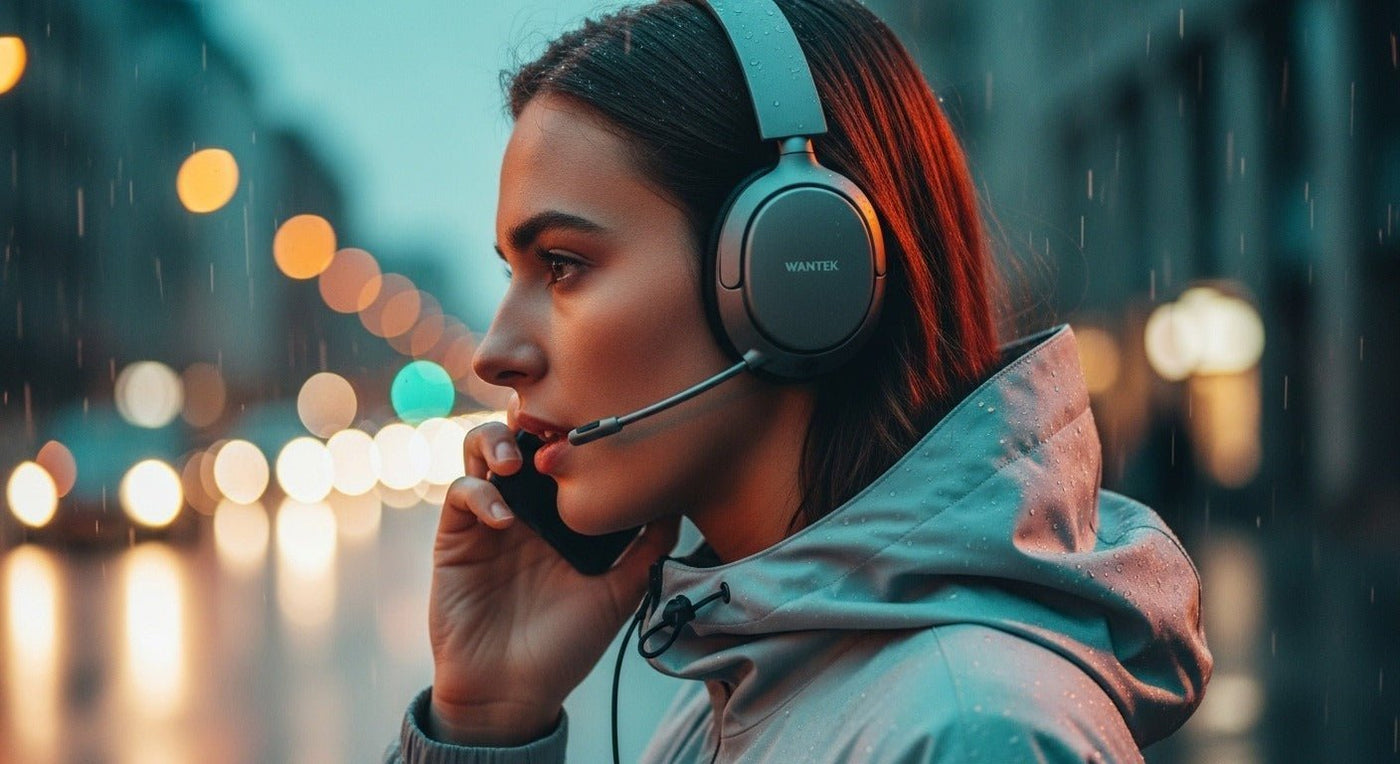
Clear Bluetooth calls depend on more than the headphone’s speakers. Microphone placement, voice processing, Bluetooth behavior, fit, and the noise around you all affect what the other person hears.
Best starting point: if calls are the primary job, compare boom-mic work headsets first. If music and travel come first, premium over-ear Bluetooth headphones with integrated microphones may be a better all-round compromise.
What matters for call clarity?
| Feature | Why it matters | What to verify |
|---|---|---|
| Mic placement | A boom mic stays closer to the mouth. | Boom vs. ear-cup/earbud microphones. |
| Mic noise reduction | Can reduce unwanted outgoing sound. | Do not confuse it with ANC for your ears. |
| Mute control | Useful during frequent meetings. | Physical mute and app compatibility. |
| Multipoint | Useful for laptop + phone workflows. | Exact switching behavior, not just pairing count. |

Boom microphone or built-in microphone?
A boom mic is the more purpose-built form factor for frequent professional calls because it stays close to the mouth. Integrated microphones keep the headset cleaner for travel and music, but call performance depends more on array placement and processing.
ANC does not describe your outgoing microphone
Active noise cancellation primarily reduces environmental sound reaching your ears. Microphone noise reduction affects the signal sent to the other person. Passive isolation is a third effect created by the ear cushions or ear tips.

Battery and Bluetooth behavior
Use “up to” battery figures as maximums under stated conditions. Call time, music playback, volume, and connected devices can change runtime. Bluetooth profiles can also change the audio path when the microphone becomes active.
For a call-first comparison, see Wantek’s office headset buying guide.
Compare a call-focused Bluetooth headset
Wantek WK882BT uses Bluetooth 5.2, a boom mic, one-key mute, passive noise cancellation, and a listed battery life of up to 45 hours.
Clear Calls Depend on the Microphone Path
For Bluetooth calls, evaluate what the person on the other end hears, not only how music sounds to you. Microphone position, background-noise processing, Bluetooth call profiles, operating-system routing, and the calling application can all affect speech quality.
Test in the environment where you will work
Make a real call in the room, vehicle, or shared workspace where the headset will be used. Check speech when you turn your head, type on a keyboard, or move away from the connected device. A quiet-room demo does not reveal every problem.
Call-Quality Checklist
- Microphone clarity
- Mute access
- Two-device switching if required
- Battery during call use
- Comfort for the expected call length
Frequently asked questions
Is ANC the same as a noise-canceling microphone?
No. ANC affects what you hear. Microphone noise reduction affects the outgoing voice signal. A headset can have one without the other.
Is a boom mic better for work calls?
It is usually the more purpose-built design because the microphone stays closer to your mouth, but processing, fit, connection, and room noise still affect results.

