
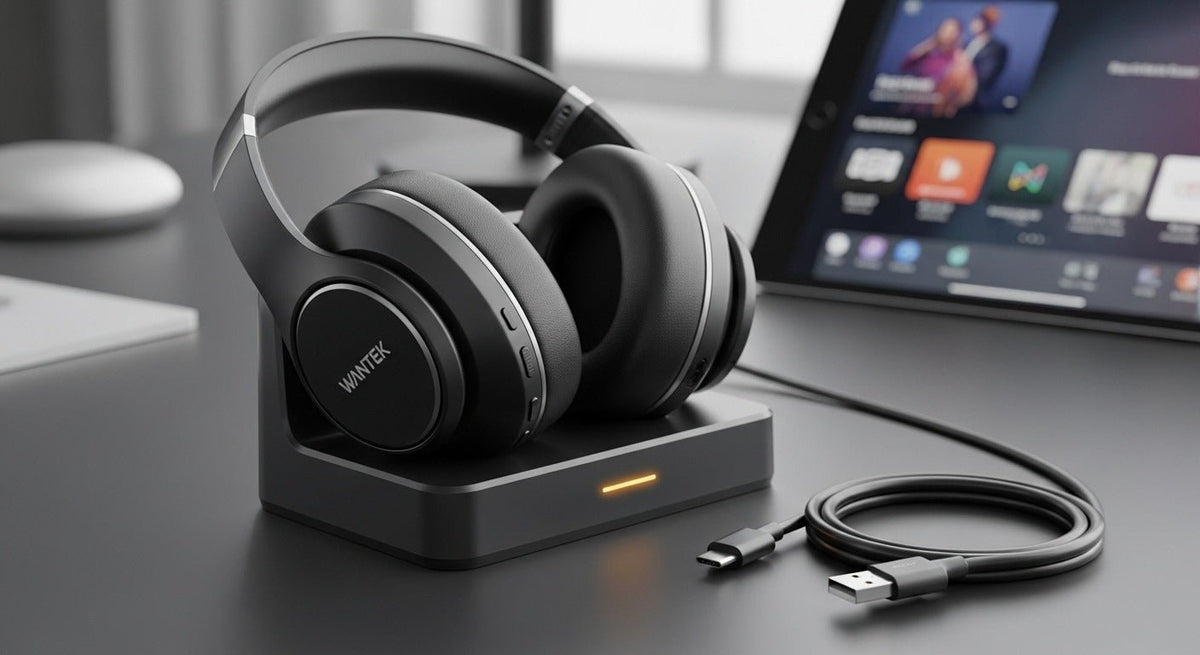
A charging dock is most useful when wireless headphones or a work headset live at a desk. It gives the device a predictable storage and charging location, but docks are usually model-specific and should not be treated as universal wireless chargers.

Quick answer: choose the headset first and the dock second. Confirm that the dock is designed for the exact model, the charging contacts align correctly, and the headset can still be charged by a practical backup method if the dock is unavailable.
What a charging dock adds
| Benefit | Why it helps | What to check |
|---|---|---|
| Fixed charging location | Reduces the chance of starting work with a low battery. | Dock placement and easy headset seating. |
| Desk storage | Keeps the headset off the work surface. | Stability and cable routing. |
| One-handed routine | Useful for frequent pick-up/put-down cycles. | Contacts engage without forcing the headset. |
| Visual charging state | Can make battery status easier to check. | Whether the exact model provides an indicator. |
Dock compatibility is model-specific
Even docks that look similar can use different contact positions, voltage requirements, magnets, or mechanical supports. Use only a dock documented for the headset rather than choosing by appearance.
Keep a backup charging path
A practical desk headset should not become unusable because the dock is lost or damaged. Check whether the headset can also charge directly by cable and whether that cable or connector is easy to replace.
Battery still matters more than the dock
A charging stand does not fix insufficient runtime. Compare the headset’s talk or listening time, charging time, and real work pattern first. The dock is a convenience layer on top of the battery system.
For docks alongside other ownership add-ons, see which headphone and headset accessories are actually useful and model-specific.
Desk use vs. travel
A dock makes sense at a fixed workstation but adds bulk for travel. Mobile users may prefer direct USB-C or another common charging cable. Hybrid workers should decide whether the dock stays at the office, home, or moves with the headset.
For work headsets, check more than charging
Microphone placement, mute controls, device compatibility, multipoint behavior, wearing style, and call-platform support can matter more than the dock. Avoid buying a headset primarily because it includes a stand.
Compare Wantek office headsets
Browse current office headsets by connection, wearing style, microphone, battery, and charging setup.
A Charging Dock Is a Workflow Feature
A dock can make daily charging easier at a fixed desk, but it does not improve wireless range, microphone quality, or battery chemistry by itself. Treat the dock as part of the storage and charging workflow rather than the main reason to choose a headset.
Check Contact Alignment and Replacement Availability
Charging docks are usually model-specific. The physical shape, charging contacts, voltage, and firmware behavior can differ even between headsets from the same brand. If the dock is important to your workflow, check whether a replacement can be purchased separately.
Plan for a Cable Backup
If the headset also supports cable charging, keep the compatible cable available. A dock can be convenient for daily use, while a cable provides a practical backup if the dock is moved, damaged, or unavailable during travel.
Desk Deployment Checklist
- Confirm the dock is made for the exact headset model.
- Check whether the headset can charge by cable as a backup.
- Make sure the dock does not block other desk equipment.
- Verify charging time and stated battery runtime for the headset itself.
- For shared desks, decide who is responsible for returning the headset to the dock.
Frequently asked questions
Are headset charging docks universal?
No. Contact layout, power requirements, magnets, and physical support are usually model-specific. Use a dock documented for the exact headset.
Is a charging dock necessary?
No. It is mainly a convenience for fixed desks. Direct cable charging can be simpler for travel or users who do not keep the headset in one place.
Should a dock replace cable charging?
Prefer a headset that still has a practical backup charging method. That reduces downtime if the dock is unavailable or damaged.

