
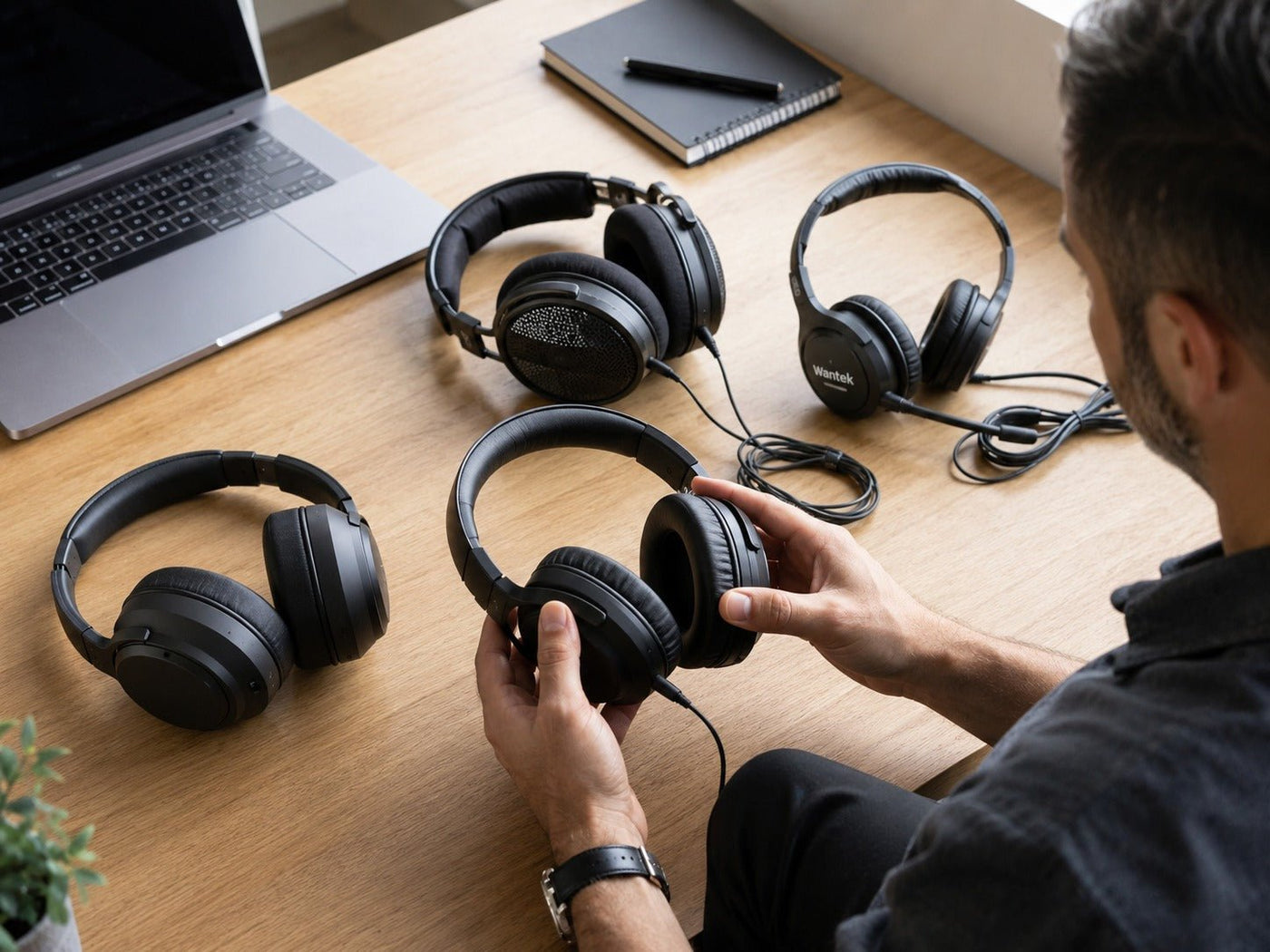
For 2026, the strongest over-ear headphones under $200 are defined less by one headline feature than by how well they balance sound quality, noise control, comfort, connectivity, and battery life. The Sony WH-CH720N is our top all-round wireless pick because it combines a very light design, active noise cancellation, long battery life, and straightforward everyday usability. The Soundcore Space Q45 is the strongest feature-value alternative, adding adaptive ANC, LDAC, multipoint connectivity, and longer battery endurance. For critical listening at home, the Sennheiser HD 560S remains a compelling wired, open-back option. For work calls rather than music-first listening, the Wantek H882 is a practical wired headset built around a boom microphone, inline controls, and PC-oriented connectivity.
Decoding the $200 Audio Sweet Spot in 2026
The sub-$200 category is one of the most useful parts of the headphone market because buyers can now choose among several clearly different approaches: lightweight wireless ANC models, feature-heavy travel headphones, wired reference-oriented designs, and communication-first work headsets. The key is not to assume that every model under the same price ceiling is trying to solve the same problem.
That distinction matters when comparing best over ear headphones under 200. A commuter may reasonably prioritize ANC and low weight, while a producer may care more about tonal accuracy and an open-back design. A remote worker who spends hours in calls may benefit more from a positioned boom microphone and simple wired controls than from high-resolution Bluetooth codecs.
This guide therefore treats $200 as a decision boundary rather than a quality guarantee. Prices change, promotions come and go, and some models periodically move above or below the threshold. The useful comparison is how each headphone performs for its intended use when it is available within budget.1
1. The Evaluation Framework: Critical Metrics for Full-Size Headphones

To determine the best fit, start with measurable specifications and then consider how they affect real use. No single metric can identify the best headphone for every buyer.
- Active Noise Cancellation (ANC): ANC uses microphones and signal processing to reduce external sound reaching the listener. Performance varies by frequency and environment; constant low-frequency noise, voices, and irregular sounds are not always reduced equally well.
- Sound Signature Tuning: Frequency-response tuning influences perceived bass, midrange, and treble balance. Neutral or reference-oriented tuning can help with critical listening, while warmer or bass-emphasized tuning may suit buyers who prefer a more energetic presentation.
- Transducer Design: Driver diameter and diaphragm construction are relevant specifications, but they do not independently predict sound quality. Tuning, enclosure design, damping, distortion, and implementation matter at least as much as driver size.
- Battery Life & Charging: Wireless buyers should compare battery life with ANC on and off because those figures can differ substantially. Fast charging is useful for travel, but charging claims should be read under the manufacturer's stated conditions.
- Comfort Ergonomics: Weight, clamping force, pad depth, headband pressure, and heat buildup can determine whether a headphone remains comfortable through a long workday or flight.
- Codec Support: SBC is the baseline Bluetooth audio codec; AAC, LDAC, and aptX-family codecs add other implementation and bitrate options. Codec support matters only when both the source device and headphones support the same codec.
- Build and Serviceability: Hinges, sliders, headbands, cables, and replaceable pads are practical durability considerations. A well-built headphone is easier to keep in service when wear parts can be replaced.
2. The Elite Tier: Strong Picks Around $150–$200
This tier is where buyers can reasonably expect several premium-style conveniences at once: ANC, multipoint connectivity, long battery life, app-based tuning, or reference-oriented acoustic design. The strongest choice still depends on the use case.
2.1 Sony WH-CH720N: The Lightweight All-Rounder
Sony's WH-CH720N is one of the easiest wireless models to recommend to commuters, office users, and listeners who value low weight. Its appeal comes from the combination of ANC, a light chassis, useful battery endurance, and simple mainstream codec support rather than from any single class-leading specification.
Sony's WH-CH720N specifications list a 30 mm dynamic driver, Bluetooth 5.2, SBC and AAC support, and up to 35 hours of continuous music playback with noise canceling on or 50 hours with it off.
- Key Specs: 30 mm dynamic drivers; Bluetooth 5.2; SBC/AAC; up to 35 hours with ANC on and 50 hours with ANC off.
- Noise Control: The WH-CH720N uses Sony's Integrated Processor V1 and active noise cancellation. It is best treated as a useful everyday ANC model rather than as a guarantee of near-total isolation in every environment.
- Ergonomic Advantage: At roughly 192 g, it is unusually light for an over-ear ANC headphone, which is a meaningful advantage for commuting and long listening sessions.
- Verdict: Choose it when low weight, mainstream wireless compatibility, and practical ANC matter more than premium materials or high-bitrate codec support.
The main limitation for Android users is the absence of LDAC. That does not make the WH-CH720N low quality; it simply means buyers who specifically want LDAC should look elsewhere.
2.2 Soundcore Space Q45: The Feature-Heavy Traveler
The Soundcore Space Q45 competes by offering a broader feature set at a midrange price. It is heavier than the Sony, but it adds adaptive ANC, LDAC support, multipoint connectivity, extensive app controls, and substantially longer rated battery life.
The official Soundcore Space Q45 specifications list 40 mm double-layer drivers, adaptive ANC, multipoint connection, a 292 g weight, up to 50 hours of playback in ANC mode, and up to 65 hours in standard mode.
- Key Specs: 40 mm double-layer drivers; adaptive ANC; LDAC; multipoint; up to 50 hours with ANC and 65 hours without.
- Sound and Tuning: The Q45 has an energetic presentation and gives users substantial control through the Soundcore app, including adjustable EQ.
- Travel Advantage: Long battery life and adaptive noise cancellation make it especially attractive for frequent travelers and users who regularly move between environments.
- Verdict: Choose the Q45 when battery life, LDAC, app customization, and multipoint connectivity outweigh the benefit of a lighter chassis.
Its larger, heavier build is the clearest trade-off against the Sony. For buyers who carry headphones all day, 292 g versus roughly 192 g can matter more than another feature on the spec sheet.
2.3 Sennheiser HD 560S: The Wired Reference-Oriented Choice
The Sennheiser HD 560S is fundamentally different from the two wireless models above. It is a wired, open-back headphone designed around analytical listening rather than commuting, call handling, or noise isolation.
Sennheiser's HD 560S product documentation describes a natural and accurate reference sound, open earcups, angled transducers, and a 120-ohm transducer. The open-back design allows sound to leak in and out, which is useful for a spacious listening presentation but unsuitable when privacy or environmental isolation is required.
- Key Specs: Open-back wired design; 120-ohm transducer; 6 Hz–38 kHz stated frequency response; approximately 280 g.
- Performance Character: The HD 560S is tuned for analytical listening, with a more neutral presentation than most consumer wireless models.
- Best Environment: Quiet home listening, editing, production practice, and critical comparison work.
- Verdict: Choose it when sound analysis and open-back presentation matter more than portability, ANC, microphones, or wireless convenience.
The HD 560S does not automatically require a dedicated amplifier. Source capability matters, and impedance alone cannot tell you whether a particular laptop, interface, or dongle will provide enough output.

3. The Value Tier: Work and Budget Options Below $100
Below $100, the strongest products tend to succeed by focusing on a narrower job. Rather than expecting every premium feature, buyers should identify which capabilities are essential and avoid paying for features they will not use.
3.1 Wantek H882: The Communication-Focused Work Headset
For calls, support desks, remote work, and PC-based communication, the Wantek H882 is a better fit than a music-first ANC headphone. The current Wantek range includes the H882 as a dual-ear wired work headset with USB and 3.5 mm connectivity, a boom microphone, inline volume control, one-key mute, and a listed weight of 6.7 oz / 189 g.
That specification set changes the buying logic. Instead of paying for batteries, Bluetooth radios, or listener-side ANC, the Wantek H882 emphasizes a stable wired connection and physical call controls.
- Key Specs: Dual-ear wired design; USB and 3.5 mm connection options; boom microphone; inline volume and mute; approximately 189 g.
- Communication Focus: A boom microphone places the mic closer to the mouth than the integrated microphones used on many consumer headphones, making microphone positioning easier to control during calls.
- Workflow Advantage: Wired operation avoids Bluetooth pairing and charging, which can be useful for fixed workstations and shared office environments.
- Verdict: Choose the Wantek H882 for communication-heavy work where microphone positioning, simple controls, and wired reliability matter more than ANC or music-focused tuning.
It should not be treated as a substitute for an open-back reference headphone or a wireless travel headphone. Its advantage is specialization.
Work Headsets
Need a Headset Built for Work Calls?
Compare Wantek USB headsets by connection, single- or dual-ear design, microphone, controls, and current product details.
3.2 Soundcore Life Q20: The Entry-Level ANC Option
The Soundcore Life Q20 remains relevant because it offers a straightforward combination of hybrid ANC, over-ear comfort, long battery life, and a bass-forward presentation at a lower price than the Space Q45.
- Key Specs: 40 mm drivers; hybrid active noise cancellation; up to 40 hours of playback with ANC and up to 60 hours without; fast charging.
- Sound Character: The Q20 favors a stronger low end and includes Soundcore's BassUp processing for listeners who want more bass impact.
- Trade-Offs: It lacks the Q45's more advanced codec, multipoint, and adaptive-ANC feature set.
- Verdict: It is a practical entry point for users who want wireless ANC and long battery life without paying for the Q45's broader feature set.
4. Head-to-Head Comparative Analysis: Matching the Headphone to the User
The most useful comparison is not simply which model has the longest specification list. It is which design matches the listener's environment and priority.
| Feature | Sony WH-CH720N | Soundcore Space Q45 | Wantek H882 | Sennheiser HD 560S |
|---|---|---|---|---|
| Best For | Commuting, office, everyday wireless use | Travel, Android users, long battery life | Calls, help desks, remote work | Critical listening, home, production practice |
| Acoustic Design | Closed-back wireless | Closed-back wireless | Dual-ear wired work headset | Open-back wired |
| Noise Control | Active noise cancellation | Adaptive active noise cancellation | Passive physical isolation; communication-focused mic | No ANC; open-back design |
| Battery Life | Up to 35h ANC on | Up to 50h ANC on | N/A | N/A |
| Connectivity | Bluetooth 5.2, cable | Bluetooth, multipoint, AUX | USB and 3.5 mm | Wired analog |
| Weight | ~192 g | 292 g | ~189 g | ~280 g |
| Key Audio Format / Path | SBC, AAC | Includes LDAC support | USB / analog wired | Analog wired |
4.1 The Commuter vs. The Remote Worker
- If you commute regularly: Start with the Sony WH-CH720N if low weight and ANC are the main priorities. Choose the Space Q45 instead if longer battery life, LDAC, multipoint connectivity, and adaptive ANC matter more than carrying extra weight.
- If you take calls all day: The Wantek H882 makes more sense when you work at a fixed PC or laptop. Its wired design avoids battery management, while the boom microphone and inline mute/volume controls are purpose-built for communication workflows.
- If you work in a quiet room and care most about sound analysis: The HD 560S is the stronger acoustic tool, but its open-back design means it will neither isolate you from coworkers nor keep your audio private.
That is the core answer to what are the best over-ear headphones under 200?: there is no single model that wins every use case. The correct choice depends on whether the job is travel, calls, wireless listening, or critical audio work.
4.2 Codec Wars: LDAC vs. AAC vs. SBC
Bluetooth codec names are useful, but they are easy to overstate. SBC provides broad compatibility. AAC is supported by the Sony WH-CH720N and is widely used in Apple's ecosystem. LDAC is available on the Space Q45 and provides higher maximum transmission rates when the source device and connection conditions support it.
A higher codec bitrate does not automatically produce a proportional improvement in audible quality. Headphone tuning, source material, Bluetooth implementation, environmental interference, and listening conditions still matter. Buyers should therefore treat codec support as one part of the system rather than as a universal ranking of sound quality.
For Android users who specifically want LDAC, the Space Q45 is the obvious match among these wireless picks. For iPhone users, the WH-CH720N's AAC support is a more straightforward fit.
5. The Science of Sound: What Actually Improved in Modern Midrange Headphones
Modern midrange headphones benefit from mature digital signal processing, compact microphones, efficient Bluetooth chipsets, improved battery management, and better software integration. The practical result is not that inexpensive headphones suddenly duplicate every flagship capability, but that more useful features can now coexist in lower price tiers.
- Adaptive Processing: ANC systems can use microphones and DSP to adjust how environmental noise is treated. Different products implement this differently, so the presence of "adaptive" processing should not be read as a guarantee of identical performance.
- Acoustic Tuning: Manufacturers combine driver tuning, damping, enclosure geometry, vents, pads, and DSP to shape frequency response. Driver size or material alone is not enough to predict distortion, soundstage, or tonal accuracy.
- App-Based Control: EQ, ANC levels, transparency settings, multipoint behavior, and firmware updates can materially change the ownership experience of wireless headphones.
- Battery Efficiency: Longer rated playback times reduce charging frequency, but actual runtime still depends on volume, ANC state, codec, calls, and other usage conditions.
These improvements explain why today's top over-ear headphones below 200 can cover very different needs without relying on exaggerated claims about one specification being universally decisive.

6. Navigating the Pitfalls: What to Avoid in 2026
When comparing headphones in this price range, several common buying mistakes matter more than marketing language.
- Battery figures without operating conditions: Check whether the quoted runtime is measured with ANC on or off. Also remember that volume level, calls, codec use, and features can change real-world endurance.
- Confusing listener ANC with microphone noise reduction: ANC primarily reduces what the wearer hears. Microphone noise reduction is intended to improve the signal sent to the person on the other end of a call. They solve different problems.
- Judging sound by driver size alone: A 50 mm driver is not automatically better than a 30 mm or 40 mm driver. Tuning and implementation matter more than diameter in isolation.
- Buying high-impedance headphones by rule of thumb: Impedance must be considered alongside sensitivity and source output. Some modern laptops can directly drive headphones that older portable devices may struggle with.
- Ignoring replaceable wear parts: Pads, cables, and headband components take physical wear. Serviceability can matter more to long-term value than an extra software feature.
- Treating sale price as permanent: A model may qualify for a sub-$200 guide only at certain retailers or during promotions. Check the current price before making the final comparison.
7. Frequently Asked Questions (FAQ)
7.1 What are the best over-ear headphones under $200 for bass?
The Soundcore Space Q45 is the stronger choice in this group for listeners who want an energetic low end plus app-based EQ control. Its customization makes it easier to increase or reduce bass without changing headphones.
7.2 Are wired headphones better than wireless under $200?
Not categorically. Wired headphones avoid Bluetooth codec constraints and battery dependence, which is valuable for critical listening and low-latency use. Wireless models add mobility, ANC, microphones, and device switching. Choose based on the job rather than assuming one connection type always sounds better.
7.3 How important is ANC at this price point?
ANC is highly valuable for commuting, flights, shared offices, and other environments with persistent background noise. In a quiet home studio, money may be better spent on tuning, comfort, or an open-back design rather than noise cancellation.
7.4 Can I use the Wantek H882 for music production?
It can reproduce general computer audio, but its design priority is communication. For critical listening, mixing practice, or tonal evaluation, a reference-oriented headphone such as the Sennheiser HD 560S is the more appropriate tool.
7.5 What impedance is best for a laptop?
There is no universal impedance cutoff. Headphone sensitivity and the source device's output capability matter alongside impedance. Compatible modern Macs are a useful example of why old rules such as "anything above 80 ohms needs an amp" are unreliable.
“You can connect high-impedance headphones directly to compatible Mac computers introduced in 2021 or later.” — Apple, Use high-impedance headphones with your Mac
For other laptops, check the manufacturer's audio-output specifications or test the headphone at the listening level you need before adding an amplifier.
7.6 Are there lifestyle-oriented options in this price range?
Yes. Brands such as Marshall, JBL, Sony, and Soundcore offer distinct design languages alongside their technical differences. Treat styling as a legitimate buying factor, but compare fit, controls, connectivity, battery behavior, and sound preferences before choosing on appearance alone.
Headset Finder
Still Not Sure Which Headset Fits Your Setup?
Start with your device and connection, then narrow the choice by how you work and whether wired or wireless makes more sense.
Device → Connection → Work Style → Headset Type
8. Final Verdict: The 2026 Buyer's Matrix
A $200 ceiling no longer forces every buyer into the same compromise. The category now includes lightweight ANC headphones, long-battery wireless models with high-bitrate codec support, wired open-back reference designs, and specialized communication headsets. The best purchase depends on matching those strengths to the primary activity.
Your choice hinges on what you do most:
- For the Urban Commuter: Choose the Sony WH-CH720N for its unusually low weight, practical ANC, and long battery life.
- For the Power User or Android Enthusiast: Choose the Soundcore Space Q45 for LDAC, adaptive ANC, multipoint connectivity, app-based tuning, and up to 50 hours of ANC playback.
- For the Remote Call Center Agent: Choose the Wantek H882 when a wired connection, boom microphone, and physical mute/volume controls fit the workstation better than consumer wireless features.
- For the Aspiring Producer or Critical Listener: Choose the Sennheiser HD 560S for its open-back, reference-oriented design when you can listen in a quiet environment.
If you are still comparing best full-size headphones under 200, start with environment first, then connection, then comfort, and finally secondary features. That sequence prevents a long specification sheet from distracting you from the factor that actually determines whether the headphones fit your daily use.
Prices and availability change over time. Confirm the current selling price, connection requirements, and model specifications before purchasing.
Related Headphone Guides
Continue Your Headphone Research
Compare form factor, comfort, connection, and acoustic design before narrowing your choice to a specific model.

