
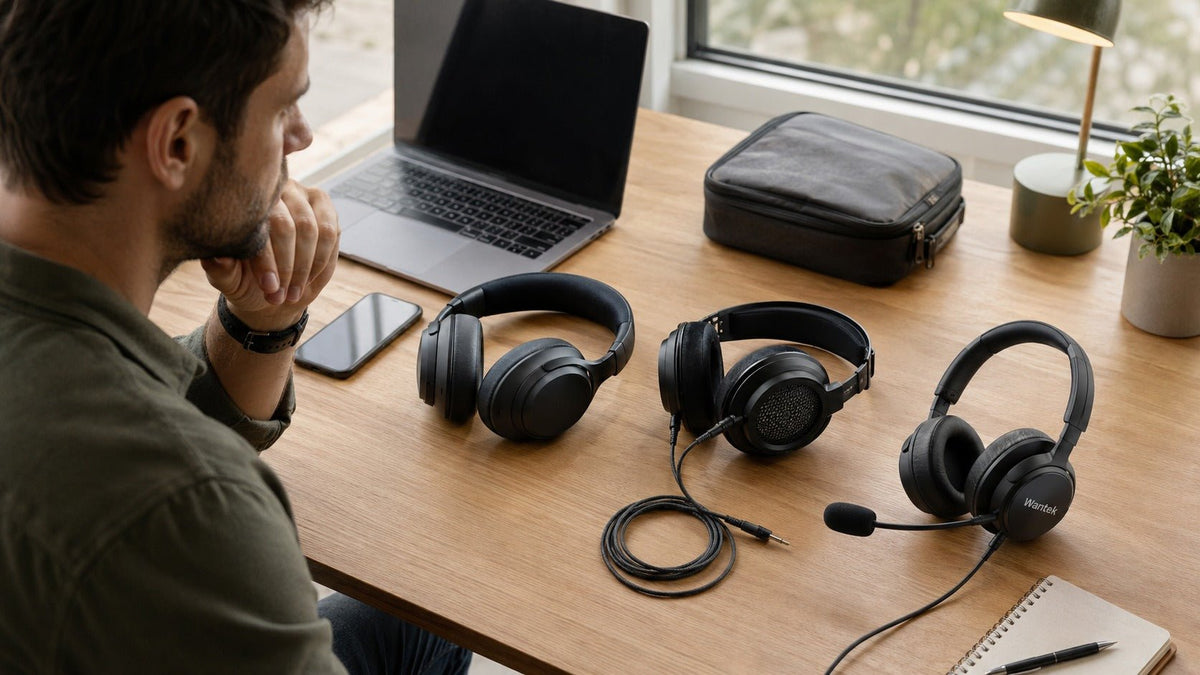
The best headphones under $200 are not one universal model. A commuter may need ANC and wireless battery life, a desktop listener may prefer a wired open-back or planar design, and someone who spends the day on calls may be better served by a dedicated headset with a positioned microphone and physical controls.
This guide compares current sub-$200 options by use case rather than pretending that one product wins every category. It is a specification-based comparison, not a hands-on laboratory ranking. Prices and availability were checked against manufacturer pages on September 10, 2026 and can change.
If you already know you want a full-size over-ear design, use our best over-ear headphones under $200 guide. This page stays broader: wireless ANC, wired studio use, planar desktop listening, and lower-cost Wantek options all belong to different decision paths.

Quick comparison: headphones under $200 by use case
Use the table to narrow the category first. “Consider it for” describes the role each product can fill based on its documented design and features; it is not a measured performance award.
| Model | Consider it for | Type | Documented highlights | Price status |
|---|---|---|---|---|
| Sony WH-CH720N | Everyday wireless ANC | Wireless over-ear | Noise cancelling, multipoint, up to 35-hour Bluetooth playback | Official US price below $200 when checked |
| Sennheiser ACCENTUM Wireless | Hybrid ANC and aptX HD | Wireless around-ear | Hybrid ANC, SBC/AAC/aptX/aptX HD, up to 50 hours with ANC | $189.95 on Sennheiser US |
| soundcore Space Q45 | Feature-rich wireless travel | Wireless over-ear | Adaptive ANC, LDAC, multipoint, 50 hours ANC / 65 hours standard | $149.99 |
| Audio-Technica ATH-M50x | Wired studio and personal listening | Wired closed-back | 45 mm drivers, detachable cables, 38-ohm impedance, collapsible design | From $159 |
| HiFiMAN HE400se | Entry-level planar desktop listening | Wired open-back planar magnetic | Planar magnetic design, open-back construction, 91 dB sensitivity | $109 on HiFiMAN product page |
| Wantek T3 | Lower-cost ANC and transparency mode | Wireless over-ear | ANC, transparency mode, Bluetooth 5.3, inline mic, up to 60-hour battery | $35 |
Start with the job the headphones need to do
For commuting and travel: prioritize noise control, battery, and portability
Wireless ANC models make the most sense when your listening environment changes throughout the day. Compare the ANC design, transparency or ambient mode if available, battery life under the mode you actually use, and whether you need multipoint for a laptop-and-phone workflow.
Do not compare battery claims without checking conditions. A 65-hour ANC-off figure is not directly comparable with a 35-hour figure measured under a different codec, volume, or processing state.
For desktop listening: decide whether you want closed-back or open-back
Closed-back headphones generally provide more physical isolation and reduce sound leakage, making them easier to use around other people. Open-back headphones intentionally allow more acoustic interaction with the surrounding space and typically leak more sound, so they are better suited to quiet rooms.
For wired headphones, check the source connector, impedance, sensitivity, cable length, and whether your device can reach a clean listening level. Do not assume that every wired model needs a separate amplifier, and do not assume that a low impedance guarantees adequate volume from every source.
For work calls: compare microphone workflow before music features
If most of your day is spent in Teams, Zoom, softphone, or customer-service calls, a consumer music headphone may not be the best use of the full $200 budget. Boom-microphone placement, mute controls, connection stability, and compatibility with the actual computer or phone can matter more than LDAC, planar drivers, or premium ANC.
Wantek’s office range is built around those communication tasks. If calls are your main priority, use the USB headset with microphone guide rather than treating every music-oriented headphone as a work headset.
Six current options in more detail
Sony WH-CH720N: everyday wireless ANC with multipoint
Sony’s WH-CH720N product page documents noise cancellation and multipoint connection. Sony lists up to 35 hours of Bluetooth music playback under stated conditions, including AAC with DSEE turned off.
Consider it if your priorities are wireless ANC, two-device pairing, and a mainstream everyday design. Sony’s US pricing was below $200 when checked, but sale pricing on the site can vary, so verify the live price before buying.
Sennheiser ACCENTUM Wireless: hybrid ANC with aptX HD
Sennheiser’s ACCENTUM Wireless is listed at $189.95 on its US store. The current specification page lists Bluetooth 5.2, SBC, AAC, aptX and aptX HD, hybrid ANC, 222 g weight, and up to 50 hours of Bluetooth music playback with ANC under the manufacturer’s stated test condition.
Consider it if codec support and a long ANC-on battery claim matter to you. aptX HD is only relevant when the source device also supports it, and the codec label by itself does not prove superior sound quality.
soundcore Space Q45: adaptive ANC, LDAC, and multipoint
The soundcore Space Q45 is listed at $149.99. soundcore documents adaptive ANC, LDAC, multipoint, app EQ, up to 50 hours of playtime with ANC and up to 65 hours in standard mode.
This is a strong feature-comparison candidate when you want ANC, app control, and multipoint in one wireless model. Note that soundcore states LDAC is disabled while multipoint is in use, so do not assume every headline wireless feature operates at the same time.
Audio-Technica ATH-M50x: wired closed-back studio option
The Audio-Technica ATH-M50x starts at $159. Audio-Technica specifies a closed-back circumaural design, 45 mm drivers, 38-ohm impedance, 285 g weight without cable and connector, a collapsible structure, and three detachable cables.
It belongs in a different decision path from wireless ANC models. Choose it when wired tracking, mixing, DJ monitoring, or personal listening fits your setup and you do not need Bluetooth battery life or ANC.
HiFiMAN HE400se: entry-level planar magnetic listening
HiFiMAN currently lists the HE400se at $109. The model uses an open-back planar magnetic design and is rated at 91 dB sensitivity. HiFiMAN’s current product page and manuals show slightly different impedance and weight figures across versions, so buyers should confirm the exact current version rather than carrying one number across every HE400se listing.
Consider it if you specifically want to try a planar magnetic open-back headphone at a relatively accessible price. Because it is open-back, it is a poor fit for commuting or shared spaces where isolation and low sound leakage matter.
Wantek T3: lower-cost ANC and transparency mode
The Wantek T3 is currently listed at $35. Wantek specifies an over-ear Bluetooth 5.3 design with active noise cancellation, transparency mode, an inline microphone, up to 60 hours of battery life, and an approximate 2 to 2.5 hour charge time.
Consider it when a low purchase price, ANC, transparency mode, and wireless over-ear form factor match your priorities. Those specifications do not establish that the T3 outperforms the Sony, Sennheiser, soundcore, Audio-Technica, or HiFiMAN models in sound, ANC, comfort, or microphone quality.
Specifications that matter—and ones that are easy to misuse
Bluetooth version is not a quality score
Bluetooth 5.2, 5.3, or a newer version does not automatically prove better sound, lower latency, LE Audio, Auracast, multipoint, or a specific codec. Verify the actual profiles and features supported by both the headphones and the source device.
Codec support has to match the source
LDAC, aptX, aptX HD, AAC, and SBC describe different Bluetooth audio options. A codec can only be used when the source and headphones support the same mode. Even then, codec support is only one part of the listening chain; tuning, fit, DSP, and recording quality still matter.
ANC and passive isolation solve different problems
ANC uses microphones and processing to reduce some external noise heard through the headphones. Passive isolation depends on the physical design and seal. Open-back headphones intentionally provide little isolation, so comparing them directly with travel-focused ANC headphones misses the purpose of each design.
Driver size does not determine sound quality
A larger driver diameter is not an automatic sound-quality upgrade. Driver technology, enclosure design, diaphragm behavior, damping, tuning, fit, and DSP all contribute to the result. Treat driver size as a specification, not a ranking system.

Why the Sennheiser HD 560S is no longer a main under-$200 pick here
An older version of this Wantek guide included the Sennheiser HD 560S as a sub-$200 wired reference option. That no longer matches the current US manufacturer price: Sennheiser lists the HD 560S at $279.95 when checked on September 10, 2026.
The model can still appear below $200 during third-party sales, but this guide does not rely on temporary reseller pricing to keep a product inside the budget ceiling. The ATH-M50x and HE400se now provide cleaner current manufacturer-price examples for wired listening under $200.
Frequently asked questions
What are good wireless headphones under $200?
Sony WH-CH720N, Sennheiser ACCENTUM Wireless, and soundcore Space Q45 are current sub-$200 manufacturer-listed options with different combinations of ANC, battery life, codecs, and multipoint.
Are wired headphones still worth considering under $200?
Yes. Wired models avoid battery charging and Bluetooth pairing. They can be a better fit for studio, desktop, or monitoring use when your source provides the required analog connection.
Do I need ANC under $200?
Only if reducing environmental noise is important to your use case. Quiet-room and open-back listening prioritize different traits, so ANC should not be treated as a universal requirement.
Is LDAC or aptX HD necessary?
No. These codecs matter only when both devices support them and when they fit your listening priorities. They do not guarantee that one headphone will sound better than another.
Do planar headphones under $200 need an amplifier?
Not automatically. Check the exact headphone sensitivity and impedance together with your source. Add amplification only when your existing device cannot provide clean, comfortable listening levels.
Should I spend the full $200 for work calls?
Not necessarily. For call-heavy work, connector compatibility, boom-mic placement, mute controls, and wearing style can matter more than spending the entire budget on consumer music features.

