
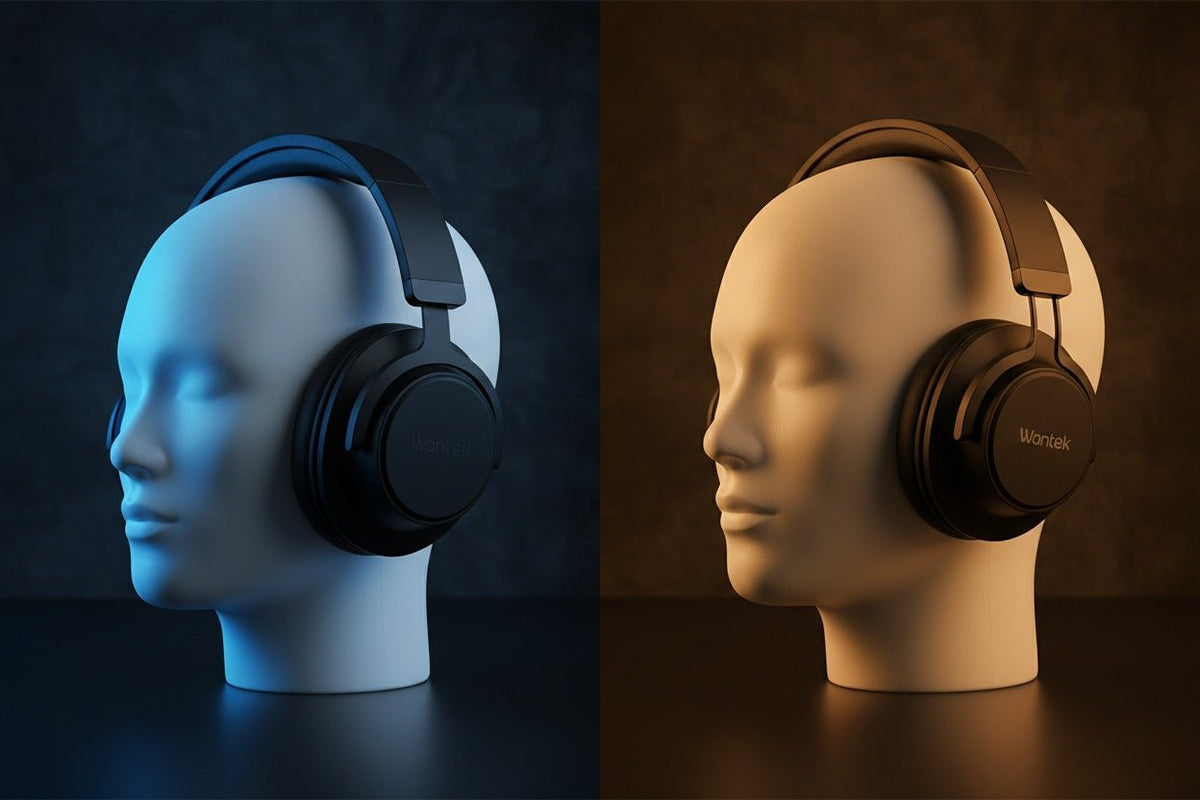
Over-ear headphones surround the outer ear; on-ear headphones rest directly on it. That simple fit difference affects comfort, heat, portability, and how consistently the earcups seal, but it does not make either design universally better for sound quality or noise cancellation.
Quick answer: choose over-ear if you usually value long-session comfort, stronger physical isolation, and an immersive fit more than compact size. Choose on-ear if a lighter, smaller headphone matters more and you are comfortable with pads pressing on the outer ear. For either type, compare the exact model’s tuning, clamp, pad dimensions, leakage, ANC, microphone, battery life, and connection features.

Over-Ear vs On-Ear Headphones at a Glance
| Factor | Over-Ear | On-Ear |
|---|---|---|
| Fit | Earcups are intended to surround the outer ear. | Pads rest directly on the outer ear. |
| Long-session comfort | Often easier on the ear itself, but weight and heat can become limiting. | Usually lighter, but direct pad pressure can become uncomfortable for some listeners. |
| Portability | Usually bulkier because of larger earcups. | Usually smaller and easier to pack. |
| Passive isolation | Often more consistent in closed-back designs when the pads seal well. | More dependent on pad contact and ear shape; often less isolating. |
| Heat | Can trap more warmth around the ear. | Often leaves more area around the ear exposed. |
| Sound quality | Neither form factor guarantees better sound. Tuning, enclosure, driver implementation, fit, seal, and the complete acoustic design matter more. | |
If you are still deciding among over-ear, on-ear, in-ear, and open-ear designs, Wantek’s guide to the main headphone types separates fit from enclosure, connection, and noise-control features.
What Is the Physical Difference?
Over-ear, also called circumaural, describes earcups large enough to surround the outer ear and rest on the area around it. On-ear, also called supra-aural, describes pads that sit on the pinna—the visible outer ear.

Those labels describe where the pads sit, not whether the headphone is open-back or closed-back, wired or wireless, or equipped with ANC. An open-back over-ear model, for example, can leak far more sound than a well-sealed closed-back on-ear model.
Comfort: Pressure Around the Ear vs Pressure on the Ear
Over-ear headphones often distribute contact around the ear instead of directly on it. That can make them comfortable for long desk, travel, gaming, or listening sessions when the earcups are deep enough and the headband distributes weight well. The trade-off is more material around the ear, which can increase warmth.
On-ear headphones usually reduce bulk and weight, but the pads press directly against the outer ear. Some listeners prefer that lighter feel; others notice soreness sooner. Glasses can also change comfort and seal for either design because the temples sit between the head and the pads.
There is no universal comfort winner. Clamp force, pad softness, earcup depth, total weight, head shape, ear size, glasses, and session length all change the result. Independent testing from RTINGS’ over-ear vs on-ear comparison reaches the same practical conclusion: over-ear designs tend to spread pressure more broadly, while on-ear models tend to be smaller and more breathable.
Noise Isolation and ANC
Closed-back over-ear headphones often have an advantage in passive isolation because the pads can form a larger boundary around the ear. But isolation is still model- and fit-dependent. Hair, glasses, worn pads, head shape, and pad geometry can weaken the seal.
Active noise cancellation is also a product-level feature, not an automatic benefit of the over-ear category. A well-designed ANC system can reduce steady ambient sounds such as engine or HVAC noise, but the result depends on the microphones, processing, fit, frequency, and environment.
Do not treat “over-ear” as shorthand for “noise-canceling.” Open-back over-ear headphones are intentionally vented and usually provide little isolation, while ANC can also appear in on-ear and in-ear products.
Sound Quality: Form Factor Is Not a Fidelity Rating
Over-ear headphones provide more physical space for pads, drivers, damping, and acoustic structures, which gives designers different engineering options. That does not mean a larger earcup or driver automatically produces deeper bass, a wider soundstage, lower distortion, or more accurate sound.
On-ear headphones can also be tuned very well. The more useful comparison is between the exact models: frequency response, distortion, channel matching, seal consistency, enclosure type, and how the headphones fit your head. Form factor sets constraints; implementation determines the outcome.
Portability, Heat, and Everyday Use
On-ear headphones usually win on packed size because the earcups can be smaller. That can matter for commuters, students, travelers, and anyone carrying headphones in a small bag. Many on-ear models also expose more of the area around the ear, which can feel cooler.
Over-ear models are typically bulkier, although folding hinges, rotating cups, and compact cases can reduce the difference. Their larger pads may be preferable at a desk or on a flight, but they can feel warm during active use or in hot environments.
Which Is Better for Travel, Work, Home, and Exercise?
Travel and Commuting
Closed-back over-ear headphones with effective ANC are a strong starting point when reducing continuous cabin or vehicle noise matters more than bag space. If portability is the priority, a compact on-ear model may be easier to carry, but compare its actual isolation and leakage rather than assuming the category performs a certain way.

Office and Remote Work
For focused desk work, an over-ear fit may be attractive if you value isolation and long-session comfort. For communication-heavy work, microphone quality, mute controls, device compatibility, sidetone, and connection reliability can matter more than earcup size.
Home Listening and Gaming
Over-ear models dominate many home, studio, and gaming categories because their size accommodates a wide range of open- and closed-back designs. That is a market-design pattern, not proof that every over-ear model sounds better. Compare the exact headphone and, for gaming, include microphone and platform compatibility.
Gym and Running
Neither headband style should be assumed to be exercise-ready. Check the manufacturer’s stated sweat or water resistance, fit security, cleanability, and warranty conditions. For outdoor activity, environmental awareness also matters. Earbuds or open-ear designs may be more practical when low weight and secure movement are priorities.
Battery Life and Wireless Features
Do not choose between over-ear and on-ear based on an assumed battery-life range. Physical size can give designers more room for a battery, but real runtime varies by cell capacity, amplifier efficiency, ANC use, codec, volume, call time, and power-management software.
Likewise, Bluetooth version, multipoint, codec support, transparency mode, app EQ, wear detection, and microphone features can appear in either form factor. Verify these on the individual model and on the source devices you plan to use.
How to Choose Between Over-Ear and On-Ear Headphones
Start with your longest normal listening session
If you regularly wear headphones for several hours, prioritize actual fit, ear clearance, clamp, heat, and weight before advanced features.
Decide how much portability matters
If the headphones must fit into a small daily bag, compare folded dimensions and case size. On-ear designs usually have the advantage here.
Match isolation to the environment
For flights, trains, or noisy offices, compare measured isolation and ANC. For shared or outdoor environments, consider how much outside sound you need to hear.
Compare the exact models last
Once the fit category is right, compare sound, microphone, battery life, controls, repairability, connection support, warranty, and price. Wantek’s headphone buying framework covers those model-level checks.
One More Factor: Safe Listening
Hearing risk depends on sound level and exposure time, not whether the pads sit around or on the ear. In noisy places, good fit and effective noise control can make it easier to listen without turning the volume up as far. The World Health Organization’s safe-listening guidance recommends controlling both volume and listening duration.
Choosing a Headset for Work Calls?
If your real decision is about meetings, customer calls, or device compatibility, start with the device and connection instead of choosing by earcup size alone.
Frequently Asked Questions
Are over-ear headphones more comfortable than on-ear headphones?
Often, but not always. Over-ear pads avoid direct pressure on the outer ear, while on-ear models are usually lighter. Clamp force, heat, pad depth, glasses, ear size, and head shape can change the result.
Do over-ear headphones sound better?
Not automatically. Over-ear designs offer more physical space, but tuning, enclosure, driver implementation, seal, distortion, and fit determine sound quality. A well-designed on-ear model can outperform a poorly designed over-ear model.
Which type blocks more outside noise?
Closed-back over-ear headphones often isolate more consistently because the pads surround the ear, but fit and construction matter. ANC performance must be compared on the exact model rather than inferred from form factor.
Are on-ear headphones better for commuting?
They can be easier to carry because they are usually smaller. If your commute is noisy, compare actual isolation, leakage, ANC, case size, and comfort before prioritizing portability alone.
Which is better for glasses?
Neither is guaranteed to be better. Glasses can create pressure points and alter the pad seal in both designs. Try the headphones with your usual frames and check comfort after a normal-length session.
Are over-ear headphones better for the gym?
Not by default. Check secure fit, manufacturer-stated sweat or water resistance, pad cleanability, and environmental awareness. For vigorous movement, smaller earbuds or open-ear designs may be more practical.

