
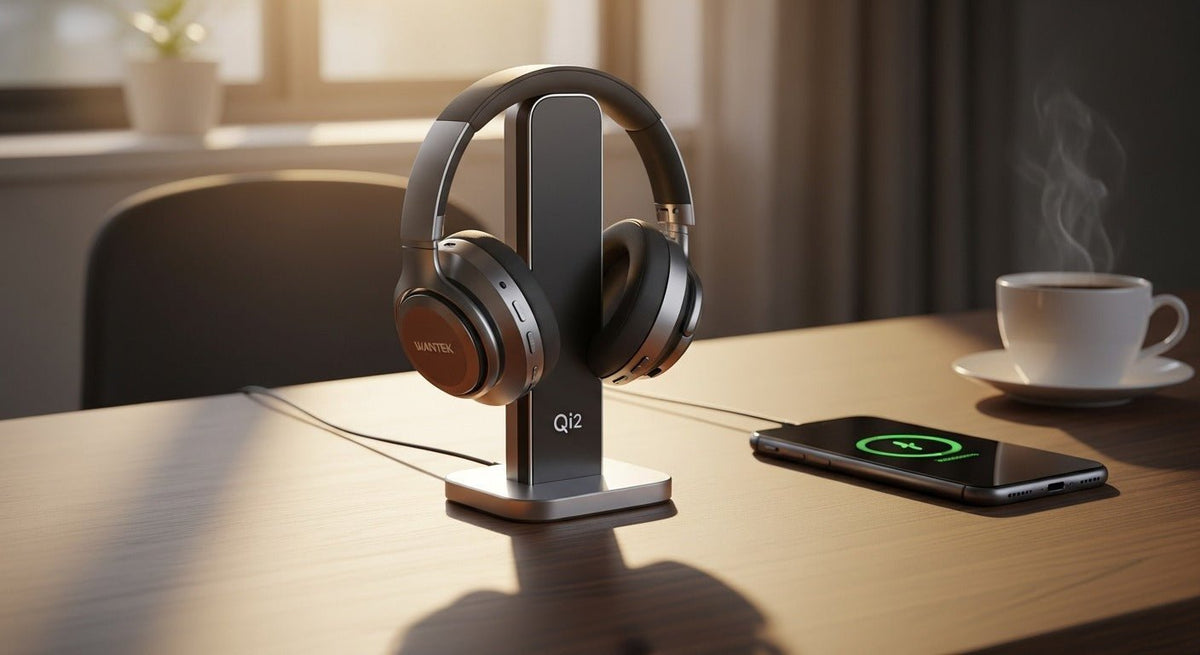
Noise-cancelling headphone features matter only when they solve the problem you actually have. Active noise cancellation can reduce some outside sound for the listener, but ANC strength, microphone quality, transparency mode, multipoint, battery life, codecs, spatial audio, and repairability are separate capabilities. A better buying decision starts by separating those functions instead of treating every premium label as one package.
Quick answer: Start with ANC performance and fit, then check transparency mode, battery life in the mode you will use, microphone behavior, and device switching. Treat spatial audio, advanced codecs, personalized sound, and repairability as secondary features unless they directly match your workflow.

Feature availability is model-specific. A product image, Bluetooth version, charging connector, or marketing term does not prove support for Qi/Qi2 charging, multipoint, adaptive ANC, spatial audio, or any other separate feature. Verify the exact product specifications.
1. Active Noise Cancellation: The Core Feature
Active noise cancellation uses microphones and signal processing to detect unwanted sound and generate an opposing signal that reduces some of what reaches your ears. It is particularly useful against steady, repetitive low-frequency noise such as engine or air-conditioning hum. It is generally less effective against irregular higher-frequency sounds such as nearby speech.
Sennheiser's ANC explanation also notes that performance varies by model and by how well the headphones fit. That is why an ANC label alone is not enough to compare two products.
Passive isolation still matters
ANC and passive isolation do different jobs. Passive isolation comes from the physical seal created by ear cups or ear tips. A poor seal can reduce the effectiveness of the overall noise-control system, while good isolation can help even when ANC is turned off.
If you are shopping for work calls, keep listener-side ANC separate from microphone noise reduction. Wantek's noise-cancelling headset guide for work explains why reducing the noise you hear is not the same as reducing the noise other people hear through your microphone.
2. Adaptive ANC and Transparency Mode
Adaptive ANC changes the amount or behavior of noise control based on conditions detected by the headphones. Transparency, ambient, or hear-through modes do the opposite job: they use microphones to let more outside sound reach you without requiring you to remove the headphones.
These features are not universal and they are not identical across brands. For example, Apple's current listening-mode documentation distinguishes Active Noise Cancellation, Transparency mode, and Adaptive Audio as separate modes on supported AirPods models.

Processor labels are not performance scores. A dedicated chip, an "AI" label, or a larger microphone count can describe an implementation, but none of those specifications alone proves stronger ANC or clearer calls.
3. Battery Life and Charging: Compare the Exact Operating Mode
Battery claims need context. ANC on or off, transparency mode, call time versus music playback, codec choice, volume level, and other features can change runtime. Compare the figure for the operating mode you actually expect to use rather than assuming one headline battery number applies in every situation.
Charging is equally model-specific. USB-C charging is common, but wired USB audio, fast charging, wireless charging, and Qi/Qi2 support are separate capabilities. If a charging feature matters, confirm it in the product documentation instead of inferring it from the connector or the shape of a stand.
4. Multipoint and Device Switching
Multipoint is valuable when you regularly use a laptop and phone with the same headphones. On supported models, it can keep two source devices connected and make switching easier than manually disconnecting and reconnecting Bluetooth each time.
But "Bluetooth" does not automatically mean "multipoint." Sony's multipoint support documentation explicitly treats simultaneous two-device connection as a feature that must be supported and enabled on compatible headphones.
5. Microphone Quality Is a Separate Buying Decision
Headphone ANC is designed primarily around what the wearer hears. Call quality depends on a different chain: microphone placement, microphone-array design, signal processing, wind handling, the connected device, and the calling application.
That distinction matters for hybrid work. A premium listening headphone can have strong ANC yet still be a weaker choice for calls than a business headset with a well-positioned boom microphone and reliable mute controls. The number of microphones by itself is not a call-quality verdict.
6. Bluetooth Codecs and LE Audio
Codec support affects how Bluetooth audio is encoded and transmitted, but the headphone and source device both need to support the same option for you to use it. A codec label also does not replace the basics: fit, tuning, ANC performance, connection reliability, and microphone behavior still matter.
Bluetooth LE Audio introduces the LC3 codec. The Bluetooth SIG's LC3 specification defines LC3 as an efficient codec for speech and music applications. Support for LE Audio or LC3 should still be verified on the exact headphones and source device rather than inferred from the Bluetooth version number alone.
7. Spatial Audio, Head Tracking, and Personalized Sound
Spatial audio and head tracking can change how compatible movies, games, or music are rendered, while personalized EQ or hearing profiles can change tuning for an individual listener. These can be useful features, but they are not measures of ANC strength.
When these features matter, check three things: whether the headphones support them, whether your phone or computer supports them, and whether the specific app or content format uses them. Ecosystem compatibility can be more important than the feature name printed on the box.
8. Repairability, Replaceable Parts, and Long-Term Ownership
Replaceable ear pads, an available battery service path, firmware support, and access to replacement parts can matter more over several years than a rarely used software mode. Do not assume that removable ear cushions mean the battery is user-replaceable, or that a modular-looking design means official repair parts are available.

Repairability should be verified, not inferred. Check the manufacturer's parts, service, warranty, and battery-replacement documentation for the exact model. Concept imagery is not evidence that a product is modular or user-repairable.
Which Noise-Cancelling Headphone Features Matter Most?
| Use case | Prioritize first | Then verify |
|---|---|---|
| Flights and transit | Effective ANC, comfortable seal, battery life with ANC on | Transparency mode, portability, wired fallback if needed |
| Office focus | ANC plus passive isolation, comfort over long sessions | Multipoint, app controls, transparency mode |
| Calls and meetings | Microphone behavior, mute controls, connection path | ANC for the wearer, platform compatibility, multipoint |
| Music and movies | Sound tuning, fit, ANC performance | Codec support, spatial audio, EQ and personalization |
| Long-term ownership | Comfort, build, replaceable wear parts | Battery service, firmware support, replacement-part availability |
A Practical Buying Checklist
Define the noise problem.
Decide whether you mainly need less engine rumble, less office distraction, better calls, or a mixture. Those are different requirements.
Verify the exact feature, not the category label.
Check whether the model actually supports adaptive ANC, transparency, multipoint, the codec you need, and the charging method you expect.
Compare battery figures under matching conditions.
Use ANC-on playback or talk-time figures when those modes match your real use. Do not compare unlike battery measurements as if they were equivalent.
Check fit and comfort before chasing optional features.
Seal affects isolation and ANC, while clamp, weight, pad heat, and ear-cup depth determine whether you will actually wear the headphones for long sessions.
Use independent tests for performance claims.
Manufacturer specifications can confirm that a feature exists. Independent measurements and repeatable call or ANC tests are more useful when comparing how well two implementations perform.
Safe Listening Still Depends on Level and Time
Noise cancellation can make it easier to hear content without fighting background noise, but it does not make high playback levels harmless. The World Health Organization's safe-listening guidance emphasizes both sound level and exposure duration and specifically recommends well-fitted, noise-cancelling headphones as one way to reduce the need to raise volume in noisy places.
Bottom Line
The most useful noise-cancelling headphone features are not the ones with the newest names. Start with measurable needs: how much unwanted sound you want to reduce, how long you wear the headphones, whether calls matter, and which devices you switch between.
For most buyers, ANC performance, fit, transparency mode, mode-specific battery life, microphone behavior, and multipoint deserve more attention than spatial audio, processor branding, or generic "AI" claims. Optional features become valuable only when they fit a real use case and work with your devices.
See a Wantek ANC Option
Wantek T3 is the current Wantek over-ear model with documented ANC, transparency mode, Bluetooth 5.3, an inline microphone, and up to 60 hours of listed battery life. Check the product page for the exact specification before buying.
Frequently Asked Questions
What is the difference between ANC and adaptive ANC?
ANC electronically reduces selected outside sound. Adaptive ANC changes the cancellation behavior automatically based on conditions or fit. The exact inputs and adjustment range depend on the headphone model.
What is transparency mode?
Transparency or ambient mode uses the headphones' microphones to pass more outside sound to the listener. It is useful when you need awareness or a quick conversation without removing the headphones.
Does a higher microphone count mean better ANC or calls?
No. Microphone count describes part of the hardware design, not overall performance. Placement, acoustic design, signal processing, fit, wind handling, and software can all affect the result.
Is Bluetooth multipoint the same as pairing multiple devices?
No. Many headphones can remember several paired devices, while multipoint specifically allows supported models to maintain simultaneous connections to more than one source. Check the model's documented behavior.
Do I need spatial audio in noise-cancelling headphones?
Not for noise cancellation itself. Spatial audio is a separate playback feature for compatible content and devices. Prioritize it only when you regularly use media or apps that support it.

