
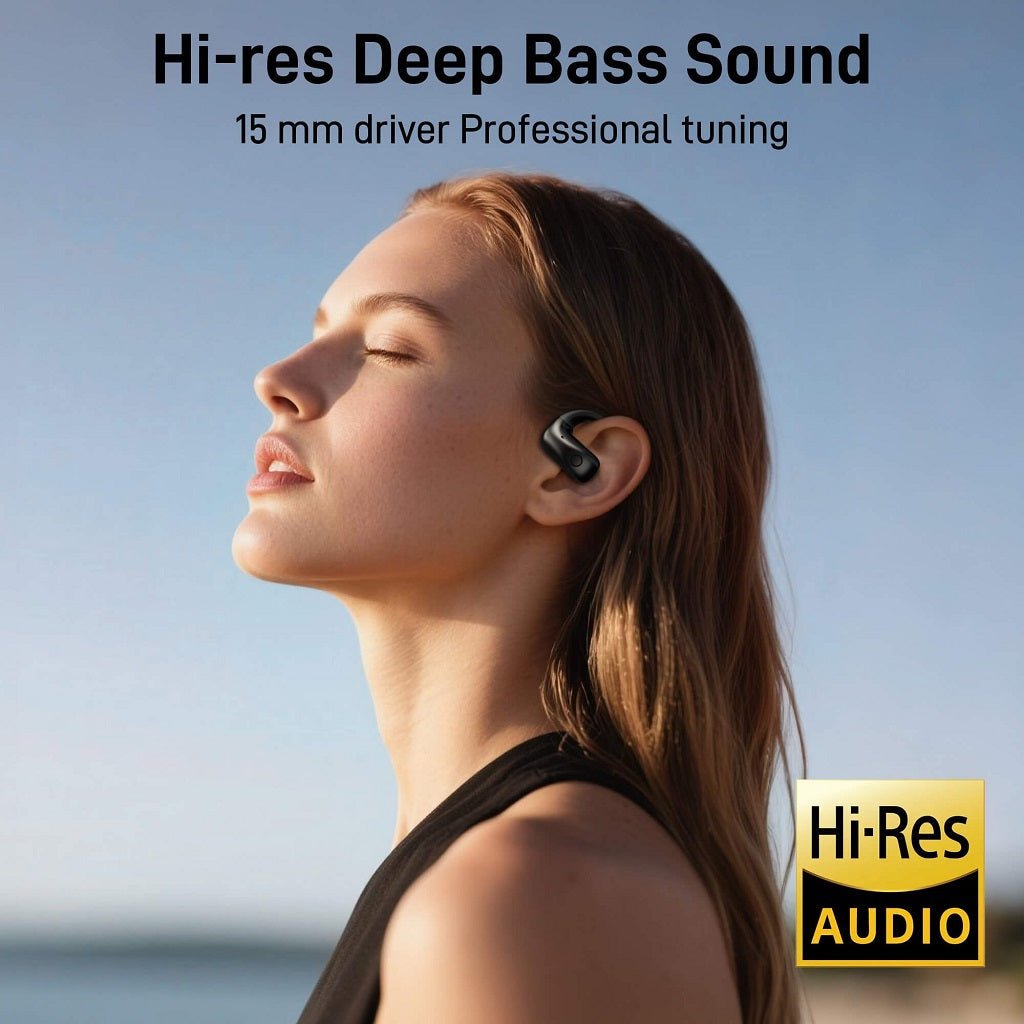
Wireless clip-on headphones use a clip around the outer ear for support and connect without an audio cable. Many current models are open-ear Bluetooth earbuds, but “clip-on” describes the fit: check where the speaker sits rather than assuming every clip leaves the ear canal open.

Quick answer: judge ear-clip headphones by clip pressure, speaker position, stability, battery, controls, microphone needs, and water resistance. If keeping the ear canal open matters, confirm that the speaker actually sits outside the canal.
Ear-clip, ear-hook, and in-ear are different
| Design | How it sits | Main tradeoff |
|---|---|---|
| Open-ear clip | Clips around part of the outer ear with the speaker outside the canal. | No sealed tip, but fit depends strongly on ear shape. |
| Ear-hook earbud | A hook wraps around the ear while the earbud may sit in the canal. | More retention, but the tip and hook both need to fit. |
| Conventional earbud | Relies mainly on the ear canal or concha for support. | Compact, but may loosen during movement for some users. |
Wireless vs. Bluetooth: what the terms mean
Bluetooth is one way to connect wirelessly; it is not an alternative to wireless. For clip-on headphones, confirm that the exact model supports your phone, tablet, or computer. A Bluetooth version number alone does not establish multipoint, low latency, microphone quality, or compatibility with every calling app.
Fit is the first buying test
Clip pressure needs to be strong enough to stay stable without creating soreness. Ear shape varies, so a design that works well for one person may pinch or move on another. Check whether the clip interferes with glasses, earrings, hats, or helmet straps. Try head turns and a short walk, and check for soreness after a longer session. For other wearing styles, see our ear clip headphone types and fit guide.
Open-ear sound changes the use case
An open-ear design does not form the same seal as an in-ear earbud. That can leave more surrounding sound audible, which some users prefer for walking, commuting, or exercise. It also means you should not expect the same passive isolation as a sealed in-ear design. Background noise can mask music or speech, and nearby people may hear sound leakage in a quiet room. Neither an open ear canal nor a secure clip guarantees that you will notice hazards.
Battery numbers need two separate checks
Small clip-on earbuds often publish one figure for listening on a single charge and a larger total that includes recharging from the case. Keep those numbers separate when comparing products. Use single-charge runtime to plan an uninterrupted session, and check the manufacturer’s test conditions: volume, calls, and listening modes can affect battery life.
Water resistance matters for workouts
For running or gym use, check the exact manufacturer water or sweat-resistance claim. An IP rating applies under defined test conditions and does not automatically mean the device is suitable for swimming or prolonged liquid exposure. Check whether the rating covers the earbuds, the case, or both. For route-specific fit and awareness checks, see our running headphone buying guide.
Controls and microphones
Touch controls can be convenient but may be harder to use while moving or wearing gloves. Physical controls can reduce accidental taps on some designs. Built-in microphones can support casual calls, but outdoor wind and traffic can make voice pickup more difficult.
If you switch between a phone and laptop, look for an explicit multipoint or two-device connection statement. Microphone noise reduction changes the voice sent to the caller; it does not establish active noise cancellation for the sound you hear.
Compare a current open-ear clip-on option
Wantek OBT030 uses an open-ear clip-on design with Bluetooth 5.4, a built-in microphone, an 8-hour listed battery life, and up to 50 hours total with the charging case. These are manufacturer claims; actual battery life varies with use. The current product page does not specify an IP rating or multipoint support, so verify those features if they are essential. Check current price and availability before ordering.
Clip-on does not mean bone conduction
Open-ear describes an unsealed ear canal, not one sound-delivery technology. Small speakers outside the canal use air conduction; bone-conduction transducers transmit vibrations through contact with the side of the head. A cuff or clip shape alone does not establish which technology a model uses.
For a shortlist of cuff-style wireless models and their published specifications, see our ear cuff headphone comparison.
Keep listening level in mind
An open design does not make loud listening safe. WHO’s safe-listening guidance explains that both sound level and listening duration matter. In noisy places, take a break or move somewhere quieter rather than continually raising the volume.
Frequently asked questions
Are all ear-clip headphones open-ear?
No. Clip-on describes the support method. Check whether the speaker stays outside the ear canal or whether the product still uses an in-ear tip.
Are ear clips good for running?
They can be, but stability, sweat resistance, ear shape, controls, and environmental awareness all matter. A clip alone does not guarantee a secure workout fit.
Can ear-clip headphones work with glasses?
Often, but comfort depends on the space behind and around the ear. Check whether the clip and glasses arm press against the same area.

