
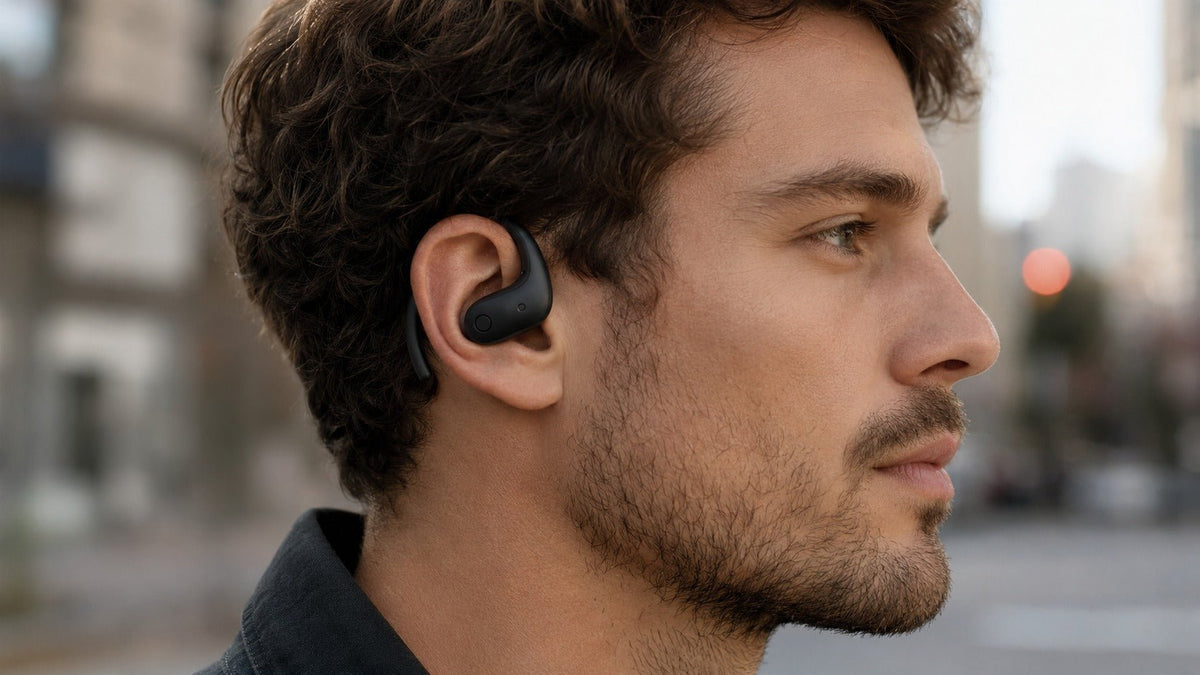
Ear cuff headphones are clip-on open-ear earbuds that hold a speaker near the ear canal without sealing it. The cuff or bridge grips the outer ear, so you can listen while environmental sound still reaches your ears. That makes the format useful for commuting, walking, casual work, and listeners who dislike in-ear tips.
The important distinction is that ear cuff does not automatically mean bone conduction. Most of the current cuff-style models in this guide use air-conduction speakers. Shokz, for example, explicitly describes its OpenDots 2 as an air-conduction product even though it also uses a bone-conduction microphone for calls.
Which clip-on earbuds should you consider? Start with fit: a cuff should rest securely on the outer ear without pinching or blocking the canal. For exercise, check movement and the exact water-resistance rating; for work calls, prioritize microphone performance in your own setting; for commuting, decide whether hearing your surroundings matters more than blocking noise.
This is a specification-based buying guide, not a hands-on ranking. The shortlist uses manufacturer information and separates documented features from editorial use-case suggestions.
What counts as ear cuff headphones?
Shopping pages use several overlapping names: ear cuff headphones, ear cuff earbuds, clip-on earbuds, and open-ear clip-on earbuds. This guide focuses on the open-ear cuff shape, where the speaker sits outside the ear canal. If you also want to compare in-ear hooks and older on-ear clips, see our ear clip headphones guide to types and fit.
| Design | Where it sits | Typical sound path | What to expect |
|---|---|---|---|
| Ear cuff / clip-on | Where it sits: Clamps or bridges around the outer ear | Typical sound path: Usually air conduction | What to expect: Open canal, compact two-piece cuff form |
| Open-ear ear hook | Where it sits: Hooks over or around the ear | Typical sound path: Usually air conduction | What to expect: More visible support around the ear |
| Bone-conduction headset | Where it sits: Transducers rest against the side of the head | Typical sound path: Bone conduction | What to expect: Often a neckband or behind-head frame |
| In-ear earbud | Where it sits: At or inside the ear canal | Typical sound path: Air conduction with a sealed or semi-sealed fit | What to expect: More isolation, but the canal is occupied |
A cuff-shaped product can still use microphones or sensors that rely on bone vibration. That does not make the speaker itself a bone-conduction transducer. When the distinction matters, check the manufacturer’s stated speaker technology instead of inferring it from the shape.
Six current ear cuff headphones to compare in 2026
There is no single best model for every ear. Fit pressure, ear shape, battery needs, device switching, water resistance, microphone use, and budget can change the answer. The table below is a shortlist based on published specifications, not measured sound or comfort scores.
| Model | Published fit / weight | Published battery | Multipoint | Water resistance |
|---|---|---|---|---|
| Wantek OBT030 | Fit / weight: Open-ear clip-on; 8.5 g | Battery: Up to 50 hours total with case | Multipoint: Not stated on current product page | Water resistance: Not stated on current product page |
| ambie AM-TW02 | Fit / weight: Sound earcuff; 4.4 g | Battery: About 6 hours; 24 hours with case | Multipoint: Yes | Water resistance: IPX5 earbuds |
| Bose Ultra Open Earbuds | Fit / weight: Cuff-shaped open-ear fit | Battery: Up to 7 hours with Immersive Audio off | Multipoint: Yes | Water resistance: IPX4 earbuds |
| Shokz OpenDots 2 | Fit / weight: Clip-on; 6.4 g ± 0.2 g | Battery: Up to 10 hours; 40 hours with case | Multipoint: Dual-device connection available through app settings | Water resistance: IP57 earbuds |
| Soundcore AeroClip | Fit / weight: Open-ear clip-on; 6.0 g | Battery: 8 hours; 32 hours with case | Multipoint: Yes | Water resistance: IP55 on current US product page |
| Sony LinkBuds Clip | Fit / weight: Open-air clip; about 0.23 oz each | Battery: Up to 9 hours music playback | Multipoint: Yes | Water resistance: IPX4 |
Wantek OBT030: a simple open-ear clip-on option
The Wantek OBT030 product page lists an open-ear clip-on design, 8.5 g weight, Bluetooth 5.4, and a built-in microphone. Its battery figures are different measures: 8 hours for the earbuds and up to 50 hours total when recharged from the case. It is positioned for workouts, commuting, casual calls, and everyday listening.
Its current product page does not establish multipoint or a water-resistance rating, so those features should not be assumed. If either one is essential, verify the exact product documentation before ordering.

ambie AM-TW02: a lightweight sound-earcuff design
ambie’s AM-TW02 specifications list 4.4 g per earbud, Bluetooth 5.3, about 6 hours of continuous playback, up to 24 hours with case charging, multipoint support, and IPX5 water resistance for the earbuds. The page lists SBC and AAC codecs.
This is the most literal “earcuff” design in the shortlist. It is useful if low earbud weight and a jewelry-like cuff form matter more than having the longest single-charge battery figure.
Bose Ultra Open Earbuds: cuff-shaped fit with multipoint
Bose describes the Ultra Open Earbuds as cuff-shaped open-ear earbuds with Bluetooth multipoint. Bose lists Bluetooth 5.3, IPX4 water resistance, no active noise cancelling, and up to 7 hours of battery life with Immersive Audio off.
These specifications refer to the original Ultra Open Earbuds. Bose also introduced Ultra Open Earbuds (2nd Gen) in 2026, with up to 9 hours of playback and a revised charging case. Check the generation before comparing battery figures. Neither version should be chosen for active noise cancellation: the open design does not provide ANC.
Shokz OpenDots 2: longer single-charge battery and IP57
Shokz’s current OpenDots 2 page lists a 6.4 g clip-on design, up to 10 hours per charge and 40 hours with the case, wireless charging, and IP57 water resistance. Shokz also says the speaker system uses air conduction rather than bone conduction.
Compare OpenDots 2 if you care about 10-hour single-charge playback, the stated IP57 rating, and switching between two devices. Shokz uses bone conduction for one microphone, not for music playback: its speaker system is air conduction.
Soundcore AeroClip: a feature-rich 6 g clip-on
Soundcore’s current US AeroClip page lists a 6.0 g clip-on design, Bluetooth 5.4, 8 hours of playback, 32 hours with the case, multipoint connection, and an IP55 rating.
That makes it worth comparing if you want multipoint and a relatively light clip without moving to a neckband. As with every open design, published driver size or processing features do not establish how it will fit your ear or sound in a noisy environment.
Sony LinkBuds Clip: multipoint and up to nine hours of playback
Sony’s WF-LC900 specifications list an open-air design, Bluetooth 5.3, multipoint, IPX4 water resistance, and up to 9 hours of continuous music playback. Sony lists SBC and AAC as supported audio formats.
Consider it if you want a current Sony clip-on model and multipoint is part of your device workflow. Its published IPX4 rating is suitable for splashes under the rating’s conditions, not a claim that the earbuds are designed for swimming.
How to choose ear cuff headphones
Start with fit pressure and ear shape
Clip-on earbuds solve the ear-canal problem by moving the contact point to the outer ear, but that creates a different fit question: where does the bridge press, and does the speaker stay aligned with your ear opening? A model can be light and still feel uncomfortable if its clamp geometry does not suit your ear.
Prioritize a return path or a chance to try the product. Check whether glasses, earrings, hats, or hair interfere with the bridge. For exercise, test walking, head turns, and light jogging before assuming a secure fit from the product shape alone.

Compare battery numbers on the same basis
Do not compare a single-charge figure from one model with a case-total figure from another. A model advertised for 40 or 50 total hours may still need to return to its case after a much shorter listening session. Also check whether spatial-audio modes, call use, high volume, or other features change the published runtime.
Decide whether multipoint matters
If you switch between a laptop and phone, look for an explicit two-device or multipoint statement. Bluetooth version alone does not establish simultaneous connections. This is one reason a blanket rule such as “Bluetooth 6.0 is required” is not useful: current cuff models span multiple Bluetooth generations while offering different connection features.
Read the IP rating literally
Water-resistance numbers are model-specific. An IPX4 or IPX5 earbud should not be treated as a swimming headset simply because the design leaves the ear canal open. Also check whether the rating applies to the earbuds, the charging case, or both.
Check call needs separately from music
A built-in microphone confirms that calls are possible; it does not prove strong voice pickup in traffic, wind, or an open office. If calls matter, make a short test recording in the environment where you actually plan to use the earbuds and check microphone routing on your phone or laptop.
Open-ear trade-offs to expect
Clip-on earbuds leave the ear canal unsealed. You can hear nearby sounds, but you also get less passive isolation than with sealed in-ear earbuds. Bass and sound leakage can depend on the design, ear shape, listening volume, and surroundings; SoundGuys’ clip-on earbud comparison discusses these trade-offs. Do not treat a published driver size as a promise of sound quality on your own ears.
If you mainly listen on planes, trains, or in a loud office and want to suppress background noise, a sealed ANC earbud or over-ear ANC headphone may be the better category. If hearing nearby speech, announcements, or traffic is more important, the open cuff format may fit the task better.
Open-ear does not make high-volume listening automatically safer. WHO’s safe-listening guidance emphasizes both sound level and listening duration. In a loud environment, avoid compensating for the open design by continually raising the volume.
Ear cuffs vs. bone conduction: choose by the job
Use a clip-on ear cuff when you want a small true-wireless form, an open ear canal, and no neckband. Use bone conduction when you specifically want transducers that transmit vibration through the side of the head, often in a sports-oriented behind-head frame. Use an open-ear ear-hook design when you want more physical support around the ear.
Do not mix the categories when comparing specifications. A neckband swimming headset and a jewelry-like ear cuff solve different fit and use problems even though both leave the ear canal open.
Frequently asked questions
Are ear cuff headphones bone conduction?
Usually not. Most current cuff-style earbuds in this guide use air-conduction speakers near the ear canal; bone-conduction products use transducers that vibrate against the side of the head.
Can other people hear ear cuff headphones?
They can leak more sound than sealed earbuds, especially at higher volumes in quiet rooms. Leakage varies by design, fit, tuning, and listening level, so test it in your normal environment.
Are ear cuff headphones safer for hearing?
Do not assume so. Hearing risk depends strongly on sound level and listening duration; an open design can still be played loudly enough to create unsafe exposure.
Are ear cuff headphones good for running?
They can suit running when the clip stays secure and the model has appropriate sweat resistance. Fit is ear-specific, so test movement and check the exact IP rating before relying on them.
How should clip-on earbuds fit?
The clip should stay on your outer ear without pinching, and the speaker should sit near—not inside—the ear canal. Try head turns and a short walk, especially if you wear glasses.
Can you swim with ear cuff headphones?
Not unless the manufacturer explicitly supports swimming or submersion for that exact model. A splash- or sweat-resistant IP rating should not be treated as permission for pool use.

