
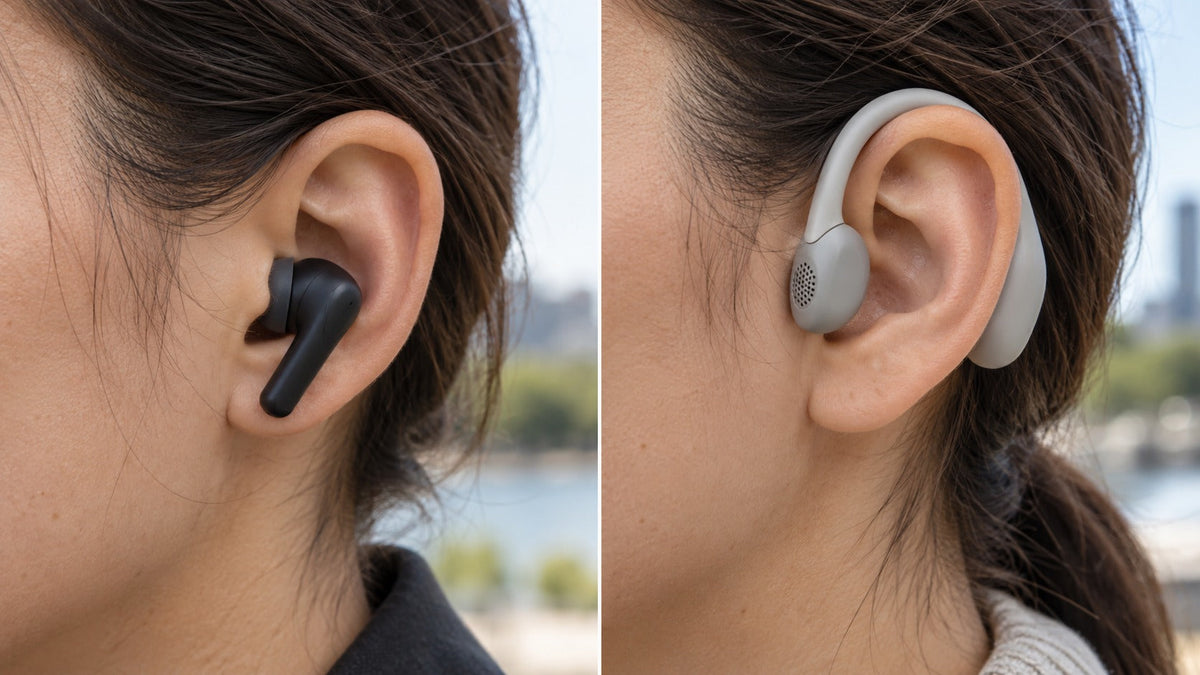
The main types of earbuds differ in how they sit on your ears: sealed in-ear, open-fit, open-ear clip-on, and ear-hook designs. Connection is a separate choice. Any of these styles may be wired or wireless, depending on the model.
Quick answer: Choose sealed in-ear earbuds when isolation matters; open-fit or open-ear earbuds when you dislike a plugged-up feel; and ear hooks when extra support matters. Then compare wired, Bluetooth, or true wireless connectivity, along with microphone needs and the environment where you listen.
Main Types of Earbuds by Fit
Fit is the most useful starting point. The terms below describe where the earbud sits and what holds it in place. They are not sound-quality rankings, and some categories overlap: an ear-hook model may be either sealed in-ear or open-ear.
| Earbud type | How it fits | What to check |
|---|---|---|
| Sealed in-ear | Tip seals inside the ear canal | Tip size, comfort, passive isolation |
| Open-fit / semi-in-ear | Rests at or near the canal entrance without a firm seal | Stability, bass consistency, leakage |
| Open-ear clip-on | Clips around the outer ear; speaker stays outside the canal | Clip pressure, awareness, sound leakage |
| Ear-hook | Hook wraps around the outer ear; speaker may be sealed or open | Fit with glasses, movement, actual speaker position |
Sealed In-Ear Earbuds and In-Ear Monitors
Sealed in-ear earbuds use silicone, foam, or other tips that form an acoustic seal in the ear canal. A good seal helps block some external noise and supports a more consistent bass response. A poor seal can make bass sound weak even when the earbud itself is working normally.
In-ear monitors (IEMs) use a similar insertion-and-seal approach, though the term also covers products intended for professional monitoring. Before replacing the earbuds, try compatible tip sizes. Wantek's guide to earbud tip materials and fit explains the differences.
Open-Fit and Semi-In-Ear Earbuds
Open-fit earbuds sit near the canal entrance without making the tight seal of a conventional in-ear tip. They can feel less intrusive, but usually block less outside sound. Their bass and retention may also change with ear shape and placement.
Open-fit does not always mean fully open-ear: part of an open-fit earbud can still touch the canal entrance.
Open-Ear Clip-On Earbuds
Clip-on earbuds hold a small speaker near the ear with a bridge around the outer ear. The ear canal stays unsealed, which can make nearby voices and other sounds easier to hear. The trade-off is less passive isolation and potentially more sound leakage.
Most clip-on models use air-conduction speakers rather than bone-conduction transducers. The clip shape alone does not identify the audio technology.
Ear-Hook Earbuds
An ear hook adds physical support around the ear, often for walking, running, or workouts. But a hook is a wearing feature, not a guarantee of an open ear canal: some hook-style earbuds still insert a sealed tip. Compare the actual speaker position, hook comfort, glasses clearance, and sweat-resistance information for each model.
For more detail on fit styles, see the ear-hook and wraparound earbud guide.
Wired, Wireless, and True Wireless Earbuds
Connection categories overlap with the fit styles above. A sealed in-ear earbud can be wired or true wireless; an open-ear clip-on design can also be true wireless.
Wired Earbuds
Wired earbuds connect through a cable, commonly with a 3.5 mm plug or a USB-C connection. They avoid Bluetooth pairing and do not require a charging case for the earbud connection. Confirm that your phone, computer, or adapter supports the specific plug and any microphone or inline controls.
Bluetooth Earbuds With a Connecting Cable or Neckband
Some wireless earbuds use Bluetooth to connect to the source but have a cable or band connecting the two earpieces. They still need charging, but the connected design can be convenient when you want to remove an earbud temporarily without storing two separate pieces.
True Wireless Earbuds (TWS)
True wireless earbuds have no wire between the left and right earpieces. Most use a charging case for storage and extra battery capacity. Compare single-charge listening time separately from total listening time with the case; those figures answer different questions.

ANC, Passive Isolation, and Transparency Mode
Noise control is another feature layer, not a separate earbud fit category. Passive isolation comes from the physical fit and seal. Active noise cancellation (ANC) uses microphones and processing to reduce some ambient sounds, especially steady low-frequency noise. Transparency or ambient mode uses microphones to pass some surrounding sound through to the listener on supported models.
Open-ear designs leave the canal unsealed, so they generally offer less passive isolation than sealed in-ear earbuds. An open canal does not guarantee you will notice every surrounding sound, particularly at high playback volume.
How to Choose the Right Earbud Type
- Start with your ears. If you tolerate ear tips and want isolation, try sealed in-ear models in several tip sizes. If you dislike the seal, compare open-fit and true open-ear designs.
- Consider where you listen. A busy commute often favors a good seal or ANC. In quieter places, an open-ear design may be preferable when you want the canal unobstructed.
- Match the support to your activity. For workouts, check stability, glasses clearance, and the exact model's moisture rating rather than relying on a “sports” label.
- Verify connection and calls. Check device ports, Bluetooth support, mic behavior, battery life, and call controls on the specific model. No wearing style guarantees microphone quality.
A Wantek Example: OBT030 Open-Ear Clip-On Earbuds
The Wantek OBT030 illustrates the open-ear clip-on category. Its product listing identifies Bluetooth 5.4, a built-in microphone, and up to 8 hours of earbud use or 50 hours total with the charging case. Those are manufacturer-listed specifications, not independent test results.

The OBT030 is worth examining if you want a compact design that keeps silicone tips out of the canal. Do not infer an IP rating, ANC performance, or multipoint support from its open-ear shape or Bluetooth version.
Frequently Asked Questions
What are the main types of earbuds?
By fit, common styles include sealed in-ear, open-fit or semi-in-ear, open-ear clip-on, and ear-hook earbuds. Wired, Bluetooth, and true wireless describe how they connect, so those categories can overlap.
Are true wireless earbuds a different fit type?
No. True wireless means the earpieces have no connecting cable. True wireless models can use a sealed in-ear fit, an open-fit shell, or an open-ear clip or hook.
Are open-ear earbuds the same as bone-conduction headphones?
No. Many open-ear earbuds use small air-conduction speakers outside the canal. Bone-conduction models use contact transducers against the head. Both can keep the ear canal physically open.
Which earbuds are better for noisy commuting?
Sealed in-ear earbuds, optionally with effective ANC, are often the more practical starting point when you want isolation. Open-ear designs are less suited to suppressing loud surrounding noise.

