
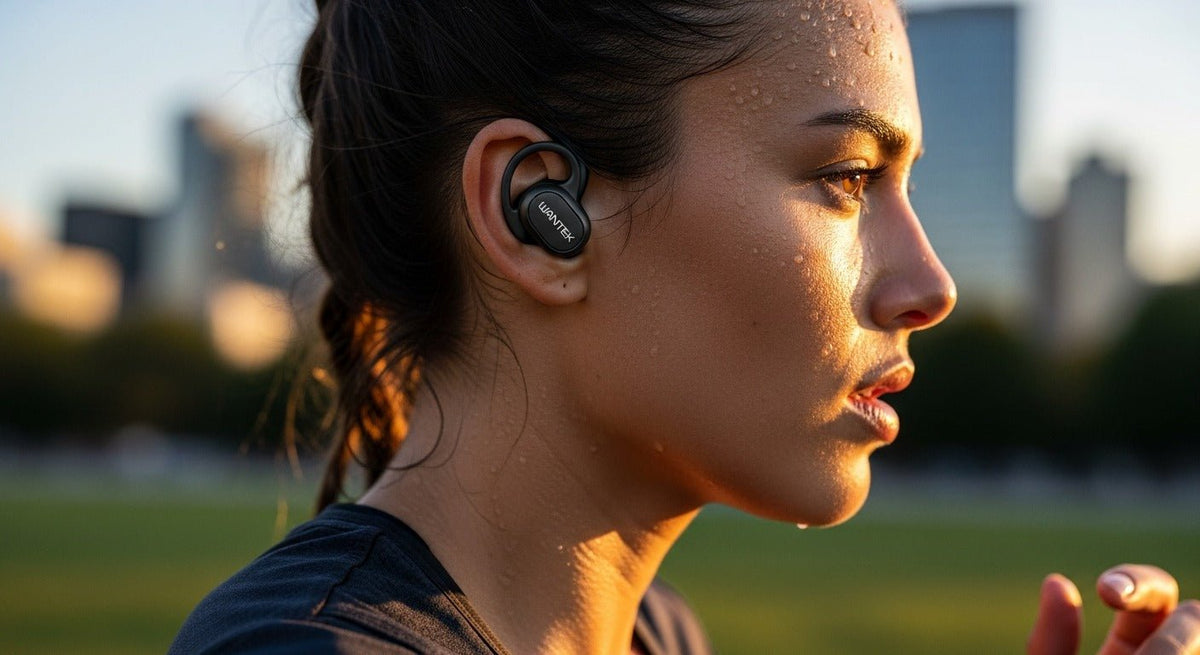
Wireless headphones can make workouts easier to manage by keeping a cable out of the way. But the right pair depends on what you do: jumping, lifting, running outdoors, floor exercises, and swimming each place different demands on fit and water protection. Start with your activity, then check the features that actually matter for it.
Quick answer: For fast movement, prioritize a secure fit and documented sweat protection. For outdoor exercise, consider how much surrounding sound you need to hear. For low-impact training, comfort and unobtrusive controls may matter more. Ordinary Bluetooth headphones are not a substitute for swim-rated headphones with suitable underwater playback.
Match wireless headphones to your workout
| Workout | Priorities and checks |
|---|---|
| Running and intervals | Secure fit during impact and turns; check tips or retention features and any documented sweat protection. |
| Strength and gym cardio | Stable fit and comfortable controls; check headband movement, heat, and the exact model’s sweat guidance. |
| Outdoor exercise | Enough awareness for your surroundings; compare open-ear designs with transparency-equipped earbuds. |
| Yoga and Pilates | Low-profile comfort; check whether earbuds or earcups press against the mat during floor movements. |
| Swimming | Explicit swim suitability and onboard music; ordinary Bluetooth playback is unreliable underwater. |
Running, intervals, and jumping
Repeated impacts can loosen earbuds that feel comfortable while sitting still. Look for an ear tip or retention design that stays in place when you turn your head, jog, and bend over. Fins and over-ear hooks can improve retention for some ears, but neither guarantees a fit. If a hook presses against glasses or a hat, that tradeoff matters as much as how secure it feels.
For more detail on the designs, compare ear-hook earbuds and open-ear clip-on alternatives before deciding.
Strength training and cardio machines
At a weight bench or stationary bike, you may prefer cushioned over-ear headphones for sound isolation or small earbuds that do not touch equipment. Check how the headband shifts when you lean forward or lie back. An over-ear model may feel stable during steady lifting but warmer during hard cardio; do not assume it tolerates sweat without manufacturer guidance.
Outdoor running, walking, and cycling
Hearing traffic, other people, and instructions may matter more than maximum isolation. Open-ear designs leave the ear canal unsealed, while sealed earbuds may offer a transparency mode. Neither guarantees you will hear every hazard, so keep volume and environmental conditions in mind. For a running-specific selection process, see the running-headphone fit and awareness guide.
Yoga, Pilates, and floor exercises
Bulky earcups or protruding earbuds can press against a mat during side-lying or supine movements. A low-profile fit with simple controls may suit these sessions better than aggressive noise cancellation. Try the movements you actually do, not only an upright fit test.
Swimming
Swimming is a separate use case. Ordinary Bluetooth connections do not reliably carry music through water, and a general sweat-resistance claim does not establish swimming suitability. Look for explicit swim-use guidance and onboard playback. For example, the Wantek BC3 Pro swimming headphones list IP68 protection and 32GB of local MP3 storage for offline pool listening; Bluetooth is intended for use out of the water.

Three checks before choosing a workout pair
1. Secure fit through movement
A comfortable seal while standing still is only a starting point. Check whether earbuds need constant readjustment during squats, turns, and faster steps. With an over-ear model, notice whether clamping pressure and the headband position change when you move. If the headset must be pushed back into place repeatedly, its audio features will not solve the fit problem.
2. Water-resistance claims you can verify
Water resistance has different meanings. Under the IEC 60529 IP code, the second numeral describes testing against water ingress: IPX4 covers splashing water, while IPX7 refers to temporary immersion under specified conditions. A higher number is not a blanket promise about sweat chemistry, cleaning, swimming, or long-term wear.
Check the exact model's stated rating, its use restrictions, and its warranty or care instructions. When a listing does not provide a rating, treat sweat protection as unverified rather than assuming it exists.
3. Awareness versus noise isolation
Sealed earbuds can reduce background sound through their fit. Active noise cancellation (ANC) can further reduce some steady noises, while a transparency mode aims to pass outside sound through microphones. Open-ear audio leaves the canal unobstructed but usually offers less isolation in a loud gym. Choose based on whether the environment calls for focus, awareness, or both at different moments.
Battery life, Bluetooth, and controls
Compare playback per charge with the length of your longest session. For true-wireless earbuds, a case's total battery figure includes recharging between sessions and is not uninterrupted listening time. ANC, volume, calling, and other settings can affect real-world endurance; use the manufacturer's stated conditions when comparing models.
Bluetooth version numbers alone do not tell you how reliably a headset will behave with your phone in a locker or gym bag. Confirm device compatibility, practical range, and whether you can skip tracks, adjust volume, or pause audio without handling your phone. Physical controls may be easier to locate during a workout than touch areas, depending on the design.
Where Wantek models fit
Wantek OBT030 open-ear clip-on earbuds are an option to consider when you want an unsealed fit. The current product listing states Bluetooth 5.4 and up to eight hours per earbud charge, with additional charges from the case. This clip-on design is not the same as a traditional over-ear hook, and its listing does not establish a specific sweat-resistance rating in the information checked here. Confirm your use conditions before treating it as a high-sweat sports model.

For lap swimming, the BC3 Pro's swim-oriented design and local MP3 playback address a different problem. These two products should not be treated as interchangeable simply because both are wireless.
Considering an open-ear fit?
Review the OBT030's current product details and decide whether the clip-on shape and documented features match your workout.
Workout Headphones FAQ
Are wireless headphones better for workouts than wired ones?
Wireless designs avoid a cable catching on equipment or clothing, which can help with freedom of movement. But fit, sweat protection, and awareness still determine whether a specific pair suits your activity.
Are all Bluetooth headphones sweatproof?
No. Bluetooth describes the connection, not water protection. Check the exact model's documented IP rating and use instructions rather than relying on words such as “sports” or “workout.”
Can I use regular wireless earbuds for swimming?
Do not assume so. Swimming calls for explicit water-use approval and a playback method that works underwater. Bluetooth audio from a phone is unreliable beneath the surface; swim-oriented models may use stored music instead.

