
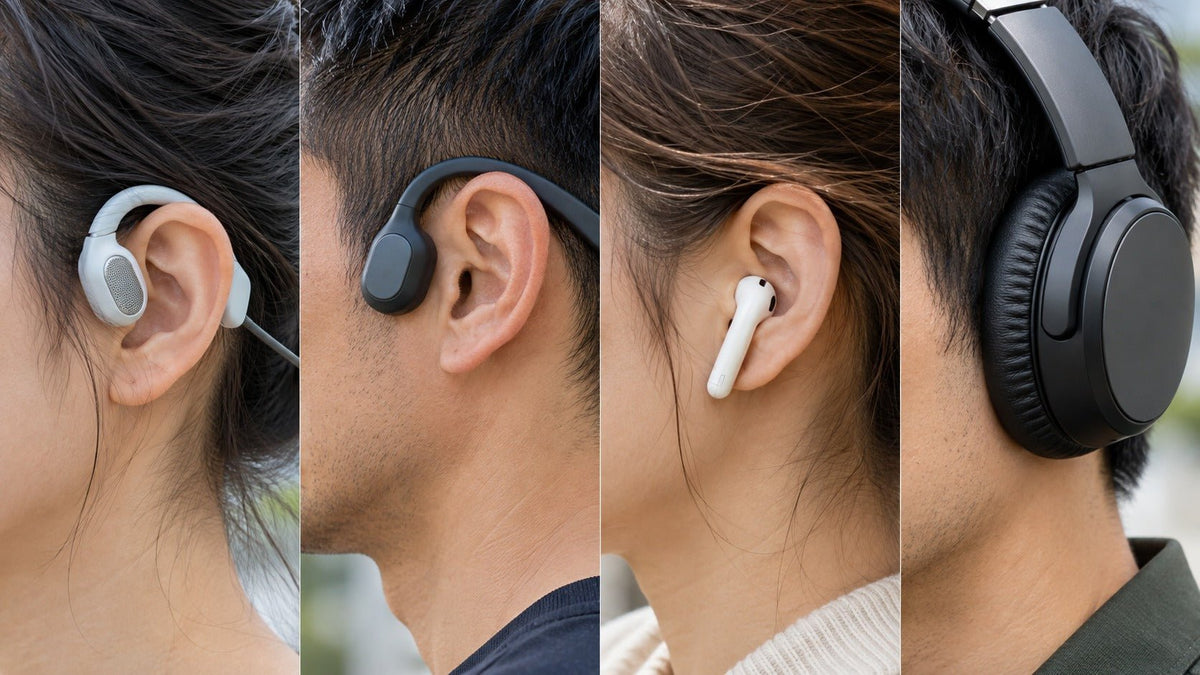
If you want headphones that don’t go in your ear canal, the category you are usually looking for is open-ear headphones or open-ear earbuds. They keep the ear canal unsealed, but they can do that in several different ways.
Quick answer: For the most literal “nothing in my ear” fit, look at open-ear air-conduction designs that clip or hook around the outer ear, or bone-conduction headphones that rest against the side of the head. Open-fit and semi-in-ear earbuds may avoid a silicone seal, but part of the earbud can still rest at the ear-canal entrance.
What Are Headphones That Don’t Go in Your Ear Called?
Open-ear headphones is the broadest useful term. Instead of sealing the ear canal with a silicone or foam tip, an open-ear design leaves the canal physically open while the device delivers audio from outside it.
That name describes the wearing approach, not one single audio technology. Some open-ear products use small speakers that send sound through the air toward your ear. Others use bone-conduction transducers that maintain contact with the side of your head and create mechanical vibration.
If you are already at the model-comparison stage, the Wantek open-ear headphones buying guide compares current clip-on, ear-hook, open-fit, and wraparound options without treating them as the same design.
| Design | Where it sits | Main trade-off |
|---|---|---|
| Open-ear air conduction | Speaker sits outside the ear canal, often with a clip or ear hook. | Leaves the canal open, but provides little passive isolation in noisy places. |
| Bone conduction | Transducers rest against the side of the head, usually in front of the ears. | Leaves the canal open, but the vibration feel and sound presentation are different from conventional speakers. |
| Open-fit or semi-in-ear | Earbud rests at or near the canal entrance without a tight silicone seal. | Less intrusive than a sealed in-ear tip, but it is not the same as keeping all hardware outside the canal area. |
| On-ear or over-ear | Pads sit on or around the outer ear. | Nothing enters the canal, but the larger cups can add heat, clamp, and bulk. |

The Main Non-In-Ear Options
Open-Ear Air-Conduction Headphones
Air-conduction open-ear headphones use a conventional speaker, but position it near the ear instead of sealing it inside the canal. Current products commonly use clip-on or ear-hook forms. The practical benefit is a truly open canal without the vibration sensation associated with bone conduction.
Because there is no acoustic seal, outside noise competes with your music, podcasts, or calls. That can be useful in a quiet office, on a walk, or during a light workout, but less useful on a loud train or airplane.
Bone-Conduction Headphones
Bone-conduction headphones also keep the ear canal open, but the listening mechanism is different. Their contact transducers rest against the side of the head and contribute to hearing through mechanical vibration rather than relying only on a speaker aimed at the canal.
If you want the technical details, fit implications, and swimming-specific considerations, the bone-conduction headphones guide covers that category in more depth.
Clip-On and Ear-Hook Describe Fit, Not Necessarily the Sound Technology
A clip-on earbud grips part of the outer ear. An ear-hook design uses a hook around or behind the ear for support. Either form can be open-ear, but the shape alone does not tell you whether the speaker uses air conduction or bone conduction.
This distinction matters when shopping. An “ear-hook earbud” can still use an in-ear tip, while an open-ear hook keeps its speaker outside the canal. Check the actual wearing position instead of assuming every hook means a non-in-ear design.
Open-Fit Earbuds Are a Middle Ground
Some earbuds skip silicone tips and do not create a tight in-ear seal, but still sit at the ear-canal entrance. These are often called open-fit or semi-in-ear earbuds. They can feel less plugged than sealed in-ear models, but they are not the best match if your requirement is literally “nothing resting in or at the canal.”
Why Choose Headphones That Stay Outside the Ear Canal?
- You dislike ear tips. Open-ear designs remove the need to insert and seal a silicone or foam tip.
- You want surrounding sound to remain physically accessible. An open canal can make voices, announcements, traffic, and other environmental sound easier to hear than a strongly isolating earbud.
- You want a different support point. Clips, hooks, and wraparound frames shift the fit from the ear canal to the outer ear or side of the head.
- You want an activity-specific form factor. Some runners prefer hooks or wraparound frames, while some everyday users prefer compact clip-on designs.
Open-ear does not mean guaranteed awareness. Playback can still mask outside sounds, and attention still matters. Treat the open fit as a design characteristic, not as a safety device.
What Are the Trade-Offs?
Less Isolation in Noisy Places
The same open fit that keeps the canal unobstructed also lets environmental noise reach your ears. In a loud commute, gym, airport, or busy street, speech and music can become harder to hear.
Turning the volume up until it overpowers the environment is not a good fix. The CDC’s hearing-loss prevention guidance emphasizes that hearing risk depends on both sound level and how long the exposure lasts.
Sound Leakage Can Be More Noticeable
Open designs do not contain sound the way a well-sealed in-ear or closed over-ear headphone can. Leakage varies by model, fit, and volume, but it is worth considering if you listen in a library, shared office, or other quiet space.
Fit Is Still Personal
Removing an ear tip does not remove every fit problem. Clip pressure, hook geometry, head shape, glasses, hats, helmets, hair, and movement can all affect comfort and stability. The best shape is the one that works with the equipment and activities you actually use.

Open-Ear Is Not Automatically Better for Sound Quality
A sealed design has physical advantages when you want strong passive isolation and consistent low-frequency response. Open-ear products trade some of that isolation for an unobstructed canal. Whether that trade is worthwhile depends on your environment and what you listen to.
How to Choose the Right Type
Decide what “not in my ear” means for you
If you want absolutely no earbud at the canal entrance, focus on clip-on open-ear, ear-hook open-ear, or bone-conduction designs. If you mainly dislike silicone tips, open-fit earbuds may also work.
Choose air conduction or bone conduction
Start with air conduction if you want a small external speaker near the ear. Consider bone conduction if you specifically want a contact-transducer design or a wraparound sports form. The open-ear earbuds vs. bone-conduction comparison explains the practical differences.
Match the support style to your activity
Clip-on designs are compact, ear hooks add visible support around the ear, and connected wraparound frames can feel more secure during repeated movement. Test the design with glasses, hats, and other gear you normally wear.
Be realistic about your listening environment
If you regularly listen in loud transportation or need strong privacy, an open-ear design may be the wrong category. If you mostly listen in quieter settings and want the canal open, it can be a better fit.
Verify product-specific features separately
Open-ear describes fit. It does not prove water resistance, multipoint Bluetooth, microphone quality, battery life, swimming support, or active noise cancellation. Check those features on the exact model.
A Wantek Example: OBT030 Open-Ear Clip-On Earbuds
Wantek OBT030 is a clip-on open-ear design that keeps the speaker outside the ear canal. The current product page lists an 8.5 g earbud weight, Bluetooth 5.4, a built-in microphone, up to 8 hours of earbud battery life, and up to 50 hours of total battery life with the charging case.
Those specifications make it a useful example of the compact air-conduction side of this category. The current product information does not state an IP water-resistance rating or multipoint support, so neither feature should be assumed from the Bluetooth version or open-ear form alone.
Want a Compact Open-Ear Clip-On Option?
Check the current Wantek OBT030 product page for its documented fit, Bluetooth, microphone, battery details, availability, and configuration.
Frequently Asked Questions
What are earbuds that don’t go in your ear called?
They are usually called open-ear earbuds or open-ear headphones. Clip-on and ear-hook models can keep the speaker outside the canal, while bone-conduction models use contact transducers near the ear.
Are open-ear headphones the same as bone-conduction headphones?
No. Bone conduction is one type of open-ear audio. Many open-ear earbuds use conventional air-conduction speakers positioned outside the ear canal instead.
Do open-ear headphones actually stay outside the ear canal?
True open-ear clip-on, ear-hook, and bone-conduction designs keep the canal unsealed. Open-fit or semi-in-ear earbuds can still rest at the canal entrance, so check the wearing position.
Are headphones that don’t go in your ear safer for hearing?
An open fit does not make high volume harmless. Hearing risk still depends on sound level and exposure duration, and noisy surroundings can encourage you to raise the volume.
Do open-ear headphones leak sound?
They can. Because there is no sealed ear canal, some sound may be audible nearby, especially at higher volume in a quiet room. Leakage varies by design and fit.

