
Welcome to Wantek online store!

Announcement: Free shipping in USA, UK, FR, DE, IT, ES

Reclaiming the Frozen Path: A Runner's Definitive System for Conquering Winter

best winter running gear

Joe Steve |

Let's dispel the myth immediately. Winter running is not a test of machismo. It is not a badge of honor earned through suffering. I believe it is a practice in intelligent preparation. The chasm between a teeth-chattering, regret-filled ordeal and a powerful, serene journey through a crystalline world is built entirely upon your choices in the minutes before you step outside. Procuring the  best winter running gear  is the non-negotiable first chapter in your cold-weather narrative. This is not about buying the most expensive item. It is about architecting a personal microclimate, a mobile ecosystem that manages moisture, traps warmth, and deflects the elements. This guide is that blueprint. We will construct it together, piece by deliberate piece, to transform you from a fair-weather runner into a four-season athlete.

The Foundational Doctrine: Stratification as Strategy

A technical diagram illustrating the three-layer winter running system a moisture-wicking base, a heat-trapping mid-layer, and a weather-resistant outer shell

Abandon the archaic notion of a single, bulky sweater. That relic belongs to a different era, a surefire path to becoming a damp, shivering mess. Contemporary cold-weather athleticism is governed by a elegant, three-tiered layering philosophy. Each stratum has a distinct, critical function. Mastering this interplay is the core of your success.

  1. The Base Stratum: The Moisture Conductor.  This is your second skin. Its entire raison d'être is active transport. It must aggressively pull perspiration  away  from your epidermis and into the subsequent layers where it can evaporate. Failure here means dampness. Dampness means conductive heat loss. Seek out terminology like "capillary action" and fabrics such as merino wool—a miracle fiber that manages moisture, tempers temperature, and possesses natural odor resistance—or advanced polyesters. Cotton is the enemy. It is a passive sponge, a harbinger of chill.
  2. The Insulative Mid-Layer: The Thermal Regulator.  Imagine this as your personal furnace housing. It captures the metabolic warmth your body generates and holds it in a matrix of still air. Its job is retention. Materials like grid-backed fleece, lightweight synthetic insulations (think PrimaLoft), or heavier wool knits excel here. This layer is your adjustable thermostat.
  3. The Protective Outer Shell: The Environmental Shield.  This is your boundary layer with the world. It must be impervious to wind and shed precipitation, whether sleet or snow. Crucially, it must also breathe. A perfectly waterproof but non-breathable shell will create a sauna of your own sweat. The goal is selective permeability: keeping external weather out while allowing internal vapor to escape. Features like underarm zippers (pit zips) are not frivolous; they are emergency pressure valves.

When this system sings in harmony, you possess a profound sense of agency. You are no longer at the mercy of the mercury. You can modulate your climate with a zipper's pull, adapting to your own output and the shifting whims of the sky.

The Anatomical Inventory: A Head-to-Toe Arsenal

Cranium, Cervical, and Digits: Guarding the Gateways

A physiological fact: your body prioritizes core temperature. It will readily sacrifice heat from the extremities to protect vital organs. Letting this happen is a strategic blunder. Protecting these areas is disproportionately effective.

  • The Cranial Cover:  A thin, moisture-wicking beanie is indispensable. It retains immense heat. For milder, damp days, I often opt for a technical fleece headband. It shields the ears—a primary heat-loss center—while allowing cranial heat to dissipate, preventing overheating. It’s a nuanced choice that speaks to the need for granular control.
  • The Versatile Neck Gaiter:  This is, without hyperbole, the most utilitarian item in my kit. A tubular piece of technical fabric can serve as a neck warmer, a face mask against biting wind, a skull cap, or a makeshift ear band. I perpetually have one tucked into my waistband or pocket. On a brutal day, pulling it over my nose and mouth warms the inhaled air—a simple trick that staves off that sharp lung burn.
  • Manual Insulation:  Gloves are a graduated science. I begin with thin, synthetic liner gloves. As temperatures plummet, I switch to insulated running-specific models. For the polar vortex moments, I employ a layered system: liner gloves under a mitten shell. This preserves the digital dexterity needed to operate a touchscreen or adjust a watch, while the mitten envelope creates a warm air pocket. I learned the hard way that bulky ski gloves are comically impractical. Fumbling with your phone becomes a Herculean task.

The Torso: The Command Center of Climate

This is the canvas where your layering philosophy becomes tangible. The variables here are most sensitive to temperature fluctuations.

  • Base Layer Top:  The journey starts with a long-sleeve technical shirt. My personal allegiance leans toward merino wool for its unparalleled performance across a spectrum of conditions. For those wary of wool or seeking a budget-conscious entry, modern polyesters are exceptional. The key is seam placement and fit—it should feel like a comfortable, second skin, not a restrictive sausage casing.
  • Mid-Layer Top:  Here is where personality enters the kit. A lightweight, gridded fleece quarter-zip is my workhorse. The quarter-zip is a masterpiece of design, allowing for rapid core venting. That first plume of steam you see rising from your chest? That’s the system working. You’re venting excess heat before it condenses into moisture.
  • The Outer Shell Jacket:  This is where investment pays dividends. A dedicated running shell should be windproof, water-resistant, and highly breathable. Look for articulated elbows, a dropped back hem for coverage in a running posture, and adjustable cuffs. Reflective elements are not an add-on; they are a mandatory safety feature. You do not need an expedition-grade parka. You need a precise tool that severs the wind-chill effect.

When considering  cold weather running gear women's  specific designs, the market has matured beautifully. Many brands now offer jackets and tops with tailored silhouettes—narrower through the waist and shorter in the torso, with sleeves scaled appropriately. This isn't merely aesthetic. It eliminates excess fabric that can bunch, chafe, or impede the arm swing. It’s engineering that acknowledges biomechanics. This attention to detail transforms a good piece into a great one.

The Lower Hemisphere: Power and Protection

The legs are formidable engines, producing significant heat. The strategy here is often more about protection from external elements than sheer insulation.

  • Tights Versus Pants:  Running tights are the dominant choice. For genuine cold, seek out brushed, fleece-lined models. They provide warmth without bulk. When facing a relentless wind or wet snow, consider tights with a windproof front panel. They defend your quads and shins while remaining breathable elsewhere. For the most frigid days, or for those who prefer a looser fit, insulated running pants exist. The non-negotiable feature? An ankle zipper. Attempting to pull a tight pant cuff over a running shoe is a slapstick routine best avoided.

The Foundation: Footwear and Sockology

Cold, sodden feet are the ultimate morale killer. They will truncate any run, no matter your mental fortitude.

  • Socks:  The cotton embargo remains in full force. Merino wool or synthetic blend running socks are the only option. Their magic lies in maintaining insulating properties even when damp. A slightly cushioned sock can also provide a welcome barrier against frozen ground feel.
  • Shoes:  Audit your regular rotation. Summer shoes are often engineered for maximum ventilation, featuring vast mesh panels. These become liabilities in slush. Strategies are tiered. You can dedicate an older, less-ventilated pair to winter duty. You can treat a favorite pair with a water-repellent spray (reapplied periodically). Or, you can invest in a purpose-built winter running shoe. These models typically feature reduced mesh, a water-resistant upper, and outsoles with deeper, more aggressive lugs for traction on snow and ice. Some runners embrace a layering approach for feet: thin liners under waterproof socks. I find this too fussy, but the principle is sound.

best winter running gear

Traction and Luminosity: The Pillars of Safety

Winter abbreviates daylight and presents novel terrain hazards. Addressing these is not optional; it is a core component of responsible preparation.

  • Traction Augmentation:  Black ice is an invisible saboteur. Slip-on traction devices are the most cost-effective performance and safety upgrade you can make. Brands like Yaktrax or Kahtoola make models that stretch over your shoes, featuring metal coils or microspikes. I keep a pair in my car throughout the season. It is profoundly better to have them and defer their use than to execute an unexpected and graceless glissade across a parking lot.
  • The Imperative of Visibility:  You must operate under the assumption that drivers are inattentive. Reflective detailing on your clothing is a start, but it is passive. You must become an active light source. A high-lumen headlamp illuminates your path and forces recognition. Supplemental lighting—LED armbands, clip-on blinkers, or knuckle lights—creates a moving constellation that defines your human form in the darkness. My rule is simple: be seen from every angle. In winter's gloom, you should aspire to be a running beacon.

Brand Spotlight: Decoding the Swoosh's Winter Arsenal

It is impossible to discuss the landscape of running technology without examining  Nike winter running gear. Their evolution from basic apparel to a integrated performance ecosystem is a case study in athletic R&D. Nike’s cold-weather philosophy often hinges on minimizing weight while maximizing adaptive warmth and protection.

  • Therma-FIT and Dri-FIT ADV:  These are Nike’s fabric lexicons for insulation and advanced weather protection, respectively. A jacket like the Nike Storm-FIT Shield might integrate both: a Therma-FIT lined body for warmth, with a Dri-FIT ADV outer shell that repels wind and water. The cuts are consistently athletic, promoting a feeling of speed and freedom—a psychological asset when battling a headwind.
  • The Nike Element Half-Zip:  This piece has achieved iconic status for a reason. Constructed from a recycled knit, it serves as a perfect mid-layer or standalone top on milder days. It provides remarkable warmth for its negligible weight and packs down to nothing. It’s the definition of a versatile workhorse.
  • Aeroshield and Storm-FIT Tights:  Here, Nike demonstrates its understanding of targeted protection. Tights often feature Storm-FIT technology panels on the front of the thighs and shins—areas most exposed to wind and precipitation—while the back remains a breathable knit. This zone-specific defense is brilliant. Furthermore, details like secure, zippered pockets that actually accommodate a modern smartphone show a user-centric design mentality.

Is Nike the sole arbiter of quality? Absolutely not. The market is rich with superb specialty brands. However, their scale allows for massive investment in material science, and their designs frequently influence broader trends. Their strength lies in merging performance with a distinct aesthetic of velocity. Slipping on a well-designed piece from their line can provide a tangible, almost emotional, boost—a feeling of being equipped, fast, and ready, even when the environment is anything but.

The Practical Playbook: A Temperature-Tiered Manifesto

Theory must yield to practice. Here is my personal, battle-tested layering matrix. Use this as a foundational algorithm, then tweak the variables based on your unique metabolism, effort level, and wind conditions.

  • 30-40°F (The "Sweet Spot"):  This is exhilarating running weather. My uniform: a long-sleeve merino base layer, standard running tights, lightweight gloves, and a headband. A wind-resistant vest is often in the mix, especially for exposed routes. The focus is on managing warmth buildup.
  • 20-30°F (The "Serious" Zone):  The system engages. I add a gridded fleece quarter-zip over my base layer. Tights become brushed or fleece-lined. A beanie replaces the headband. Gloves gain insulation. The neck gaiter makes its first appearance, often worn loosely.
  • 10-20°F (The "Focused" Zone):  Full protocol is active. Base layer, insulated mid-layer, and a windproof shell are all deployed. Legs are in heavyweight, fleece-lined tights, sometimes with wind panels. Heavy gloves, a thermal beanie, and the neck gaiter is worn over my mouth and nose on initial exposure. Traction devices are in my pocket or on my shoes from the start. My pace is more deliberate, my attention turned inward.
  • Below 10°F (The "Expedition" Zone):  This is for the committed and the curious. All previous layers are applied. I may add an ultralight down or synthetic gilet (vest) under my shell for unparalleled core warmth without arm restriction. A balaclava integrates head and face protection. Exposed skin is minimized; I check for gaps at wrists and ankles. Runs are shorter, more purposeful. The goal shifts from performance to profound experience—to hear the crunch of snow in absolute stillness, to feel the unique clarity of frozen air. And then, to get inside, where the hot tea awaits.

The Psychological Arena and Ephemeral Wisdom

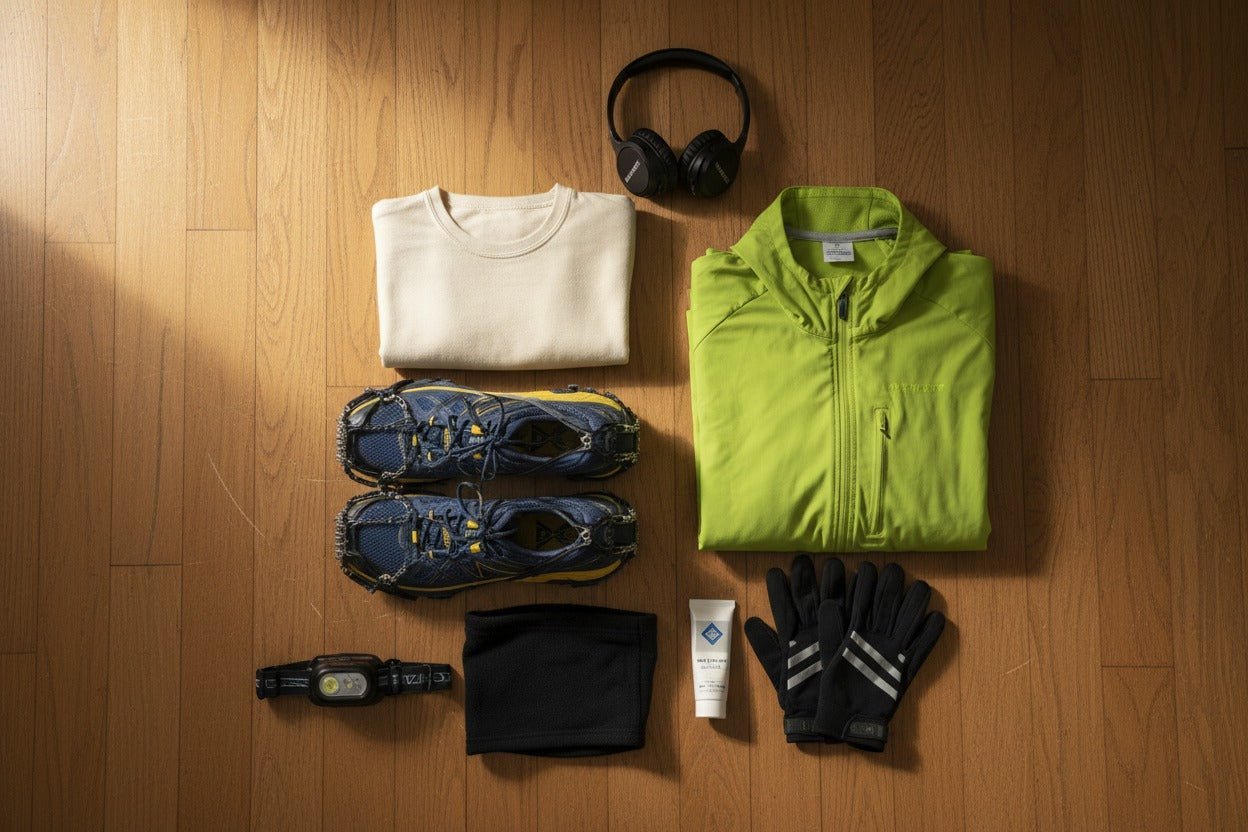
The finest gear only solves the physical equation. The mental barrier—the cozy allure of a warm home—remains. My most effective tactic is pre-commitment. I lay out my complete  best winter running gear  assemblage the night before. The visual of the prepared kit, a colorful puzzle waiting to be solved, creates momentum. It makes the run an appointment. I also adhere to the "ten-minute treaty." I must run for ten minutes. After that, I am granted a unilateral pardon to turn home if I am truly miserable. I have invoked this clause maybe twice in a decade.

A scattering of final, hard-won insights:

  • The Chafing Paradox:  Counterintuitively, winter presents a heightened risk of chafing. Multiple layers, combined with moisture-wicking fabrics moving against each other, can create fierce friction points. Anti-chafe balm applied to seams, underarms, and inner thighs is not a suggestion. It is a sacred ritual. Neglect it at your peril.
  • Hydration's Winter Illusion:  Thirst is a muted signal in the cold. You are still losing vast amounts of fluid through respiration and sweat. A frozen hydration tube is a useless plastic sculpture. Use insulated handheld bottles or plan a route that circles back to your car or home for a liquid break.
  • The Post-Run Sequence:  This is critical. Have a thermos of warm beverage waiting. The moment you stop, your core temperature can plummet. Get out of the damp layers immediately. Do not linger in sweaty kit. A warm shower is not just hygiene; it is the ceremonial closing of the winter run, a gradual return to the ambient world.

Winter running, in its essence, is a form of quiet rebellion. It reclaims a season often ceded to indoor monotony. It reveals landscapes in minimalist repose and offers a solitude the crowded summer paths cannot. The crunch of snow underfoot, the sight of your breath in the beam of a headlamp, the stark beauty of a frozen world—these are the rewards. But they are only accessible through the gateway of intelligent preparation. Your gear is the key to that gate. It is the enabler of confidence, comfort, and ultimately, joy. This is not about enduring winter. It is about embracing it, on your terms, with every insulated, reflective, and carefully considered piece you wear. The entire year is now your domain. Go explore it.

Frequently Asked Questions

What are the most essential pieces of gear for winter running?

The absolute essentials are a moisture-wicking base layer, an insulating mid-layer, a windproof and water-resistant outer shell, thermal running tights, a hat or headband, gloves, and traction devices for your shoes if you encounter ice.

How do I dress for winter running without overheating?

Follow the "dress for 20 degrees warmer" rule. Dress as if it's 20°F (about 11°C) warmer than the actual temperature to account for your body heat generation once you start running. Layering is key so you can adjust.

Are regular running shoes okay for winter, or do I need special ones?

While you can use regular shoes, dedicated winter running shoes offer benefits like water-resistant uppers, improved traction on lugs, and sometimes added insulation. For severe ice, separate traction devices like microspikes are highly recommended.

What safety precautions are crucial for running in cold, dark winter conditions?

Always prioritize visibility with reflective gear and a headlamp or blinking lights. Run against traffic if on roads, let someone know your route, carry a phone, and be extra cautious on potentially icy surfaces. Cover exposed skin in extreme cold to prevent frostbite.

Read more

📖 Top Headphones for Flying – Noise Cancelling & Comfort

📖 3.5mm to Headphone Jack: The Complete Adapter Guide

📖 How to Use Bluetooth Headphones with TV – Easy Guide

📖 Green Headphones Guide: Top Picks from Beats to Sony Wireless

📖 What is Cyber Monday? History, Dates & Best Deals

📖 How to Set Up Call Forwarding on iPhone (Verizon & More)

📖 Discover the Best Cat Ear Headphones: Ultimate Wireless and Bluetooth

📖 Best Wired Noise Cancelling Headphones 2025 – Top Picks

📖 Best Noise Cancelling Earbuds for Airplane Travel: An In-Depth Review

📖 Best Gym Headphones 2025 – Top Wireless & Sweatproof Picks