
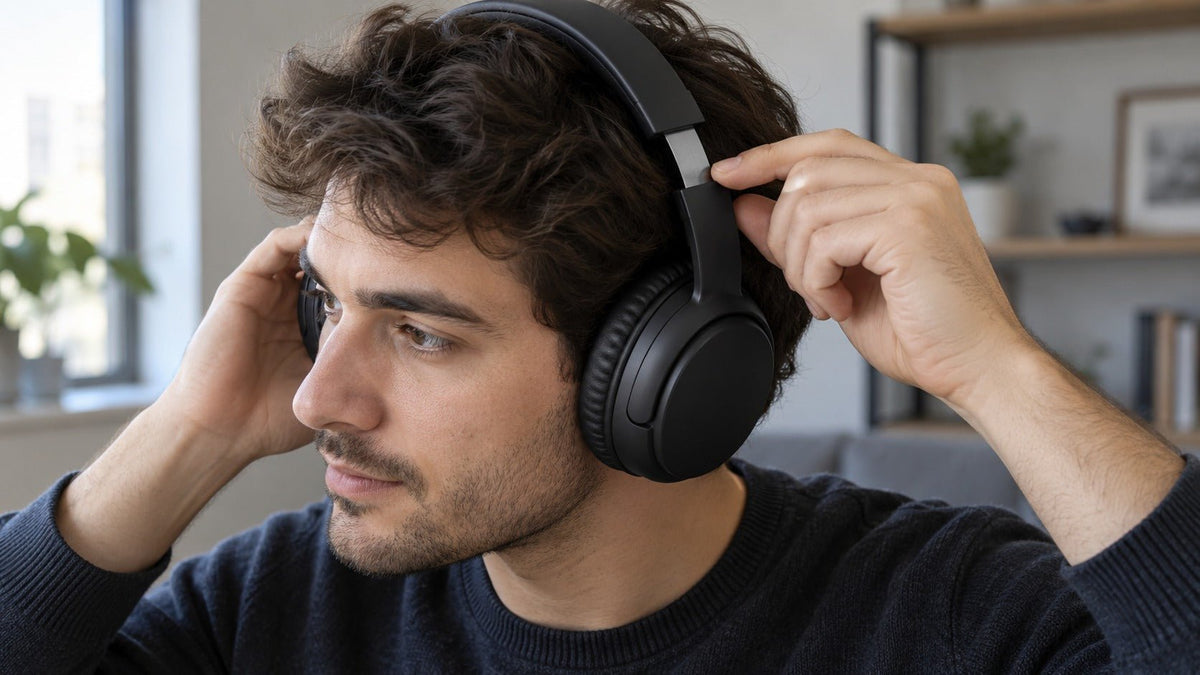
Adjustable headphones let you change the fit, but “adjustable” is not one feature. On conventional over-ear and on-ear headphones, sliders usually change headband length and earcup height; some models also let the earcups swivel or pivot. A good fit still depends on clamp, padding, earcup size, weight, glasses, and your head shape.
Quick answer: adjust the headband until the earcups sit at the correct height without concentrating pressure on the crown. If the headphones still feel too tight, too loose, or unstable after the height is correct, compare the frame tension, earcup dimensions, padding, and overall wearing style rather than assuming more slider range will solve the problem.
What Counts as Adjustable Headphones?
For conventional headphones, adjustable usually means the headband can extend or retract so the earcups sit higher or lower on your head. Depending on the design, the earcups may also rotate, swivel, or pivot to follow the angle of your head. Those mechanisms help position the headphones; they do not guarantee that every head size or ear shape will fit comfortably.
The phrase headband headphones can also describe soft fabric bands with thin speakers inside them. That is a separate form factor used for sleep, relaxation, travel, or light activity. A fabric audio headband does not use the same rigid slider-and-earcup fit system as a conventional over-ear or on-ear headphone, so the two categories need different buying checks.
What Headband Adjustment Can — and Cannot — Change
| Adjustment | What it can change | What it does not guarantee |
|---|---|---|
| Headband slider or extension | Overall band length and the vertical position of the earcups | Lower clamp, larger ear openings, softer padding, or universal fit |
| Earcup swivel or pivot | The angle at which the pads contact your head | More headband length or less frame tension |
| Adjustable microphone boom | Microphone position relative to your mouth on a headset | A different headband fit or earcup size |
This distinction matters because headband length and clamp are different variables. RTINGS' headphone comfort methodology treats adjustability, weight, padding, frame tightness, and clamping force as separate ergonomic factors. A headphone can have plenty of extension range and still feel uncomfortable if the frame tension or contact points do not suit you.
Three Main Headband Styles
| Style | Useful when | Main trade-off to check |
|---|---|---|
| Over-ear | You want the cushions to surround the outer ears for longer listening, stronger passive isolation, or models with ANC. | Larger size, heat buildup, total weight, earcup clearance, and headband pressure can affect comfort. |
| On-ear | You prefer a smaller headphone that rests directly on the outer ear and usually packs more easily. | Direct pressure on the ear can become uncomfortable for some users during long sessions. |
| Fabric headband | You need a soft, low-profile design for side lying, relaxation, travel, or a specific sport-oriented use. | Speaker position, sound leakage, cleaning instructions, electronics removal, and model-specific water protection need close checking. |
If you are choosing between the two conventional styles, Wantek's over-ear vs. on-ear headphone comparison explains how pad position changes ear pressure, heat, portability, and seal. Neither style is automatically more adjustable or more comfortable for every listener.

What Actually Determines Comfort?
Comfort is the combined result of pressure, contact area, weight distribution, padding, heat, and fit. Headband adjustment matters because it places the earcups, but it is only one part of that system.
Headband pressure, clamp, and weight distribution
A narrow or poorly positioned band can create a hot spot on the crown even when the headphone is light. A wider padded band can spread the load more effectively. Clamp is separate from slider length: too much frame tension can become uncomfortable, while too little can allow the headphone to slip. RTINGS similarly notes that tightness and tension can become painful over longer listening sessions, while secure fit without excessive pressure is the goal.
Where the earcups touch
Over-ear cushions should sit around the outer ear rather than folding or pressing it. On-ear pads intentionally rest on the ear, so cushion softness and clamp become more important. If the headband is adjusted correctly but an over-ear pad still touches your ear, the limiting factor may be the pad opening or cup depth rather than headband length.
Glasses and hair can change the fit
Eyeglass temples sit between your head and the pads, which can change pressure and seal. Hair trapped under the cushions can do the same. In its model-specific fit guidance for the Space 2, soundcore recommends centering the headband, adjusting the extension arms evenly, and checking the height when wearing glasses. The exact adjustment method still depends on the headphone you own.
Heat and breathability
Large sealed earcups can retain more heat during long sessions. On-ear and fabric designs can expose more area around the ear, but the result still depends on pad material, room temperature, activity level, and how tightly the product fits.
Speaker thickness in fabric headbands
For a sleep-oriented fabric headband, the speaker module should be thin enough that it does not create a pressure point when your head is on a pillow. Speaker position also matters: if the drivers sit too far forward or backward, both comfort and perceived volume can suffer.
How to Adjust Headphones for a Better Fit
Place the earcups before extending the band
Put the headphones on in their shorter or neutral position first. For over-ear models, center each ear inside the cushion opening. For on-ear models, center each pad on the outer ear.
Extend the headband until the earcups sit naturally
Increase the extension only as much as needed to remove upward pull or crown pressure while keeping the cups aligned with your ears. When the design has matching left and right sliders, an even starting position makes it easier to identify whether your fit is actually asymmetrical.
Check pressure, slipping, glasses, and pad contact
If the cups are at the correct height but the frame still feels tight, the problem is probably not headband length alone. If the headphones slide when you move, reducing extension slightly may help, but persistent slipping can indicate that the frame shape or clamp is a poor match.
Judge the fit during your normal use
Initial softness does not reveal every pressure point or heat issue. Recheck the crown, ears, glasses contact, and stability during the kind of listening, calling, travel, or desk session you actually plan to do.
Do not try to create more adjustment range by aggressively bending a headband. Use the product's normal slider, swivel, or fit mechanisms first. Frame materials and hinge designs vary, and forced stretching can permanently change or damage some headphones.

Adjustable Headphones for Work Calls
For office and call-center headsets, fit adjustment should be checked alongside microphone position, connection type, controls, and wearing style. A headband that fits well does not establish USB, 3.5 mm, Bluetooth, desk-phone, or calling-app compatibility.
Wantek's H600 USB headset is one wired example: its current product page lists an extendable adjustable headband, a single-ear wearing style, a boom microphone, inline volume control, and one-key mute. For a wireless single-ear example, the WK881BT product page lists a retractable adjustable headband, Bluetooth 5.2, a boom microphone, one-key mute, and a charging-dock option. Those are model-specific facts, not a claim that either fit will suit every user.
Choose the Design by Use Case
Work and long listening sessions
Start with fit and the task you need the headphones to perform. Over-ear designs can avoid direct pad pressure on the outer ear, while on-ear and single-ear headsets reduce bulk. For calls, microphone placement, mute controls, connection path, and device compatibility can matter more than the amount of headband extension.
Travel and commuting
Conventional over-ear Bluetooth headphones are usually the more relevant starting point when isolation or ANC matters. Adjustment helps position the pads, but a stable seal also depends on pad shape, glasses, hair, and frame tension. Fabric headbands can be comfortable for resting, but they should not be assumed to block cabin or transit noise.
Sleep and side lying
This is where a fabric headband with thin internal speakers can solve a problem that rigid earcups cannot. As one real-world category example, SleepPhones sells soft fabric headbands with flat internal speakers. Battery life, speaker thickness, controls, electronics removal, and cleaning methods vary by model, so check those details individually.
Running and workouts
Do not choose a sports headphone from the word adjustable alone. Stability, environmental awareness, sweat or water protection, controls, and phone or watch compatibility matter more. Wantek's running headphone guide separates those checks by environment and form factor.

How to Evaluate Fabric Headband Headphones
Fabric models deserve a separate checklist because their structure and maintenance differ from conventional adjustable headphones.
- Speaker position: confirm the drivers can be aligned with your ears and stay in place as you move or lie down.
- Band sizing: check the manufacturer's available sizes or fit guidance rather than assuming the fabric stretches enough for everyone.
- Electronics removal: check whether the speakers, battery, or Bluetooth module must be removed before cleaning.
- Cleaning method: do not assume every headband is machine washable. Follow the instructions for the exact model.
- Battery and charging: compare stated runtime with your intended sleep, travel, or workout duration.
- Microphone and controls: verify they exist if you plan to take calls. A fabric headband can be audio-only.
- Water or sweat protection: confirm a documented rating or manufacturer statement if exercise use is important.
A Practical Buying Checklist
| Decision | What to check | Why it matters |
|---|---|---|
| Adjustment range | Slider or extension range, earcup height, and any swivel or pivot | These determine whether the cups can reach and align with your ears. |
| Pressure | Clamp, crown contact, pad contact, and whether glasses create pressure points | Correct earcup height does not fix excessive frame tension. |
| Earcup fit | Over-ear or on-ear style, usable pad opening, depth, and cushion material | Your ears can still touch the pads or inner cup even when the headband length is correct. |
| Primary use | Work, music, travel, sleep, running, gaming, or mixed use | The correct wearing style and feature set change with the task. |
| Calls | Microphone position, mute and volume controls, connection, and device compatibility | Adjustable fit does not make a listening headphone a suitable work headset. |
| Wireless use | Battery life, charging method, pairing behavior, and actual device compatibility | Bluetooth version alone does not establish runtime, range, latency, or switching behavior. |
Compare Wantek Headsets by Fit and Connection
If you need a conventional work headset, start with wearing style and connection, then open the individual product page to confirm headband adjustment, ear-cushion contact, microphone, and controls.
Comfort Does Not Replace Safe Listening
A headphone can fit comfortably while still being played too loudly. The World Health Organization's safe-listening guidance recommends keeping a device at no more than 60% of maximum volume and, when using a sound-level app, staying below an 80 dB average. WHO also recommends well-fitted, noise-cancelling headphones in noisy settings because they can reduce the need to raise the volume.
Fit and listening exposure are separate decisions: use the adjustment system to position the headphones securely and comfortably, then manage sound level and listening duration independently.
Frequently Asked Questions
What does “adjustable” mean on headphones?
It usually means the headband can extend or retract so the earcups sit higher or lower. Some models also add swiveling or pivoting earcups, but the exact adjustment mechanisms vary.
Do adjustable headphones fit every head size?
No. Adjustment range helps with positioning, but fit also depends on frame shape, clamp, earcup dimensions, padding, weight, and the user's head and ear shape.
Does extending the headband reduce clamping force?
Not necessarily. A typical slider changes band length and earcup height, while clamp comes mainly from frame tension. Some designs may offer separate pressure adjustment, so check the exact model.
How should adjustable headphones sit with glasses?
Set the earcups at the correct height, then check where the temples pass under the pads. Small height changes can reduce pressure, but pad shape and clamp still determine the final fit.
Why do headphones still hurt the top of my head after adjustment?
Headband shape, padding, weight distribution, or frame tension can create crown pressure even when the earcups are correctly positioned. More extension is not always the fix.
Are fabric headband headphones adjustable?
Some use stretch, multiple sizes, closures, or movable internal speakers rather than rigid sliders. Check the exact sizing and speaker-position system instead of assuming they adjust like conventional headphones.
Can fabric headband headphones be washed?
Only when the manufacturer says they can. Washable designs may require speakers, batteries, or Bluetooth modules to be removed first, so follow the instructions for the exact model.
Final Takeaway
Adjustable headphones are useful because they let you position the earcups, not because they guarantee universal comfort. Set the headband length first, then judge clamp, crown pressure, earcup clearance, padding, glasses interaction, weight, and stability. If those factors still do not work after normal adjustment, a different frame or wearing style is more useful than forcing the existing headband farther.

