
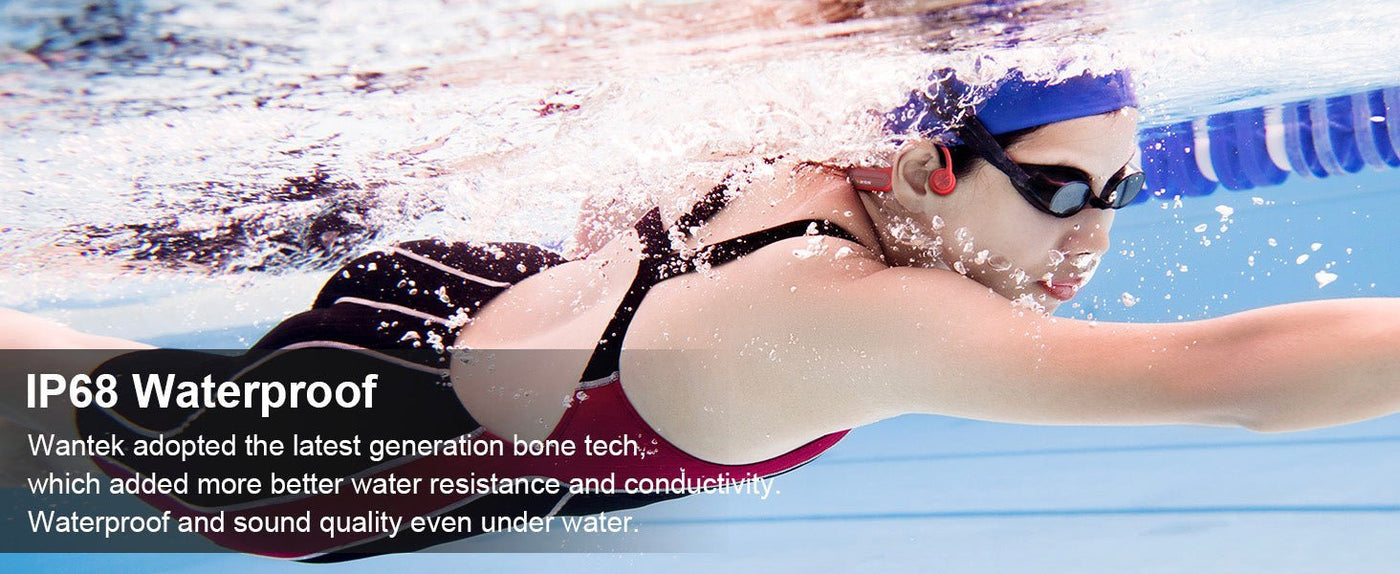
Ordinary Bluetooth audio does not stream reliably underwater. Water weakens the 2.4 GHz radio signal between a phone and submerged headphones. Swimming-oriented bone-conduction models therefore use onboard audio storage in the pool, while Bluetooth remains useful for supported listening on land.
Quick answer: choose a model with water-use guidance that matches your swim and enough onboard storage for local audio. Wantek BC3 Pro and Shokz OpenSwim Pro both combine IP68 protection with 32GB of storage, but their Bluetooth connection is for use above water rather than normal phone streaming while submerged.

Does Bluetooth Work Underwater?
Not reliably for normal phone-to-headset audio streaming. Shokz explicitly states that OpenSwim Pro uses MP3 Mode underwater because water disrupts Bluetooth. Wantek gives the same practical guidance for BC3 Pro: transfer MP3 files to the headset and use its onboard storage in the pool.
Bluetooth uses 2.4 GHz radio waves, which lose strength as they travel through water. Keeping your phone dry on the pool deck does not make streaming reliable when the headset is submerged. An IP68 rating describes water ingress protection under specified conditions, not underwater Bluetooth range.
Plan your swim playlist before entering the water. Offline songs saved inside Spotify, Apple Music, or another streaming app are not automatically transferable MP3 files. The headset needs compatible local files on its own storage.
What to Check Before Using Bone-Conduction Headphones for Swimming
| Check | Why it matters | What to verify |
|---|---|---|
| Water protection | An IP rating alone does not state every allowed depth, duration, or environment. | Read the exact manufacturer's immersion and care guidance for the model and region. |
| Onboard storage | Local playback avoids dependence on a phone-to-headset Bluetooth link underwater. | Storage capacity, supported file formats, and transfer method. |
| Physical controls | A touchscreen or phone app is not practical while submerged. | How to switch modes, start playback, change tracks, and adjust volume from the headset. |
| Fit with swim gear | Goggles and caps can alter pressure and transducer position. | Whether the frame stays secure and comfortable with your normal equipment. |
Wantek BC3 Pro: Bluetooth on Land, 32GB MP3 Storage in the Pool
The current Wantek BC3 Pro product page lists IP68 protection, 32GB of onboard MP3 storage, Bluetooth 5.3, a built-in microphone, 32 g weight, and up to six hours of battery life. Wantek's swimming guidance directs users to MP3 mode for pool playback because water disrupts Bluetooth.
BC3 Pro is therefore best understood as a dual-use device: Bluetooth for supported dry-land listening and local MP3 playback for swimming. Its current product page does not state a specific immersion depth, so do not infer a deeper-water limit from the IP68 label alone.
Shokz OpenSwim Pro: The Same Two-Mode Principle
Shokz's current OpenSwim Pro page lists IP68 protection, 32GB integrated storage, Bluetooth 5.4 for land use, and MP3 Mode underwater. Shokz states that underwater use is limited to MP3 Mode because Bluetooth signals are disrupted by water.
Shokz also publishes more specific water-use guidance for this model, including submersion up to two meters in fresh water and after-use care for open-water exposure. Follow the latest instructions for the exact regional model rather than extending those limits to a different product.
BC3 Pro vs. OpenSwim Pro: What Is Actually Comparable?
Both models use bone conduction, list IP68 protection, provide 32GB of local storage, and separate land-based Bluetooth from underwater local playback. Their published specifications differ in weight, Bluetooth version, file support, app features, battery reporting, and water-use detail.
For the full specification comparison, use the BC3 Pro vs. Shokz OpenSwim Pro guide. It keeps the battery figures and water-use conditions separate instead of treating unmatched manufacturer tests as equivalent.
Do You Need Bone Conduction Specifically?
Bone conduction leaves the ear canal physically open and uses transducers against the head. That can be useful for swimming because there is no conventional earbud speaker sitting in the canal, but it does not guarantee better sound, fit, or comfort for every swimmer.
The bone conduction headphones guide explains how the technology works, where open-ear listening helps, and the trade-offs compared with conventional headphones.
Pool Swimming vs. Open Water
Do not treat “waterproof” as permission for every aquatic activity. Swimming depth, time submerged, salt exposure, chlorine, diving pressure, and post-use care are model-specific issues. An IP68 label establishes a protection classification under specified test conditions; the manufacturer's operating instructions define the practical use boundary for that product.
- Use the manufacturer's published depth and environment limits.
- Rinse or clean the headset as directed after chlorine or salt exposure.
- Dry charging contacts before charging.
- Do not extend “swimming” guidance into deeper diving unless the manufacturer explicitly supports it.
How to Prepare Music for an Underwater Session
Check supported file formats
Use the exact model documentation. Do not assume every swim headset supports the same formats.
Transfer local audio files
Connect the headset to a computer using the manufacturer's supported cable or transfer method and copy compatible files to onboard storage.
Switch to local playback before swimming
Confirm that MP3 or memory mode works while you are still dry so you do not depend on a phone connection in the pool.
Use the physical controls
Learn the headset's playback and mode buttons before entering the water.
Frequently Asked Questions
Can I stream Spotify to bone-conduction headphones underwater?
Do not plan on normal Bluetooth streaming while submerged. Use compatible local files stored on a swim headset that supports onboard playback.
Will Bluetooth work if my phone stays above the water?
Do not count on it. The signal still has to reach submerged headphones through water. For swimming, use a model's supported onboard playback mode instead of relying on a poolside phone.
Why do swimming headphones advertise Bluetooth if it does not work underwater?
Bluetooth is useful for dry-land listening, calls, or setup on supported models. Swimming mode can use the same headset's onboard storage instead.
Is IP68 enough for diving?
No. Check the manufacturer's specific depth, duration, environment, and care instructions. A general IP68 label should not be extended to deep diving without explicit support.
How much storage do BC3 Pro and OpenSwim Pro provide?
Both current product pages list 32GB of onboard storage. Supported formats and playback features differ, so compare those separately.
Can I use BC3 Pro as ordinary Bluetooth headphones outside the pool?
Yes. Wantek lists Bluetooth 5.3 for supported dry-land use and onboard MP3 storage for offline playback, including swimming.
Want a Swimming-First Wantek Option?
Check the current BC3 Pro page for IP68 protection, 32GB MP3 storage, Bluetooth 5.3, battery information, and availability.

