
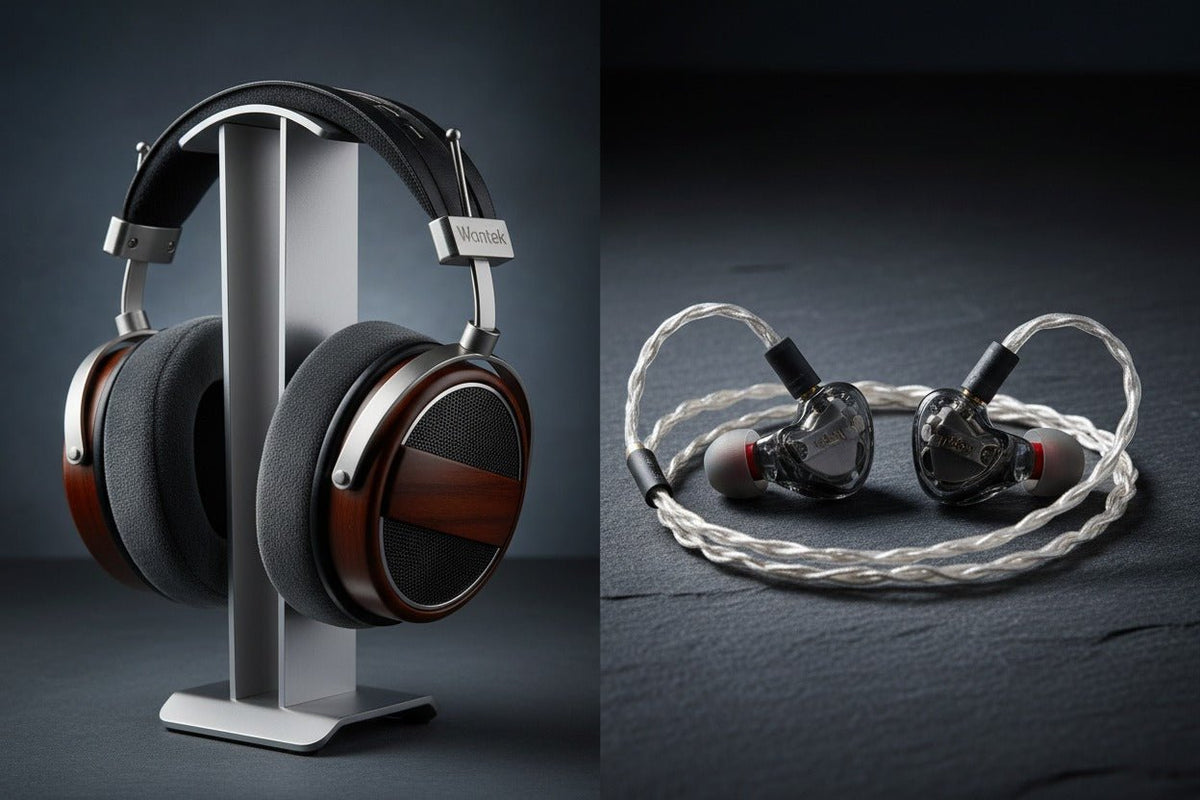
Headphones and earphones solve the same basic problem in different ways. Headphones use a headband with earcups that sit on or around your ears. Earphones are much smaller and sit at the ear canal entrance or seal inside it. That difference affects portability, fit, isolation, heat, and how each device fits into daily life.
Quick answer: start with headphones if you want a larger, head-worn design for desk use, long stationary sessions, or a wider choice of open-back and over-ear options. Start with earphones if pocket-size portability, exercise-friendly fit, or strong passive isolation from a sealed in-ear design matters more. Neither form factor automatically guarantees better sound, comfort, noise cancellation, or hearing safety.
| Factor | Headphones | Earphones |
|---|---|---|
| Fit | Over-ear models surround the ear; on-ear models rest on it. | Earbuds rest near the ear canal; in-ear models use tips that seal in the canal. |
| Portability | Usually bulkier and more noticeable to carry. | Usually easier to pocket, store, and use while moving. |
| Comfort | Depends on clamp force, pad size, weight distribution, glasses, and heat. | Depends on ear shape, tip size, insertion depth, and tolerance for an in-ear seal. |
| Isolation | Closed-back models can isolate well; open-back models intentionally leak sound. | Sealed in-ear models can provide strong passive isolation when the fit is correct. |
| Sound | Over-ear and open-back designs can support a spacious presentation, but tuning and implementation matter more than size alone. | Well-designed in-ear models can deliver excellent bass, detail, and low distortion; a poor seal can change the sound substantially. |
| Wireless use | More physical room can allow larger batteries and controls, but runtime varies by model and settings. | True wireless models trade very small earpieces for a charging case and more frequent charging cycles. |

What counts as headphones and earphones?
For this comparison, headphones means headband-style designs: over-ear headphones that surround the ear and on-ear headphones that rest on it. Earphones means smaller products worn at or inside the ear. Everyday terminology is inconsistent, so “earbuds,” “in-ear headphones,” “IEMs,” and “earphones” are sometimes used interchangeably even though the fit can differ.
Over-ear and on-ear headphones
Over-ear headphones use pads that sit around the outer ear. On-ear headphones use smaller pads that press on the ear itself. The larger chassis gives designers more room for drivers, batteries, controls, microphones, and acoustic structures, but none of those advantages guarantees better performance on its own.
Earbuds and in-ear monitors
Traditional earbuds rest in the outer ear without creating a deep seal. In-ear headphones and IEMs use silicone, foam, or custom tips to seal the ear canal. That seal can improve bass consistency and passive isolation, but only when the fit works for the listener.
1. Comfort and fit: neither style wins for everyone
Comfort is more individual than the form factor label suggests. Over-ear headphones avoid inserting anything into the ear canal, which some listeners prefer for long sessions. Their disadvantages can include headband pressure, heat around the ears, pad pressure against glasses, and overall weight.
Earphones remove the headband and most of the weight, but they introduce a different fit problem: the earpiece and tip must match the user’s ear anatomy. A tip that is too large, too small, or inserted poorly can cause soreness, looseness, weak bass, or reduced isolation.
Practical rule: do not buy by form factor alone when comfort is a priority. Check return options, try more than one ear-tip size when applicable, and evaluate comfort over the length of session you actually expect to use the device.
2. Portability and movement
Earphones have the clear size advantage. Wired earphones can fit in a small pouch, while true wireless earbuds usually fit in a pocket-size charging case. That makes them convenient for commuting, travel, walking, and workouts.
Headphones take more bag space and can move more during vigorous activity. Foldable designs reduce bulk, but they remain larger than earphones. For stationary listening, that size penalty may not matter at all.
3. Sound quality: form factor changes the design, not the final score
It is inaccurate to assume that headphones always sound better because they use larger drivers, or that earphones are automatically more detailed because the driver sits closer to the ear. Frequency response, distortion, enclosure design, seal, driver implementation, DSP, and tuning all matter.
Over-ear headphones—especially open-back designs—can create a spacious presentation because the driver and enclosure interact with the outer ear differently. In-ear models can produce excellent extension and detail while using the ear-canal seal to control low-frequency leakage. A strong model in either category can outperform a weak model in the other.
4. Passive isolation and active noise cancellation are separate questions
Passive isolation comes from the physical barrier between outside sound and your ear. A well-sealed in-ear monitor can isolate strongly without electronics. Closed-back headphones can also block outside sound through their pads and cups, while open-back headphones intentionally provide little isolation.
Active noise cancellation (ANC) uses microphones and signal processing to reduce selected ambient sounds. ANC exists in both over-ear headphones and true wireless earphones, and performance is model-specific. Do not assume a category is better without comparing measurements or reliable testing for the exact products.
5. Wireless headphones and true wireless earphones
Wireless headphones and true wireless earphones both use batteries, radios, codecs, and onboard electronics. Headphones have more physical room for batteries, but actual runtime depends on the model, listening level, ANC, codecs, calls, temperature, and other features. True wireless earphones split battery capacity between the earpieces and their charging case.
If connection method is the next decision after form factor, compare wired and wireless options separately for mobility, charging, latency, source compatibility, and the features you actually use.

6. Calls and meetings: microphone design matters more than earcup size
For voice calls, the microphone system and its placement are often more important than whether the speakers are over-ear or in-ear. Consumer headphones and earbuds may use built-in microphone arrays. Purpose-built work headsets often use a boom microphone, dedicated mute controls, and connection options designed around calls.
If calls are the main job, compare the microphone, controls, device compatibility, and connection path rather than treating “headphones” or “earphones” as a proxy for call quality.
7. Which is better for commuting, workouts, gaming, or home listening?
| Use case | Start with | Why |
|---|---|---|
| Commuting | Sealed earphones or closed-back ANC headphones | Isolation, portability, and noise control usually matter more than form factor alone. |
| Workouts | Secure-fit earphones or open-ear sports designs | Low weight and stability are useful while moving; check fit, durability, and environmental awareness for the activity. |
| Home listening | Over-ear headphones | Bulk matters less at home, and you gain access to many closed-back and open-back designs. |
| Gaming | Headset or headphone/earphone based on platform and mic needs | Connection, latency, microphone routing, comfort, and platform support matter more than speaker location. |
| Work calls | Purpose-built headset when calls dominate | Boom mic placement, mute controls, connection, and device compatibility can outweigh music-first features. |
| Minimal everyday carry | Earphones | They are easier to pocket and carry than full-size headphones. |
8. Which is safer for your hearing?
Neither headphones nor earphones are inherently safe or unsafe at normal listening levels. Hearing risk depends mainly on sound level and exposure time. The World Health Organization’s safe-listening guidance gives 80 dB for up to 40 hours per week as an example exposure level; at 90 dB, the example drops to four hours per week. WHO also suggests keeping device volume at no more than 60% of maximum as a simple practical habit, while noting that monitored sound level is more informative.
The National Institute on Deafness and Other Communication Disorders notes that long or repeated exposure at or above 85 dBA can cause noise-induced hearing loss. A well-fitting device or effective noise control can help reduce the temptation to raise volume in noisy places, but the listening level still matters.
How to choose between headphones and earphones
- Choose the wearing style you can tolerate. Decide whether you prefer pressure around the ears, on the ears, or inside the ear canal.
- Match the form factor to where you listen. Pocket portability favors earphones; stationary desk or home use makes full-size headphones easier to live with.
- Decide how much isolation you need. Compare sealed in-ear, closed-back, open-back, and ANC designs separately.
- Check the actual connection path. Wired, Bluetooth, USB, and console/controller support are separate from the wearing style.
- Prioritize the job that matters most. Music, calls, gaming, commuting, and exercise can require different compromises.
For a broader checklist covering form factor, sound, connectivity, comfort, ANC, microphones, and budget, use Wantek’s beginner’s guide to choosing headphones.
Choosing Mainly for Work Calls?
Start with your device and connection, then narrow the wearing style and microphone requirements.
Frequently Asked Questions
Are earphones and earbuds the same thing?
Not always. “Earphones” is often used broadly for small in-ear products. Traditional earbuds rest near the ear-canal entrance, while in-ear headphones and IEMs use tips that create a seal inside the canal.
Are headphones better than earphones?
No. Headphones and earphones optimize different trade-offs. Fit, tuning, isolation, connection, microphone design, and the listening environment matter more than the category name by itself.
Which is better for long listening sessions?
It depends on fit. Some people prefer over-ear pads because nothing enters the ear canal; others prefer lightweight earphones. Evaluate pressure, heat, tip fit, and comfort over your normal session length.
Which is better for workouts?
Earphones and open-ear sports designs are often easier to secure and carry while moving. Check the exact fit, durability, sweat or water rating, controls, and the level of environmental awareness your activity requires.
Which is safer for hearing: headphones or earphones?
Neither is inherently safer. The main variables are playback level and exposure time. A secure fit or effective noise control can help you hear clearly without turning the volume up as much in noisy environments.

