
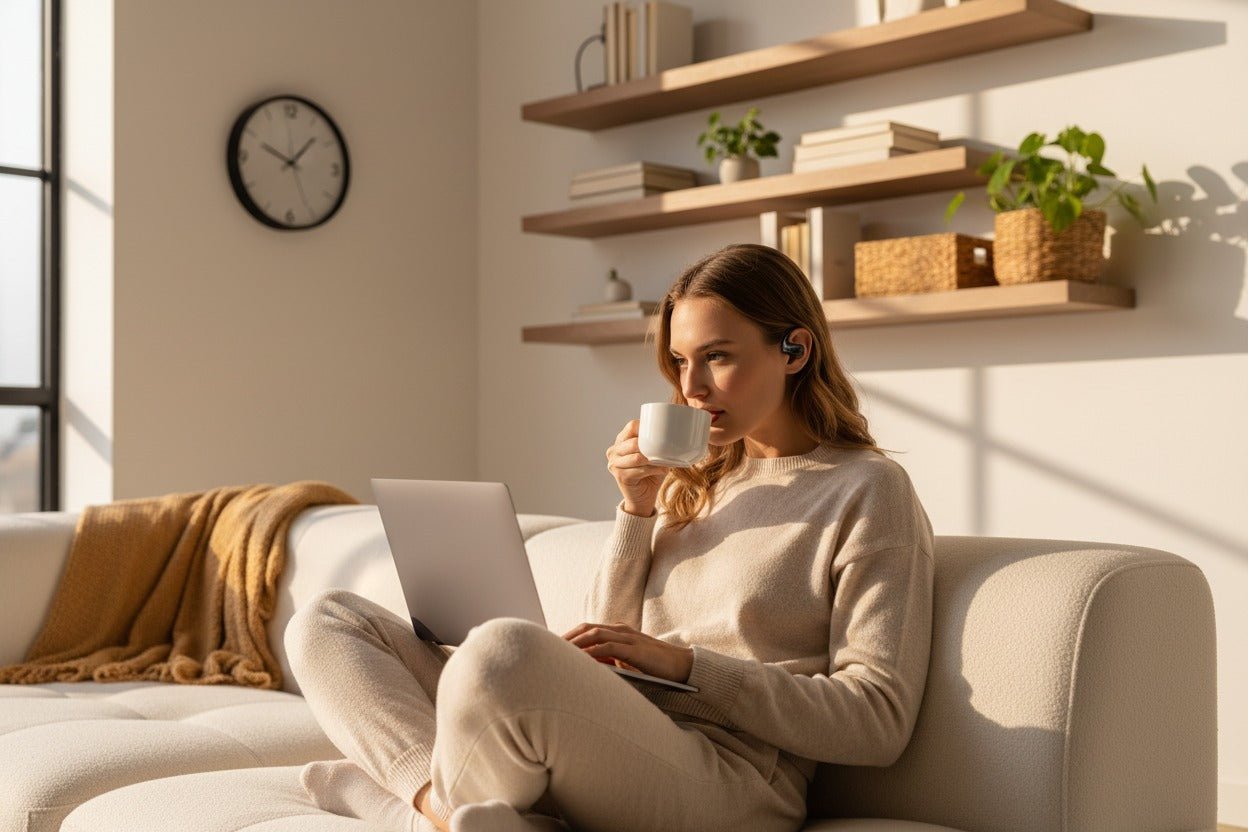
The best open-ear earbuds for phone calls are the ones that match where you call, how much surrounding sound you need to hear, and whether you switch between a phone and computer. Microphone hardware matters, but mic count alone does not prove call quality.
Quick answer: For a call-focused clip-on design, the Anker soundcore AeroClip 2 has the most explicit call-oriented hardware description in this group: four microphones, two voice pickup units, and multipoint. Shokz OpenFit Pro is the ear-hook option to compare when published wind-control features matter. Shokz OpenDots 2 combines a compact clip-on fit with three microphones and multipoint. Bose Ultra Open Earbuds (2nd Gen) target premium everyday listening and calls. Wantek OBT030 is a simpler open-ear clip-on for everyday listening and casual calls.
This is a specification-based comparison, not a Wantek-controlled microphone test. Published battery figures below are playback or general battery figures unless the manufacturer specifically labels them as talk time.
What Does Open-Ear Mean for Phone Calls?
Open-ear earbuds keep the ear canal unsealed. Most current models use small air-conduction speakers positioned outside the canal; some open-ear headphones use bone conduction instead. If the terminology is still unclear, the guide to headphones that do not go in your ear explains the main fit types and where each design sits.
For calls, that open fit has a useful tradeoff. You can hear more of the room, traffic, or coworkers around you, but the same openness means outside noise can also compete with the caller's voice. A strong microphone system can help the person on the other end hear you; it cannot seal your own ears from a loud environment.

Best Open-Ear Earbuds for Phone Calls at a Glance
| Option | Documented call and connection features | Best match and main limit |
|---|---|---|
| Anker soundcore AeroClip 2 | Four microphones plus two voice pickup units, Bluetooth 6, multipoint, 8-hour playback and 32 hours with the case, IP57, 6.2 g per earbud. | Call-first clip-on shoppers who want an explicitly call-focused design. Published playback time is not the same as verified continuous talk time. |
| Shokz OpenFit Pro | AI-powered triple-mic system with published wind-control technology, Bluetooth 6.1, multipoint, IP55, up to 12 hours per charge with open-ear noise reduction off. | Active or outdoor callers who prefer an ear-hook fit and want documented wind-focused call features. It is larger than clip-on designs. |
| Shokz OpenDots 2 | Three microphones per earbud, including one bone-conduction microphone, multipoint, Bluetooth 6.1, up to 10 hours per charge and 40 hours with the case, IP57. | Compact clip-on fit plus a two-device workflow. The microphone design is documented, but Wantek has not run a head-to-head call test against the other models here. |
| Bose Ultra Open Earbuds (2nd Gen) | SpeechClarity call technology, Bluetooth multipoint, up to 9 hours of playback, wireless charging and an open cuff-style fit. | Premium everyday music and calls in one open-ear design. Bose lists no active noise cancellation on this model. |
| Wantek OBT030 | Open-ear clip-on design, Bluetooth 5.4, built-in microphone, listed 8-hour battery life and up to 50 hours total with the charging case, 8.5 g listed weight. | Lower-cost everyday listening and casual calls. The current product page does not list multipoint or a specialized call-noise-reduction microphone system. |
How to read the table: these are manufacturer-published features, not a normalized lab score. Battery test conditions differ, and features such as "AI noise reduction" or "SpeechClarity" are brand-specific systems rather than directly comparable performance measurements.
Which Option Fits Your Call Routine?
For a call-focused clip-on: Anker soundcore AeroClip 2
AeroClip 2 is the clearest call-first candidate in this set on published hardware alone. Soundcore lists four high-SNR microphones, two bone-conduction voice pickup units, dual-device connection, and button controls. That makes it easy to shortlist when your main question is whether a clip-on open-ear design has dedicated call hardware rather than only a basic built-in mic.
That does not make it a universal winner. Fit is personal, the 8-hour figure is playback time, and manufacturer processing claims still need to be judged in the places where you actually take calls.
For an ear-hook fit and wind-focused features: Shokz OpenFit Pro
OpenFit Pro uses an ear-hook design rather than a cuff-style clip. Shokz documents a triple-mic call system, wind-control technology, multipoint, and up to 12 hours of listening per charge with open-ear noise reduction disabled. It is a sensible model to compare if outdoor movement and a secure hook matter as much as phone-call use.
For a compact clip-on and two-device workflow: Shokz OpenDots 2
OpenDots 2 uses two air-conduction microphones plus one bone-conduction microphone per earbud, and Shokz supports multipoint through its app. If you move between a phone and laptop, that connection behavior is more useful than a headline Bluetooth version by itself.
For premium open-ear listening plus calls: Bose Ultra Open Earbuds (2nd Gen)
Bose's second-generation Ultra Open model adds SpeechClarity call processing, multipoint and up to 9 hours of playback in a cuff-style design. It is the option here to compare when music, comfort and everyday calls all matter. It is not a sealed ANC earbud, so do not buy it expecting the listener-side isolation of Bose's in-ear QuietComfort line.
For a simpler Wantek option: OBT030
Wantek OBT030 is a lightweight open-ear clip-on with Bluetooth 5.4 and a built-in microphone. Its current product page lists 8 hours of battery life and up to 50 hours total with the charging case. Wantek positions it for workouts, commuting, everyday listening and casual calls.
If professional call quality is your first priority, compare OBT030's simpler microphone specification against call-focused models before buying. The current OBT030 page does not publish beamforming, multipoint or a dedicated wind-noise call rating.
Prefer a Simple Open-Ear Clip-On?
Compare the Wantek OBT030 if you want a lightweight open-ear fit for everyday listening, commuting and casual calls rather than a business headset with a boom microphone.
What to Check Before You Buy Open-Ear Earbuds for Calls
1. Separate microphone claims from listener-side noise control
Microphone noise reduction is meant to improve the voice sent to the other person. Active noise cancellation changes what you hear. Those are different jobs. An open-ear model can have sophisticated microphone processing while still letting substantial outside sound reach your ears.
2. Match the product to your noisiest normal call location
A quiet home office, a shared office, a sidewalk and a train platform are very different test cases. Open-ear earbuds are most attractive when awareness matters, but a very loud environment can make the caller hard for you to hear even if your microphone is doing a good job.
3. Verify multipoint if you use both a phone and laptop
Multipoint can reduce the friction of moving between devices, but implementation varies. Check whether the exact model can stay connected to two devices, how it handles an incoming call, and whether its app is required to enable or manage the feature.
4. Compare talk time with talk time, not case totals
Playback time, talk time, standby time and total battery with a charging case answer different questions. If you spend hours in meetings, look for a published continuous-call figure when available. Do not assume a 40- or 50-hour case total means the earbuds can stay on one call for that long.
5. Check fit with glasses, hats and movement
Clip-on, cuff and ear-hook designs put pressure on different parts of the outer ear. If you wear glasses or a hat, the best choice is the one that stays stable without competing for the same space. The broader ear cuff headphones guide covers clip-on fit and buying factors in more detail.

When Open-Ear Earbuds Are Not the Best Tool
If you take calls in a consistently loud office, vehicle, warehouse or other high-noise setting, keeping the ear canal open may work against your ability to hear the other person. A call-focused headset with a boom microphone or a more isolating listening design can be the better category.
For work calls where microphone position, mute controls and device switching matter more than an earbud-style fit, compare the separate guide to Bluetooth headsets for phone calls. That page covers boom-mic and mono options that solve a different problem from open-ear earbuds.
Open-Ear Earbuds vs. Bone Conduction for Calls
Open-ear is a wearing category, not one single audio technology. Most clip-on and ear-hook earbuds use air conduction, while bone-conduction headphones send playback vibration through contact points on the head. Neither technology guarantees better call quality; the microphone system is a separate design decision.
If you are choosing between those two categories for outdoor use, the open-ear earbuds vs. bone conduction guide explains the fit, playback and use-case differences without treating either one as universally better.
Frequently Asked Questions
Are open-ear earbuds good for phone calls?
They can be. Open-ear earbuds are useful when you want to hear your surroundings, but call quality depends on microphone design, wind handling, connection stability and the noise level around you.
Do open-ear earbuds have noise cancellation?
Some use microphone noise reduction, and a few add listener-side open-ear noise reduction. Those features are not automatically the same as active noise cancellation in sealed in-ear earbuds.
Is multipoint important for work calls?
It is useful if you regularly use both a phone and computer. Confirm that the exact model supports two simultaneous device connections and test how it switches during incoming calls.
Are bone-conduction headphones better than open-ear earbuds for calls?
Not automatically. Bone conduction describes how you hear playback; call quality still depends on the microphone system, processing, wind exposure, fit and the environment where you speak.

