
The best wireless earbuds for jogging are the ones that stay secure on your ears, have documented protection for the sweat or weather you expect, and match how much outside sound you need to hear. For outdoor routes, that may mean an open-ear design or a usable ambient mode. For treadmills and controlled indoor workouts, a sealed in-ear design with stronger isolation may make more sense.
Quick buying rule: choose the fit and running environment first, then compare water resistance, single-charge battery life, controls, and phone or watch compatibility.
- Secure fit: ear hooks, stabilizing structures, clip-on designs, or correctly sized ear tips can reduce movement, but no design fits every ear equally well.
- Sweat and rain: read the exact IP rating and the manufacturer’s use limits instead of treating “sport” or “sweatproof” as universal protection.
- Outdoor awareness: open-ear designs and ambient modes can make surrounding sound more accessible, but neither guarantees that you will notice every vehicle, cyclist, runner, or warning.
- Battery: compare earbud runtime in the mode you will actually use, not only the larger case-total number.
If you have not decided between sealed in-ear earbuds, open-ear earbuds, and wraparound running headphones, start with Wantek’s broader running-headphone guide. This page stays narrower: wireless earbuds and ear-mounted designs for jogging.

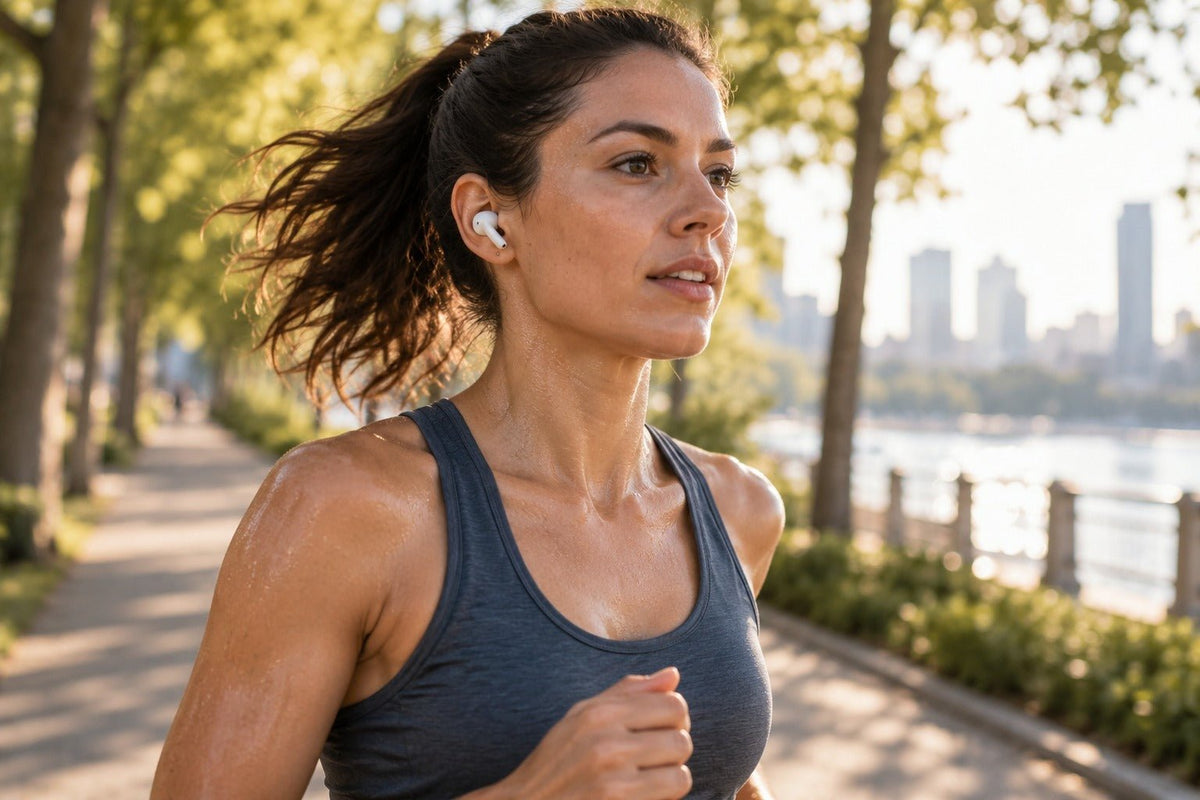
Editorial illustration retained from the original article. It does not document a Wantek heart-rate feature or any verified product specification.
What Matters Most in Jogging Earbuds
1. Fit and retention come before extra features
Running creates repeated impact, head movement, sweat, and jaw motion. Ear hooks add a mechanical anchor around the ear. Stabilizing fins brace an in-ear design against the outer ear. Clip-on and other open-ear designs use different contact points instead of relying on a sealed silicone tip.
None of those designs can guarantee a secure fit for every runner. Ear shape, glasses, hats, hair, and personal comfort all affect retention. If fit is uncertain, the return policy and included fit options can matter more than one additional audio feature.
2. Read the IP rating literally
The IEC 60529 IP Code classifies degrees of enclosure protection against solid-particle and water ingress. A product’s exact rating should still be read together with the manufacturer’s own use and care instructions.
There is no universal rule that running earbuds must be IP57 or higher. For example, Powerbeats Pro 2 are officially rated IPX4 for sweat and water resistance, Shokz OpenFit 2+ earbuds are IP55, and JBL Endurance Peak 4 earbuds are IP68. Those ratings describe different tested protection levels; they do not establish which pair will fit your ears best.

Editorial illustration retained from the original article. The image does not establish a Wantek IP rating. Use the published specification for the exact product model instead.
3. Decide how much outside sound you need
Sealed in-ear earbuds can provide stronger passive isolation and may add active noise cancellation. That can be useful on a treadmill or in a controlled gym. Outdoors, open-ear designs leave the ear canal unsealed, while transparency or ambient modes use microphones to mix external sound into what you hear.
Neither approach is a safety guarantee. NHTSA advises pedestrians to stay alert and avoid electronic-device distraction that takes their eyes or ears off the road. Route conditions, traffic, playback volume, wind, and attention still matter.
4. Compare battery life on the same basis
Battery headlines often mix two figures: one-charge listening time from the earbuds and a larger total after recharging from the case. ANC and other features can reduce runtime. For a long run, the single-charge figure in your expected listening mode matters more than a case-total number.
5. Check controls and source compatibility
If you run without your phone, confirm that your watch or other source device supports the playback and controls you expect. Do not assume a newer Bluetooth version automatically means better range, lower latency, multipoint, or stronger connection stability; those depend on the full implementation on both devices.
Current Wireless Earbuds to Compare for Jogging
This is a specification-based shortlist, not a claim that Wantek road-tested these products side by side. The examples show how current designs solve different jogging needs. Fit, sound, ANC quality, microphone performance, and long-term durability are not ranked here.
| Model | Fit and protection | Battery and useful features |
|---|---|---|
| Powerbeats Pro 2 | In-ear with reinforced secure-fit ear hooks; IPX4 sweat and water resistance | Up to 10 hours with ANC off and up to 8 hours with ANC on; up to 45 hours total; ANC, Transparency mode, physical volume controls, optional heart-rate monitoring |
| JBL Endurance Peak 4 | In-ear sport design with ear hooks and TwistLock; IP68 earbuds | Up to 12 hours with ANC off or 8 hours with ANC on; up to 48 hours total; Smart Ambient and multipoint |
| Shokz OpenFit 2+ | Open-ear air-conduction ear-hook design; IP55 earbuds | Up to 11 hours per charge and 48 hours with case; physical controls and multipoint |
| Bose Ultra Open Earbuds (2nd Gen) | Open-ear cuff design; IPX4 sweat and water resistance | Up to 9 hours; Bluetooth 5.4, multipoint, wireless charging; no ANC |
| Wantek OBT030 | Open-ear clip-on design; current product page does not state an IP rating | 8-hour earbud specification and up to 50 hours total with case; Bluetooth 5.4 and built-in microphone |
How the Main Designs Differ
Powerbeats Pro 2: ear-hook retention with a sealed in-ear fit
Powerbeats Pro 2 use reinforced ear hooks plus in-ear tips. Beats lists IPX4 sweat and water resistance, ANC, Transparency mode, on-device volume controls, and optional heart-rate monitoring for workouts. The manufacturer publishes up to 10 hours from the earbuds with ANC and Transparency off, or up to 8 hours with ANC on.
This format is worth comparing if you want a strong mechanical anchor around the ear but still prefer a sealed in-ear design.
JBL Endurance Peak 4: higher published ingress protection
JBL lists Endurance Peak 4 earbuds at IP68 and uses an ear-hook sport design with TwistLock. The published battery figures are up to 12 hours with ANC off and 8 hours with ANC on, with up to 48 hours total from the earbuds and case.
The model also includes Smart Ambient and multipoint. Its IP68 earbud rating is relevant for runners who expect heavier sweat or wet conditions, but fit and the charging case’s separate protection still need to be considered.
Shokz OpenFit 2+: an open-ear ear-hook approach
OpenFit 2+ uses air conduction rather than bone conduction and keeps the ear canal open. Shokz lists IP55 protection for the earbuds, up to 11 hours on one charge, up to 48 hours with the case, physical buttons, and multipoint pairing.
If keeping the ear canal unsealed is the priority, compare it with other options in Wantek’s open-ear headphones guide rather than assuming all open-ear products use the same fit or technology.
Bose Ultra Open Earbuds (2nd Gen): cuff-style open-ear fit
Bose’s 2026 second-generation Ultra Open Earbuds use a cuff-shaped open-ear design. Bose lists IPX4 sweat and water resistance, up to 9 hours of battery life, Bluetooth 5.4, multipoint, and wireless charging. They do not use active noise cancellation.
This design is relevant if you want an open-ear format without a conventional over-ear hook or in-ear seal.
Wantek OBT030: a simpler open-ear clip-on option
The Wantek OBT030 product page lists a clip-on open-ear design, Bluetooth 5.4, an 8.5 g weight, a built-in microphone, an 8-hour earbud battery specification, and up to 50 hours of total battery life with the case.
The current product page does not publish an IP rating. That means the OBT030 should not be presented as a documented rain- or heavy-sweat option unless Wantek publishes an appropriate protection specification for the exact model.
Compare the Wantek OBT030
If a lightweight open-ear clip-on format fits your training style, review the current OBT030 fit, battery, Bluetooth, microphone, price, and availability details. Check your sweat and weather requirements separately because the current page does not state an IP rating.
Outdoor Jogging: Awareness Still Depends on the Runner

Leaving the ear canal open can make outside sound easier to hear than a strongly isolating seal, but it does not guarantee situational awareness. Keep the route, traffic, volume, and your own attention in the decision. NHTSA’s pedestrian guidance specifically recommends staying alert and avoiding electronic-device distraction that takes your eyes or ears off the road.
Listening level matters for hearing health as well. The World Health Organization’s safe-listening guidance notes that hearing risk depends on both sound level and listening duration and recommends keeping personal-device volume no higher than about 60% of maximum as a practical measure.
A Practical Jogging-Earbud Checklist
Choose the retention style
Decide whether you prefer in-ear tips, stabilizing wings, over-ear hooks, a clip-on design, or another open-ear structure.
Match protection to expected exposure
Read the exact published IP rating and the manufacturer’s sweat, rain, splash, immersion, and care limits.
Set your awareness requirement
For outdoor routes, decide whether you want an open-ear design, an ambient mode, or another approach that matches your environment.
Compare one-charge battery life
Use the figure for the mode you expect to run with, especially when ANC or other features change runtime.
Verify your phone or watch
Confirm playback, app, codec, multipoint, heart-rate, and control requirements only if you actually plan to use them.
Final Takeaway
Do not choose jogging earbuds from a single “best” label. Start with retention and running environment. Then verify the exact water-resistance claim, decide how much outside sound you need, compare battery figures on the same basis, and check compatibility with the device you actually run with.
That process separates meaningful differences—such as sealed versus open-ear fit, IPX4 versus IP55 or IP68 protection, and earbud-only versus case-supported battery life—from features that may not matter on your route.
Frequently Asked Questions
What type of wireless earbuds stay in best while jogging?
Ear hooks, stabilizing wings, secure clip-on designs, and correctly sized in-ear tips can all improve retention. No design fits every ear, so fit options and a workable return policy still matter.
What IP rating do jogging earbuds need?
There is no universal minimum. Match the manufacturer’s documented rating and use limits to the sweat, rain, dust, or water exposure you actually expect.
Are open-ear earbuds better for outdoor running?
They keep the ear canal unsealed, which can make surrounding sound more accessible. Volume, traffic, wind, route conditions, and attention still determine how much you notice around you.
Should I use ANC while jogging outside?
Choose the listening mode around your route and awareness needs. Full isolation may be more appropriate indoors; outdoor routes can require greater access to surrounding sound and attention.
Is the charging-case battery number useful for runners?
It shows how long you can go between wall charges, but single-charge earbud runtime matters more for one uninterrupted long run. Compare both figures separately.
Can I run with the Wantek OBT030 in rain?
The current OBT030 product page does not state an IP rating, so a specific level of rain or sweat protection should not be assumed from its workout positioning alone.

