
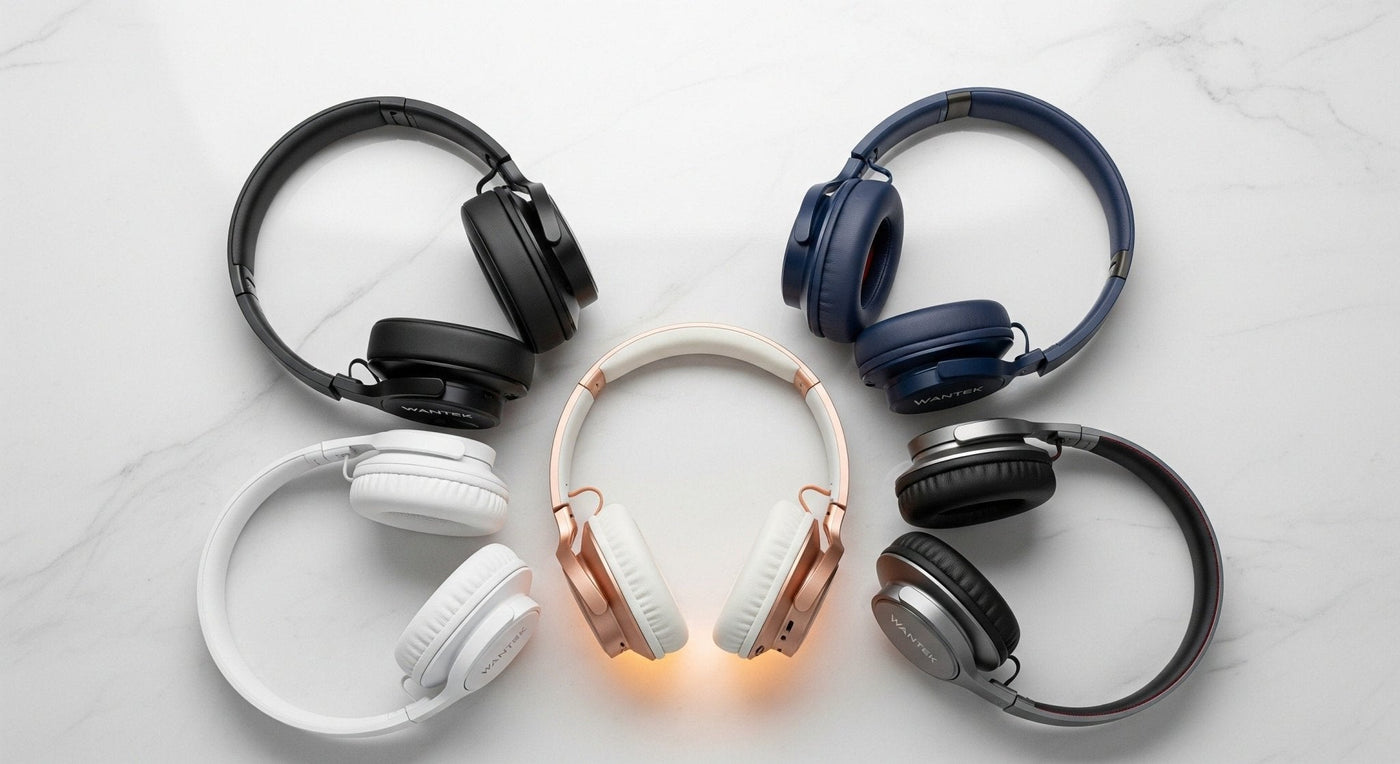
For a small head, the most useful headphone specification is often the one missing from the product page: how the headset fits at its shortest adjustment. Start by checking whether the cups sit around your ears without sliding below them. Low weight helps, but it does not prove a secure fit.
Check fit before comparing features
Head circumference alone cannot predict comfort. Headband shape, cup height, pad depth, and the angle of your jaw all affect where the headphones sit. A smaller head also does not necessarily mean smaller ears.
| Check | A useful result | Reason to try another fit |
|---|---|---|
| Shortest setting | Cups line up with your ears | Cups hang below your ears |
| Head movement | Headband stays seated during a gentle nod | You keep repositioning it |
| Pad contact | Even contact without a painful pressure point | Gaps or pressure near the jaw |
| Ear clearance | Your ears fit inside over-ear openings | The pads or driver covers press on your ears |
| Glasses | Usual frames remain comfortable | Temple pressure or a changed seal |
If you are deciding between pads that surround the ears and pads that sit on them, read our over-ear versus on-ear comparison. On-ear designs avoid a large cup opening, but they apply pressure directly to the outer ear.

Three models worth trying for different uses
These are candidates drawn from the original shortlist, not a measured ranking of minimum head size. Their documented designs help narrow the type of headphone to try; none is guaranteed to fit every small head.
Sony WH-CH720N: wireless listening with ANC
Sony lists an over-ear design and a weight of approximately 6.8 ounces in its WH-CH720N specifications. It is a candidate when you want wireless listening and noise cancellation without a heavy headset. Check the minimum headband setting and whether the cups remain level before treating the low weight as a fit advantage.
Audio-Technica ATH-M50x: wired, closed-back listening
The ATH-M50x has swiveling cups, a collapsible design, and detachable cables. Those features are useful for positioning and storage, but do not establish minimum fit. Try it when you want a wired headphone; pay particular attention to pad pressure and the space inside the cups.
Sennheiser HD 599: open-back listening at home
Sennheiser describes the HD 599 as an open-back headphone with large cups and replaceable pads. Try it in a quiet room if that design suits your listening. Check headband reach and stability directly; large pads do not prove it will fit a small head. The open construction also makes it a poor choice when you need acoustic privacy.
Run a repeatable fitting session
- Start at the shortest headband setting and extend each side only as needed.
- Wear your usual glasses. Move your head gently and check whether the cups slip or press on the frames.
- Listen to familiar speech and music at a comfortable level. Reposition the cups and notice whether the sound changes substantially.
- Keep the headphones on long enough to notice pressure or heat, while staying within the seller's return conditions.
- Check the exact return policy before purchase. Model dimensions and user reviews cannot replace a personal fit check.
Should you add padding or choose earbuds?
A removable headband cushion can take up space, but it also changes where the cups sit. Confirm attachment clearance and returnability before adding accessories. Do not bend the frame simply because the shortest setting is still too large.
Earbuds remove headband sizing from the decision, but introduce a different fit problem at the ear. If over-ear cups are comfortable but the band is too long, prioritize a smaller adjustment range. If pressure on the outer ear is the main problem, changing to an on-ear design may make it worse.
Frequently asked questions
Are on-ear headphones always better for small heads?
No. They may be more compact, but the headband still needs to fit and the pads press on your ears. Compare both designs using the same fitting routine.
Does a lightweight headphone slip less?
Not necessarily. Stability also depends on headband reach, cup position, pad contact, and clamping force. Test gentle head movement instead of choosing by weight alone.
Can I buy adult headphones for a child with a small head?
Fit alone is not enough to make that decision. Check age suitability, volume controls, supervision needs, and the manufacturer's guidance for the specific product.

