
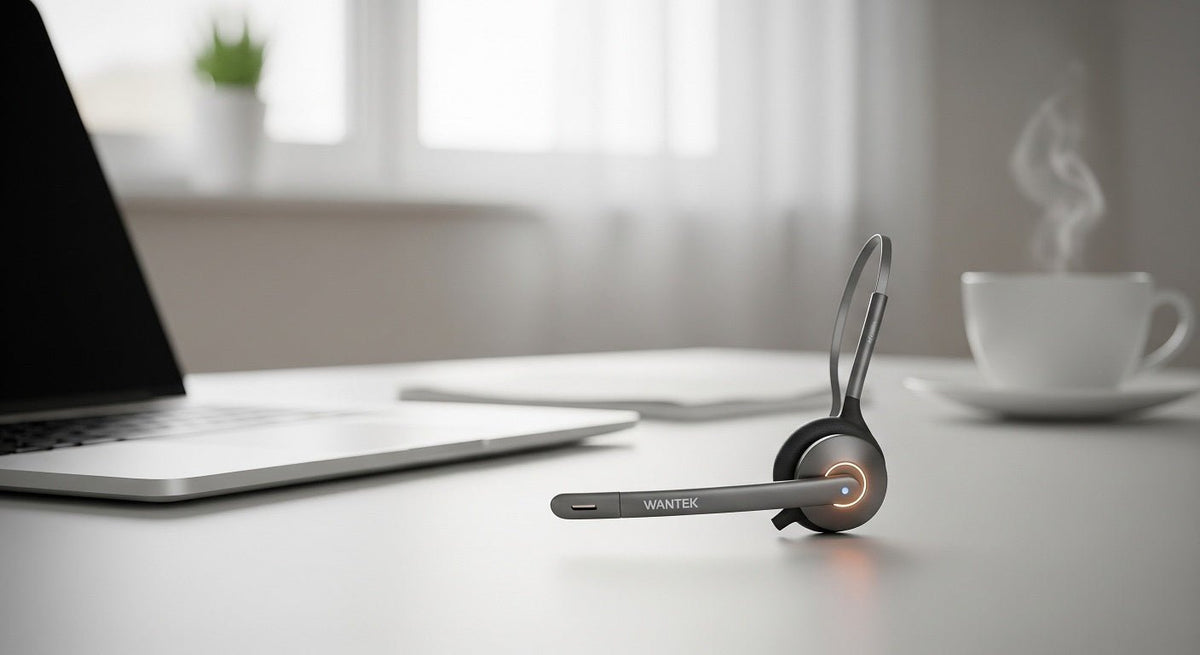
The best cordless phone headset is not the one with the longest feature list. It is the one that is actually compatible with your phone or base, fits the way you take calls, and provides the microphone and mobility you need. Start with the exact phone model before comparing headsets.
First question: where does the headset connect?
“Cordless phone” can describe several different setups. Some handsets have a 2.5 mm headset jack. Some bases support Bluetooth headsets. Some professional systems use a dedicated wireless base, and some phone models require a specific adapter or call-control accessory.
Similar-looking connectors are not enough to confirm compatibility. Wiring, firmware, supported profiles, and the phone's own headset implementation can all matter.
Common connection paths
| Connection | When it can work | What to verify |
|---|---|---|
| 2.5 mm wired headset | Handset has a compatible 2.5 mm headset jack | Phone model, jack function, wiring, microphone support |
| Bluetooth headset | Phone or base supports third-party Bluetooth headsets | Headset profile support, pairing path, call controls |
| DECT / dedicated wireless base | Headset system is designed for the phone connection | Base-to-phone cable, adapters, EHS/lifter needs, range |
| Computer softphone | Calls are routed through a PC rather than the cordless handset | USB/Bluetooth compatibility and app controls |

Do not assume “universal compatibility”
There is no useful universal-compatibility claim for every cordless phone. A headset can fit one Panasonic, VTech, AT&T, Poly, or other system and fail on another model because the connection path differs. The exact model number is the right starting point.
Wantek's desk-phone compatibility tool is designed around that model-first check.
Wired headset or wireless headset?
Wired to the handset
A compatible wired headset is simple and does not need charging. The limitation is obvious: you remain physically connected to the handset, so mobility depends on how you use the phone.
Wireless from the base or phone
A wireless headset can allow movement away from the phone, but the base, adapter, Bluetooth support, or DECT system must be compatible. Range is not one universal number; walls, floors, radio conditions, and the specific implementation affect the usable distance.
Microphone and wearing style
For long calls, a boom microphone can help keep the pickup element at a consistent position near the mouth. Monaural headsets leave one ear uncovered, while binaural headsets put call audio in both ears. Choose based on environmental awareness, concentration, and personal comfort.
Noise-control terms also need to be separated. ANC changes what the wearer hears. Microphone noise reduction affects the outgoing signal. A headset may have one without the other.
Battery and call control for wireless systems
Compare rated talk time with your longest expected calling period, not just standby time. Also confirm charging time, low-battery alerts, and whether the headset can be used while charging.
If remote answer/end control matters, verify it for the exact phone and accessory path. Some systems require an electronic hook switch or handset lifter; others do not support remote call control at all.
Pre-purchase checklist
- Phone brand and full model number
- Photo or documentation of the available headset port
- Whether calls happen on the handset, base, or connected computer
- Required wired, Bluetooth, DECT, or adapter path
- Need for answer/end control away from the phone
- Single-ear or dual-ear preference
- Longest call duration and charging routine
- Return option if fit or compatibility is wrong
If your calls mainly run through a laptop softphone instead of the cordless handset, use the work headset buying guide to compare computer-focused wired and wireless paths.
Cordless Phone Headset FAQ
Will any 2.5 mm headset work with a 2.5 mm cordless phone jack?
Not automatically. The physical plug is only one part of compatibility; wiring and the phone's headset implementation also matter.
Can any Bluetooth headset pair with a cordless phone?
No. The phone or base must support the required Bluetooth headset functionality. Some cordless systems use Bluetooth for mobile-phone integration without supporting arbitrary headsets.
Is DECT the same as Bluetooth?
No. They are different wireless technologies and require compatible equipment. A DECT headset system is not automatically compatible with a Bluetooth-only phone path.
Check the phone before choosing the headset
Have the full phone model and connection details ready, then verify the supported headset path.

