
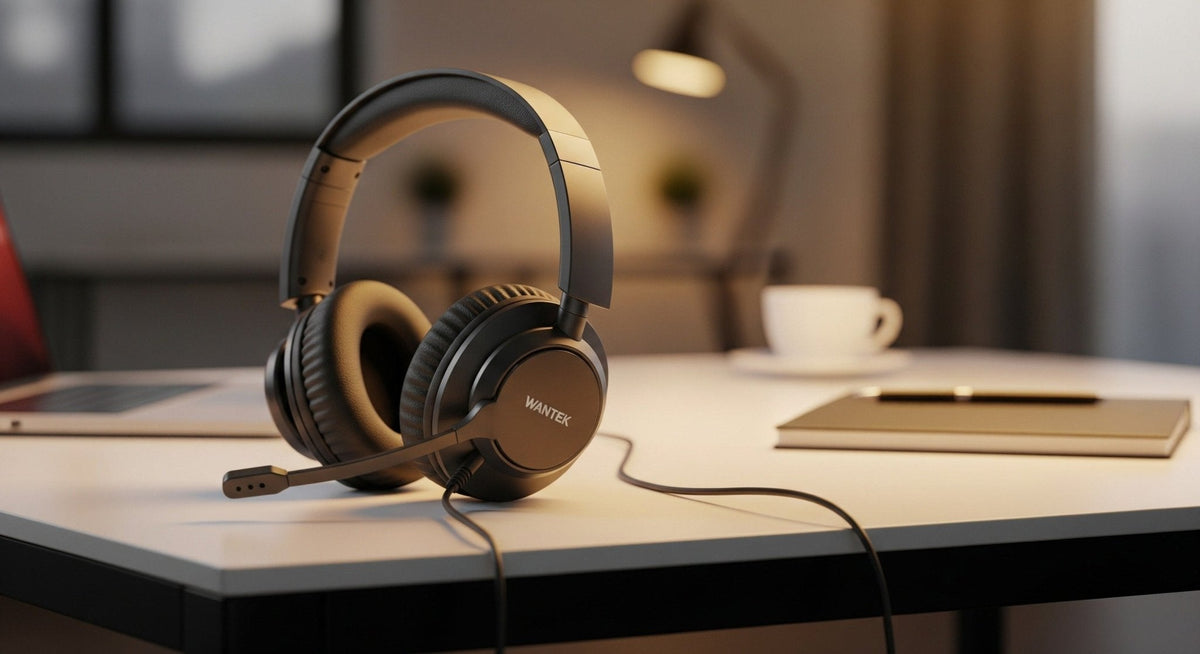
A work headset should match the calls you take, the devices you use, and how much you move during the day. Start with microphone placement and connection compatibility, then choose wearing style, wireless features, and controls. A longer feature list does not automatically make a headset better for your workflow.
Start with the call path
Identify where calls actually happen: a laptop softphone, mobile phone, desk phone, or a mix. A USB headset can be simple for a computer. A Bluetooth headset may be useful across mobile and computer workflows. A desk phone may need a model-specific headset port, adapter, base station, electronic hook switch, or other accessory.
If a desk phone is involved, verify the exact phone model instead of buying by connector appearance. Use Wantek's desk-phone headset compatibility tool as the starting point.

Single-ear or dual-ear?
Single-ear
A monaural headset leaves one ear uncovered. That can be useful when you need to hear coworkers, doorbells, alarms, or other activity while staying on a call.
Dual-ear
A binaural headset puts call audio in both ears and can reduce distraction from the room through physical coverage. The tradeoff is lower awareness of nearby sound.
Neither style is universally more comfortable. Clamp pressure, cushion shape, weight distribution, heat, glasses, and head size all affect long-session fit.
Microphone design matters more than ANC for callers
Active noise cancellation primarily changes what the wearer hears. It is separate from microphone noise reduction, which affects the outgoing voice signal. For frequent meetings and customer calls, evaluate the microphone and boom position independently from listening ANC.
A boom microphone can keep the pickup element at a more consistent distance from the mouth than a microphone built into a distant earcup. Digital processing can help with background noise, but no headset can guarantee that the caller hears only your voice.
Wired vs. wireless for work
| Connection | Strength | Tradeoff |
|---|---|---|
| USB wired | No charging; predictable workstation connection | Cable limits movement |
| Bluetooth | Mobility; may support computer and phone workflows | Battery, pairing, profiles, and device behavior vary |
| Desk-phone wired / RJ-type | Direct phone workflow when compatible | Connector wiring and phone support must be verified |
| Dedicated wireless base | Desk mobility and, on supported systems, remote call control | May require additional base or call-control accessories |
Multipoint: useful, but define what you expect
Multipoint generally refers to maintaining Bluetooth relationships with more than one device, but product behavior differs. Pairing with two devices does not necessarily mean both devices can play audio at the same time. Confirm switching behavior for the exact model and the applications you use.
Current Wantek work models to compare
Wantek's current wireless collection positions the WK882BT as a dual-ear work headset and the WK881BT as a single-ear option; both list boom microphones, one-key mute, and up to 45 hours of battery life. The 186BTC is positioned for Bluetooth multipoint work, while the 162BTC is an over-ear work/study model.
These are specification-based distinctions, not a claim that one model has better microphone quality or comfort without side-by-side testing.
Call controls and mute
For high-call-volume work, physical controls can matter as much as audio specifications. Check where mute and volume controls are located, whether mute state is obvious, and whether answer/end controls work with your actual calling app or phone. Hardware support and application integration are separate questions.
Pre-purchase checklist
- Exact laptop, phone, or desk-phone model
- Required connector or Bluetooth path
- Single-ear vs. dual-ear preference
- Boom microphone vs. integrated microphone
- Need for multipoint or device switching
- Required battery duration
- Mute and call-control needs
- Return policy for fit and comfort
For a broader remote-work comparison that includes consumer ANC headphones and business headsets, see the work-from-home headphones guide.
Work Headset FAQ
Is a wireless work headset better than wired?
No. Wireless is useful for movement; wired avoids charging and pairing. The better choice depends on the desk, device, and call pattern.
Does ANC improve my microphone?
Not by itself. ANC reduces sound heard by the wearer. Microphone noise reduction is a separate part of the outgoing call path.
Can one Bluetooth headset work with a laptop and phone?
Some models support multipoint or multi-device switching, but behavior varies. Confirm the exact model and whether it can stay connected to the devices you use.
Find the right starting point
Compare current work models by single- or dual-ear design, microphone, multipoint positioning, ANC, and battery specifications.

