
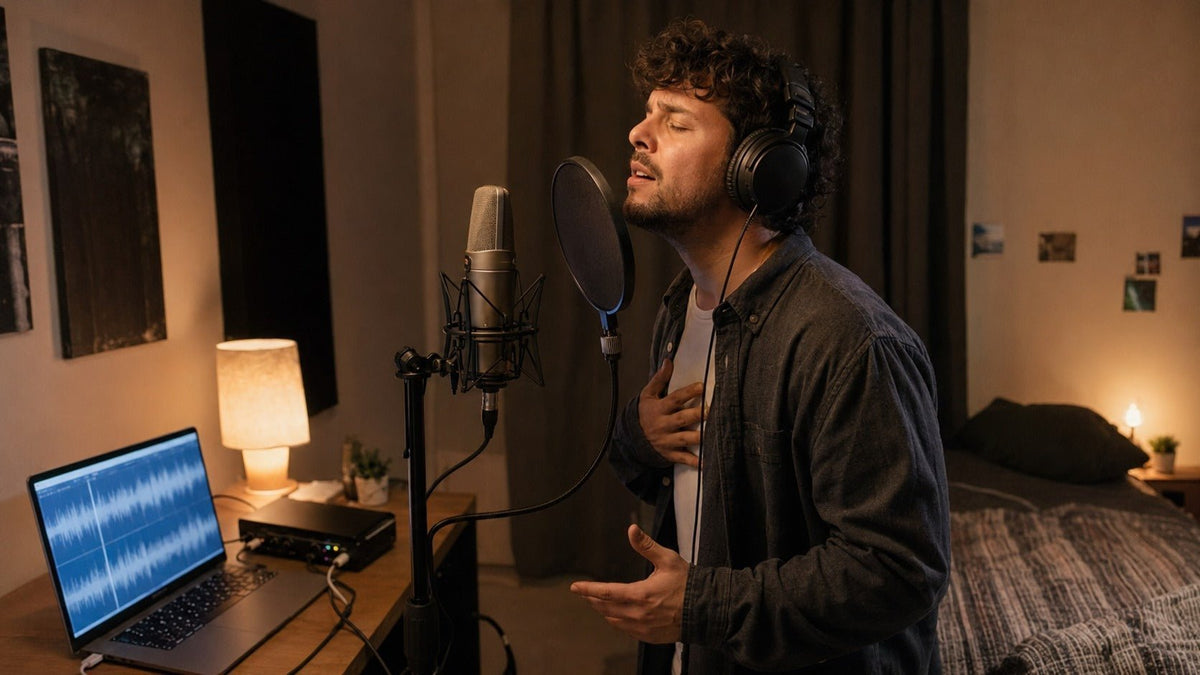
Elegir un micrófono para cantar comienza por la función que debe desempeñar. Un escenario en vivo, un estudio acondicionado y un dormitorio sin tratamiento plantean exigencias diferentes en cuanto al control de retroalimentación (feedback), la captación ambiental, el ruido de manipulación, la ganancia, la alimentación y la conexión. Empiece por el lugar donde cantará con más frecuencia y, luego, compare el tipo de micrófono, el patrón polar, la ruta de señal y cómo suena realmente el micrófono con su voz.
Respuesta rápida: Un micrófono dinámico direccional de mano es una primera prueba práctica para muchos cantantes en vivo porque está diseñado para un uso cercano y el control en el escenario. Para grabaciones vocales en estudio en una sala controlada, a menudo vale la pena considerar un micrófono de condensador, ya que su sensibilidad y respuesta extendida pueden captar más detalles. Ninguno de los dos diseños es automáticamente mejor para todos los cantantes, salas o actuaciones.

1. Comience por el uso en estudio o escenario
Su primera decisión debe ser el entorno. La guía de micrófonos vocales de Shure también comienza diferenciando la actuación en vivo de la grabación, ya que los micrófonos diseñados para una tarea pueden comportarse de forma muy distinta en otra.
| Entorno | Primer tipo a probar | Qué verificar |
|---|---|---|
| Escenario en vivo con monitores de suelo | Dinámico direccional de mano | Margen de retroalimentación, rechazo fuera de eje, ruido de manipulación, durabilidad y colocación de monitores |
| Habitación doméstica sin tratamiento | Dinámico o condensador direccional | Reflexiones de la sala, ruido de computadora o ventilación, distancia de trabajo y ganancia del preamplificador |
| Estudio acondicionado | Comparación entre dinámico y condensador | Ajuste a la voz, sensibilidad, ruido propio (cuando sea relevante), colocación y comportamiento del preamplificador |
| Un micrófono para ensayos y conciertos | Micrófono vocal de mano diseñado para tal fin | Patrón, ergonomía, nivel de salida, durabilidad y compatibilidad con sistemas de megafonía (PA) |
Trate esto como puntos de partida, no como reglas. Existen micrófonos de condensador para escenario y los micrófonos dinámicos pueden producir excelentes voces en estudio. El entorno reduce la lista de candidatos; el cantante y la cadena de señal deciden la elección final.
2. Compare correctamente los micrófonos dinámicos y de condensador
Micrófonos dinámicos
Un micrófono dinámico de bobina móvil convencional genera su señal sin necesidad de alimentación fantasma (phantom power). Muchos micrófonos dinámicos vocales están diseñados para un uso cercano, durabilidad física y una captación direccional predecible, lo que explica por qué son comunes en los escenarios. También pueden ser útiles en salas imperfectas, ya que su colocación cercana aumenta la proporción de voz directa frente a las reflexiones de la sala.
No equipare "dinámico" con baja calidad o solo para cantantes de voz potente. Un modelo dinámico puede simplemente adaptarse mejor a una voz, técnica, sala o mezcla en particular.
Micrófonos de condensador
Los micrófonos de condensador utilizan electrónica activa y, por lo tanto, requieren alimentación. Con muchos micrófonos de estudio XLR convencionales, esa energía proviene de la entrada del micrófono a través de la alimentación fantasma; los micrófonos de condensador USB obtienen energía a través de su conexión USB. La guía de conceptos básicos sobre micrófonos de Shure explica las diferencias de transductor y alimentación entre los diseños dinámicos y de condensador.
Los condensadores suelen ofrecer una alta sensibilidad y una respuesta extendida en altas frecuencias, lo que puede ser útil para grabaciones vocales detalladas. La contrapartida es que un micrófono sensible también puede revelar más reflexiones de la sala y ruidos cercanos. En un espacio con mala acústica, cambiar la ubicación o controlar la sala puede ser más importante que comprar un micrófono "más detallado".
Regla de decisión: Elija primero el micrófono que resuelva el problema de la sala y de la interpretación. No elija basándose únicamente en las palabras "dinámico", "condensador" o "estudio".
3. Elija el patrón polar según la sala y la disposición del escenario
Un patrón polar describe cómo cambia la sensibilidad de un micrófono según la dirección. La introducción de Shure sobre patrones polares es un antecedente útil cuando compare los gráficos de los fabricantes.
El patrón cardioide es un punto de partida común para voces porque es más sensible desde el frente y atenúa más el sonido desde la parte trasera. El patrón supercardioide estrecha la captación frontal pero desplaza los ángulos de mayor rechazo, por lo que la colocación de los monitores debe ajustarse al patrón polar real del micrófono.
La captación direccional no hace desaparecer una sala con mala acústica ni garantiza la ausencia de retroalimentación. En el escenario, utilice el diagrama polar del fabricante al colocar los monitores. En una sala de grabación, trate la dirección del micrófono, la distancia y las reflexiones de la sala como variables independientes.
4. Compruebe la cadena de señal completa antes de comprar
La conexión no es lo mismo que el tipo de micrófono
XLR, USB e inalámbrico describen cómo llega la señal al siguiente dispositivo. No le indican si la cápsula es dinámica o de condensador, ni garantizan que dos micrófonos necesiten el mismo equipo de soporte.
- Micrófono XLR: verifique la entrada de la mezcladora o interfaz, el cable, la ganancia disponible y el requerimiento de alimentación fantasma cuando corresponda.
- Micrófono USB: verifique la compatibilidad del sistema operativo, el comportamiento del monitoreo directo si lo necesita, el enrutamiento de auriculares y si la interfaz integrada se adapta a su flujo de trabajo de grabación.
- Micrófono inalámbrico: verifique el transmisor y el receptor como un sistema completo, la conexión de salida, las necesidades de latencia, las normas locales del espectro y la coordinación de frecuencias cuando varios canales inalámbricos operen juntos.
Asegúrese de que el preamplificador tenga suficiente ganancia utilizable
La sensibilidad del micrófono afecta cuánta salida eléctrica produce este ante una entrada acústica determinada. Un micrófono de menor salida puede requerir más ganancia del preamplificador. Eso no es un defecto en sí mismo, pero la interfaz o mezcladora debe proporcionar suficiente ganancia utilizable sin añadir ruidos molestos.
No asuma que una grabación demasiado baja siempre se puede corregir más tarde. La ganancia digital eleva tanto la señal capturada como el ruido capturado al mismo tiempo.
5. Lea las especificaciones sin dejar que un solo número elija el micrófono
Las especificaciones son útiles cuando responden a un requisito real. Son criterios de compra débiles cuando se reducen a un solo número de "cuanto más grande, mejor".
| Especificación | Útil para | No asuma que |
|---|---|---|
| Patrón polar | Planificar la posición de la fuente, la captación de la sala, la colocación de monitores y el control de fugas de sonido | Un patrón elimina automáticamente la retroalimentación o el sonido de la sala |
| Sensibilidad | Estimar el nivel de salida y las necesidades de ganancia del preamplificador | Una mayor sensibilidad significa un mejor sonido |
| Respuesta en frecuencia | Ver tendencias tonales cuando se proporciona una curva de respuesta | Un rango citado más amplio suena automáticamente más natural |
| NPS máximo (SPL) | Comprobar el margen (headroom) para niveles acústicos altos | El número más alto hace el mejor micrófono vocal |
| Ruido propio | Comparar micrófonos alimentados para situaciones de grabación silenciosas | Dominará todas las grabaciones vocales cercanas |
Un gráfico de respuesta en frecuencia suele decirle más que los dos puntos finales de un rango de frecuencia citado. Un aumento en la presencia que ayuda a un cantante a destacar en la mezcla puede hacer que otra voz suene aguda o sibilante. Use el gráfico para decidir qué probar, no para declarar un ganador antes de escuchar.
6. Pruebe los micrófonos con el mismo cantante, sala y pasaje
Una vez que tenga una lista corta, compare los micrófonos en condiciones controladas. La guía de selección de Shure también enfatiza probar diferentes modelos con su propia voz en lugar de asumir que el precio o la categoría del micrófono predicen la mejor elección.
Use el mismo pasaje vocal
Incluya frases suaves, notas más fuertes, consonantes y vocales sostenidas que representen el material que realmente canta.
Mantenga el resto de la cadena de señal comparable
Utilice la misma sala, interfaz o mezcladora, ruta de monitoreo y ajustes de grabación en la medida de lo posible.
Ajuste la ganancia correctamente para cada micrófono
No compare un micrófono a un nivel de reproducción notablemente más alto y confunda el volumen con un mejor tono.
Escuche problemas específicos
Compruebe oclusivas, sibilancia, acumulación en medios-bajos, aspereza, captación de la sala, ruido de manipulación y cómo se asienta la voz con la música.
Cambie la colocación antes de rechazar el micrófono
Un cambio modesto en la distancia o el ángulo puede alterar el tono y la captación de la sala lo suficiente como para cambiar el resultado.
Para una compra de estudio, grabe muestras cortas y compárelas después a niveles de reproducción igualados. Para una compra de escenario, pruebe a través de la configuración real de PA y monitores siempre que sea posible. Un micrófono que suena impresionante en los auriculares de una tienda silenciosa puede comportarse de forma diferente junto a una banda ruidosa.
7. Pruebe la colocación antes de reemplazar el micrófono
La colocación cambia tanto el tono como el nivel. La guía de grabación vocal de Shure sugiere unos 10–20 cm (4–8 pulg.) como distancia de inicio útil para muchos cantantes, y luego recomienda ajustar según el cantante y el micrófono, manteniendo la distancia razonablemente constante.
Con micrófonos direccionales, acercarse puede aumentar los graves debido al efecto de proximidad. Un filtro antipop puede ayudar a controlar las oclusivas en la grabación de estudio. Si la sibilancia es excesiva, un pequeño cambio en la altura o el ángulo del micrófono puede reducir la cantidad de energía de alta frecuencia que llega directamente a la cápsula.
Para micrófonos de mano en escenarios, evite tapar o cubrir la rejilla. Cambiar los puertos acústicos puede alterar el comportamiento direccional previsto, lo cual también puede cambiar el rendimiento frente a la retroalimentación.
Una tabla de decisiones práctica
| Problema | Pruebe primero | Por qué |
|---|---|---|
| Retroalimentación en escenario o exceso de fuga | Micrófono direccional de mano y colocación correcta de monitores | El patrón de captación y la colocación de la fuente afectan la separación y la ganancia utilizable antes de la retroalimentación |
| La sala sin tratamiento es demasiado evidente | Colocación direccional más cercana y cambios en la sala | Aumenta la proporción de voz directa en relación con el sonido reflejado |
| La voz en estudio necesita más detalle | Condensador en una sala adecuada e interfaz | Una mayor sensibilidad y respuesta extendida pueden adaptarse a la fuente |
| La voz suena áspera o sibilante | Ángulo, distancia y luego un micrófono con una respuesta diferente | La colocación y la respuesta en frecuencia influyen en el resultado |
| Las oclusivas dominan la grabación | Filtro antipop más ajuste de distancia y ángulo | Controla el flujo de aire antes de reemplazar el micrófono |
| No hay interfaz de audio disponible | Micrófono vocal USB diseñado para tal fin | Una interfaz integrada puede simplificar una configuración de computadora con un solo micrófono |
Si realmente necesita un micrófono de diadema
Un micrófono de mano o de estudio y un auricular de trabajo resuelven problemas diferentes. Si necesita manos libres para actuar, empiece por el factor de forma y el sistema inalámbrico en lugar de aplicar criterios de llamadas de escritorio; nuestra guía de micrófonos inalámbricos de diadema para cantantes cubre esa rama por separado.
Si la tarea real es hacer llamadas de negocios, atención al cliente o reuniones en línea, compare los auriculares por dispositivo, conexión, diseño de micrófono de brazo, controles y estilo de uso. Para fallos de configuración después de la compra, utilice la guía de solución de problemas del micrófono de diadema en lugar de cambiar los ajustes de un micrófono de canto.
¿Busca un auricular para trabajar en lugar de cantar?
Empiece por el dispositivo que gestionará sus llamadas, luego filtre por conexión, estilo de uso y operación con o sin cables.
Preguntas frecuentes
¿Es mejor un micrófono dinámico o de condensador para cantar?
Ninguno es universalmente mejor. Los micrófonos dinámicos son comunes para voces en vivo y salas imperfectas; los condensadores son a menudo útiles en espacios de grabación controlados donde su sensibilidad y detalle se adaptan al cantante.
¿Los micrófonos de condensador siempre necesitan alimentación fantasma de 48 V?
No. Muchos condensadores XLR convencionales utilizan alimentación fantasma, mientras que los condensadores USB reciben energía a través del USB. Compruebe siempre el requisito de alimentación exacto del micrófono antes de conectarlo.
¿Qué patrón polar es mejor para voces?
El cardioide es un punto de partida común porque favorece el frente y reduce más sonido de la parte trasera. El supercardioide puede estrechar la captación, pero requiere una colocación diferente de monitores y fuentes.
¿Es mejor USB o XLR para grabar voces?
El USB puede simplificar una configuración de computadora con un solo micrófono. El XLR separa el micrófono de la interfaz o mezcladora, lo que le da más libertad para cambiar cualquiera de las partes más adelante.
¿Qué tan cerca debo cantar del micrófono?
Para voces en estudio, unos 10–20 cm (4–8 pulg.) es un punto de partida útil. Ajuste según el micrófono, el cantante, la sala, las oclusivas y el efecto de proximidad, manteniendo la distancia razonablemente constante.

