
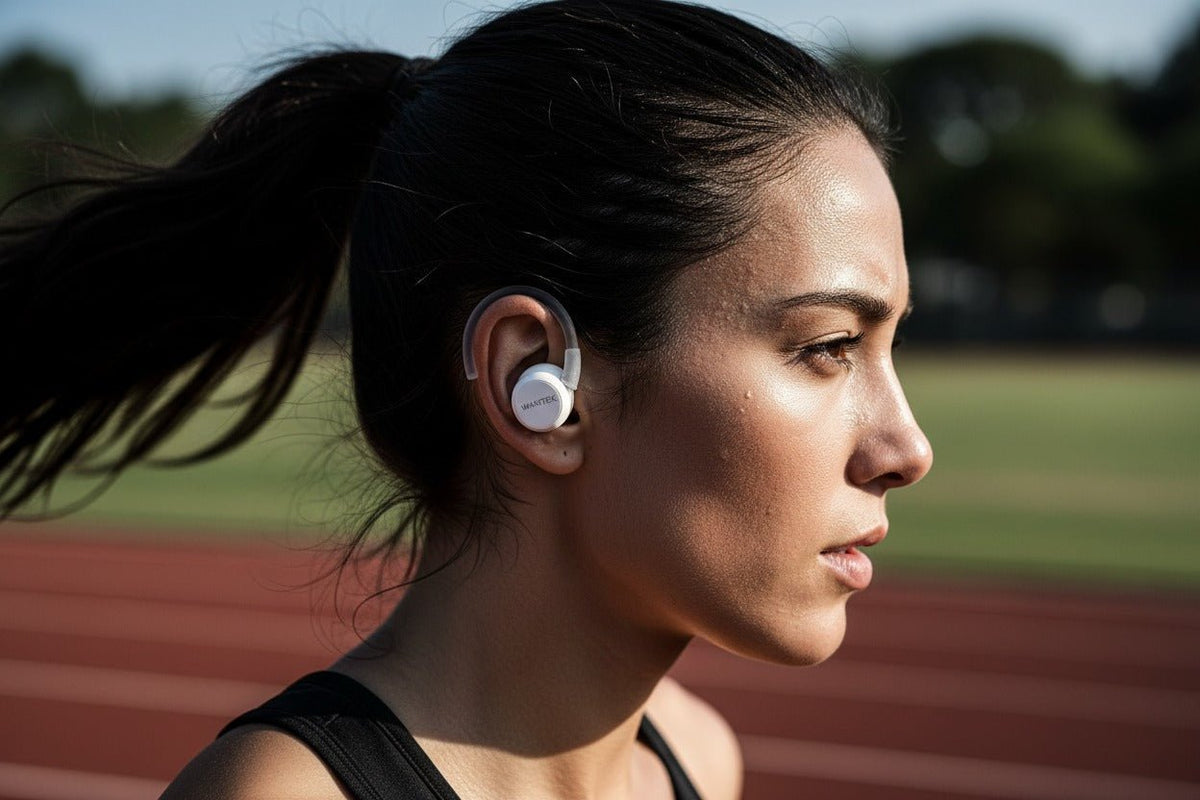
An ear hook can mean two different things: a loop that helps stabilize an earbud, or a small retainer that helps glasses stay in place behind the ear. They solve different fit problems, and neither category is truly universal.
Quick answer: for earbuds, start with exact model compatibility, hook shape, charging-case clearance, and how the hook shares space with glasses or headgear. For glasses, match the retainer to the frame arm's width and shape, then position it so it adds grip without creating a pressure point.
What Counts as an Ear Hook?
For earbuds, a full ear hook wraps over or around the outer ear to add another contact point beyond the earbud itself. The hook may be built into the product or added as a removable accessory. An ear wing or fin is different: it braces against part of the outer ear but does not loop over the top of the ear.
For glasses, an ear hook is usually a small sleeve or retainer fitted to the temple arm. It sits behind the ear to reduce forward movement. A glasses strap or sports retainer serves a similar goal but is a different type of accessory.

How to Choose Ear Hooks for Earbuds
Integrated ear hooks
Integrated hooks are designed as part of the earbud, so the charging case, controls, microphones, and left/right orientation are built around that shape. Fit instructions remain product-specific. For example, Beats' Powerbeats Pro 2 support guide tells users to secure the hook behind the ear, insert the earbud, and rotate the hook into a comfortable position.
Aftermarket ear hooks
Removable hooks can help when otherwise suitable earbuds feel unstable, but the accessory needs to match the exact earbud body or stem. A hook that looks close enough can still block a microphone, button, sensor, charging contact, or the space needed for the case to close.
Ear wings and fins
Wings and fins are lower-profile stabilizers that brace inside the outer ear rather than looping behind it. They can be useful when a full hook feels bulky, but they should not be treated as interchangeable with over-ear hooks because the pressure points and compatibility requirements differ.
If you are choosing a complete wireless model rather than an add-on accessory, Wantek's wireless ear-hook headphone comparison separates true ear-hook designs from open-ear, sealed in-ear, and clip-on alternatives.
Earbud Hook Compatibility Checklist
Confirm the exact earbud model and generation
Do not assume two earbuds from the same brand share the same housing dimensions. Check the accessory maker's compatibility list for your exact model.
Check what the hook touches
The accessory should not cover microphones, touch surfaces, buttons, sensors, vents, or charging contacts.
Check charging-case clearance
Some removable hooks must be taken off before the earbuds fit back into their case. Verify that before buying if frequent removal would be inconvenient.
Test the hook with the gear you actually wear
Glasses arms, helmet straps, hats, long hair, and mask loops can all change how much space is available around the ear.
Can You Wear Ear-Hook Earbuds With Glasses?
Often, yes, but there is no universal fit rule. The earbud hook and the glasses temple may occupy the same area behind the ear, so comfort depends on the thickness and position of both pieces plus your ear and head shape.
For its own open-ear products, Shokz recommends experimenting with wearing order and small position changes when glasses and headphones feel crowded. That is a useful fitting principle, but the amount of adjustment available depends on the product.
- Start with the manufacturer's normal wearing position for the earbuds.
- Put on your glasses and check whether the temple arm sits directly on top of the hook.
- If the design allows it, make a small forward or backward adjustment instead of forcing the hook tighter.
- If pressure persists, a thinner or lower-profile hook may work better than continuing to compress both accessories behind the ear.
- Do not bend a rigid hook unless the manufacturer specifically describes it as adjustable.
Why Ear Shape Changes the Fit
Ear-hook products use the contours of the outer ear for stability, while wings and fins rely on different contact points inside the outer ear. Because ear size and shape vary, the same hook can feel secure on one person and create a pressure point on another.

How to Choose Ear Hooks for Glasses
Glasses ear hooks are usually small slip-on retainers that add grip behind the ear. They work best when the frame already fits reasonably well and needs extra stability rather than a major correction.
- Check temple-arm width and shape: thin metal arms, thick plastic arms, and strongly curved temples may require different openings.
- Position for grip, not pressure: move the retainer until the glasses feel stable without pinching behind the ear.
- Keep both sides even: asymmetric placement can make the frame sit crooked or create a hot spot on one side.
- Use a stronger retention system when needed: for activities where losing the glasses would be a serious problem, a purpose-built sports strap or retainer can provide more retention than a small slip-on hook alone.
| Design | What it does | Check first |
|---|---|---|
| Integrated earbud hook | Wraps around the outer ear as part of the earbud | Personal fit and space shared with glasses or headgear |
| Aftermarket earbud hook | Adds an external anchor to an existing earbud | Exact earbud model, controls, sensors, and charging-case clearance |
| Ear wing or fin | Braces against the outer ear without looping behind it | Correct size and the pressure point inside the outer ear |
| Glasses slip-on hook | Adds grip behind the ear to reduce frame movement | Temple-arm width, shape, and comfortable position |
| Glasses strap or sports retainer | Adds retention around the back of the head | Frame compatibility and the activity's retention requirement |
Fit Problems and Practical Fixes
The earbud still moves
Recheck the ear tip or speaker position before assuming the hook is too loose. If the hook is removable, confirm that it is installed in the correct orientation and is actually intended for that earbud model.
The hook hurts behind the ear
A persistent hot spot usually means the hook shape, tension, or overlap with glasses is wrong for you. Reposition only within the manufacturer's instructions; otherwise try a more flexible, thinner, or differently shaped design.
The charging case will not close
Do not force the lid. Some aftermarket hooks are meant to be removed before charging. If frequent removal is a problem, look for an accessory explicitly designed to fit inside your case or choose an integrated-hook earbud.
The glasses still slide
Move the hooks slightly along the temple arms and check whether the frame itself is loose or sitting unevenly. An accessory can add grip, but it cannot correct every frame-fit problem.
Cleaning and Replacement
Care instructions depend on the material and whether the hook is part of an electronic device. For ear-hook earbuds, follow the manufacturer's cleaning instructions instead of treating the whole product like a removable silicone accessory. Apple, for example, advises using a dry cleaning cloth for Beats earphones and avoiding aerosol sprays, solvents, and abrasives in its Beats cleaning guidance.
For removable non-electronic hooks, use the accessory maker's directions. Let any washable part dry completely before reattaching it, and replace a hook that has stretched, cracked, torn, or no longer stays securely in position.
Frequently Asked Questions
Are ear hooks for earbuds universal?
No. Many aftermarket hooks are model-specific. Check the exact earbud generation, housing shape, control and sensor clearance, and whether the earbuds still fit in their charging case.
Can I wear ear-hook earbuds with glasses?
Often, but comfort depends on how the hook and glasses arm share space behind your ear. A slim or flexible hook may feel less crowded than a thicker fixed design.
Are ear wings the same as ear hooks?
No. A full ear hook loops around the outer ear. A wing or fin braces against part of the outer ear without wrapping over the top.
Can I leave aftermarket ear hooks on while charging?
Only if the accessory and charging case are designed for it. Some hooks add enough bulk that they must be removed before the case can close properly.
Are ear hooks for glasses one-size-fits-all?
No. The opening must match the glasses arm's width and shape. A hook that is too loose may slide; one that is too tight can be difficult to position comfortably.
Do ear hooks improve sound quality?
Not by themselves. A stable fit can help an in-ear model maintain its intended position or seal, but the hook does not change the earbud's drivers or tuning.

