
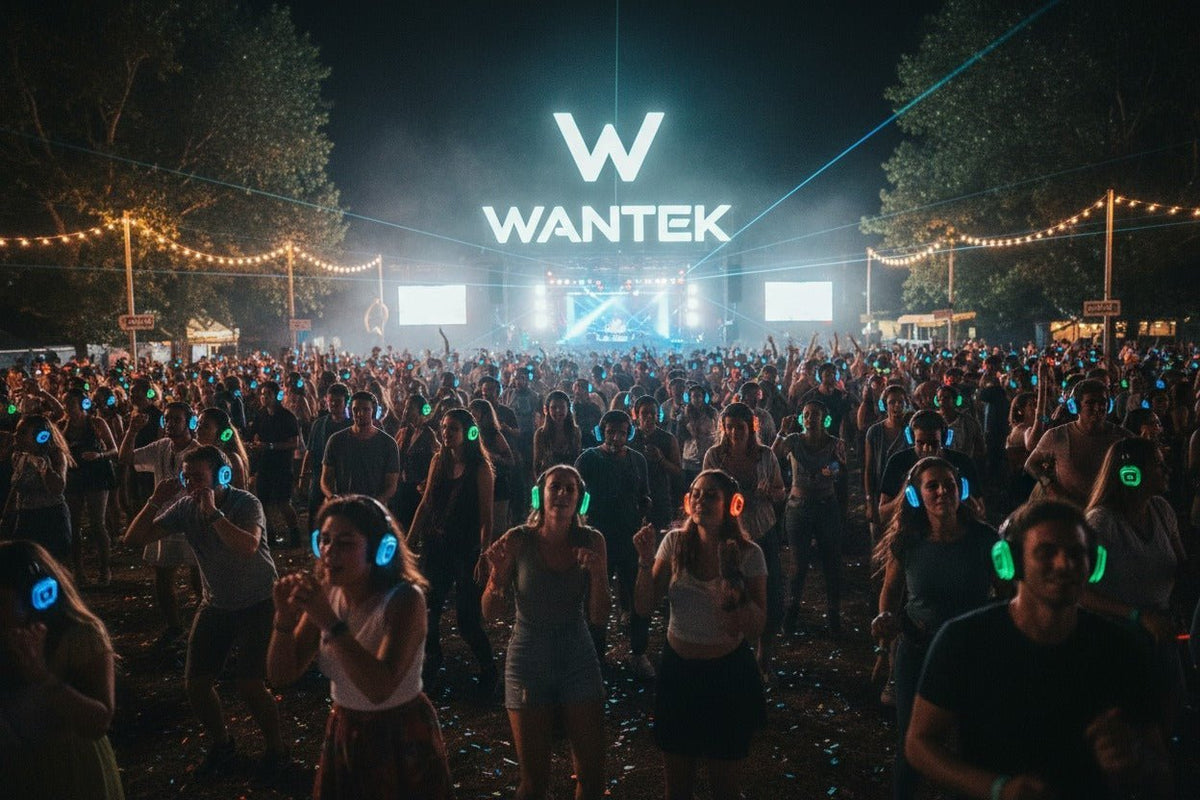
Sound Off headphones are purpose-built wireless receivers for silent discos, fitness classes, conferences, and other shared-listening events. If you are comparing the current Sound Off lineup, the important decision is not simply which headphone sounds “best.” It is which RF system supports the number of channels, operating time, charging workflow, and event format you actually need.
Quick answer: Sound Off currently lists three main headphone families: the three-channel GLO 4, the ten-channel GLO 3XB for conference-style applications, and the three-channel GLO 2. All are built around RF/UHF event audio rather than ordinary Bluetooth headphone pairing.
What “Sound Off headphones” means

Here, Sound Off headphones refers to the Sound Off event-audio ecosystem, not a generic category of headphones used at low volume. The current lineup is designed around dedicated RF or UHF/RF transmission so one source can feed many listeners within the same event system.
That architecture is useful for silent discos because attendees can hear program audio without a room full of loudspeakers. It also supports formats such as fitness classes, meetings, translation, breakout sessions, and other situations where different listeners may need selectable channels.
The headphones are only one part of the system. You also need a compatible transmitter and an audio source such as a DJ controller, mixer, laptop, phone, or microphone chain. Sound Off’s own event setup guidance states that each simultaneous audio source needs its own transmitter.
Current Sound Off headphone lineup
| Model | Core event specs | Manufacturer positioning |
|---|---|---|
| GLO 4 | Up to 3 channels; up to 12 hours | Silent discos, fitness classes, and general event use |
| GLO 3XB | Up to 10 channels; 12 hours | Conferences, meetings, translation, and breakout sessions |
| GLO 2 | Up to 3 channels; up to 11 hours | Versatile personal and professional event use |
These specifications come from Sound Off’s current technology and product overview. The GLO 4 and GLO 3XB also list USB-C charging, while the GLO 2 is listed with a rechargeable lithium-polymer battery.
GLO 4: the current three-channel event model
The GLO 4 is positioned as Sound Off’s premium three-channel headphone. It supports up to three channels, includes channel-lock and LED display features, and is rated for up to 12 hours of battery life. For a conventional silent disco with multiple DJs or playlists, three channels are usually the central capability to evaluate.
GLO 3XB: built for more complex professional events
The GLO 3XB increases the system to as many as ten channels. Sound Off positions it for conferences, meetings, translation, and breakout sessions where attendees may need to select among multiple speakers or language feeds. If your event requires more than three simultaneous programs, this is the meaningful distinction—not a generic “premium” label.
For guided tours and one-to-many speech systems rather than a silent-disco format, see Wantek’s wireless tour guide headset buying guide. That use case has a different mix of transmitter, receiver, microphone, range, and participant requirements.
GLO 2: the established three-channel option
The GLO 2 is also a three-channel UHF/RF model. Sound Off lists 40 mm drivers, an adjustable headband, leatherette ear cushions, passive isolation, and up to 11 hours of battery life. It remains relevant when you need the established three-channel Sound Off workflow without the GLO 4 feature set.
RF silent-disco systems vs. Bluetooth headphones
Traditional consumer Bluetooth audio and a dedicated silent-disco RF system solve different problems. A normal Bluetooth headphone is usually designed around a personal device connection. A silent-event RF system is designed around one-to-many distribution, channel selection, and event-scale operations.
What changes with Bluetooth LE Audio?

However, it is no longer accurate to say Bluetooth audio can only work point-to-point. Bluetooth LE Audio introduced broadcast audio, and Auracast broadcast audio can send an audio broadcast to an unlimited number of compatible in-range receivers. That makes Bluetooth broadcast increasingly relevant to public and shared-listening use cases.
Important: Auracast does not make every Bluetooth headphone a silent-disco receiver. The transmitter, headphones or earbuds, and joining workflow must all support the required Bluetooth LE Audio broadcast features. A Sound Off RF system and an Auracast system should therefore be evaluated as separate ecosystems.
What to check before buying or renting silent-event headphones
1. Count simultaneous audio sources, not just attendees
Headphone quantity determines how many people can participate, but transmitter count is driven by simultaneous sources. A one-DJ event may need one source channel. A three-DJ silent disco needs three program feeds. A conference with multiple breakout sessions may need substantially more.
2. Match channel capacity to the event format
Three channels can cover many party, fitness, and entertainment formats. Ten channels make more sense when the event involves translation, concurrent presentations, or a larger set of selectable feeds. Buying more channel capacity than the format needs adds complexity without improving the basic listening experience.
3. Treat battery life as an operating-plan requirement
Manufacturer battery ratings are useful for screening, but your real workflow also includes charging time, turnaround between sessions, storage, spare inventory, and battery condition over repeated use. For a long conference or rental fleet, charging logistics can matter as much as the headline hour rating.
4. Check the transmitter, inputs, and venue layout
Sound Off lists different transmitter models with different inputs and manufacturer-rated ranges. That means “range” is a system specification, not a headphone-only specification. Confirm the transmitter model, source connections, venue size, walls or obstructions, and where the transmitter can be placed before relying on a distance claim.
5. Plan hygiene and fleet handling
Shared headphones need a repeatable cleaning, charging, counting, and storage process. For rentals or recurring events, check whether ear cushions are easy to wipe or replace, how quickly units can be inspected, and how the system indicates channel and battery status.
6. Verify regional radio requirements
RF products can differ by market, frequency configuration, and local rules. Confirm that the exact transmitter and headphone variant is intended for the country where the event will operate. Do not assume a frequency specification from another region applies to the U.S. model.
Do you need a silent-disco system or a different group-audio system?
A dedicated silent-disco system is a strong fit when many people need synchronized program audio, selectable channels, visible channel identification, and individual volume control. It is less compelling when the real job is ordinary personal listening, a two-way communication headset, or a tour system where the guide’s microphone is the primary source.
For a party, fitness class, or multi-channel event, evaluate the entire headphone-plus-transmitter system. For conferences, also consider the number of breakout feeds and translation channels. For tours or industrial communication, prioritize microphone workflow, receiver management, range around obstacles, and whether communication is one-way or two-way.
Frequently asked questions
Are Sound Off headphones Bluetooth headphones?
No. The current GLO headphone models use RF/UHF-RF for the event audio link. Some Sound Off transmitters can accept Bluetooth as an input source, but that does not turn the headphone link itself into ordinary Bluetooth pairing.
How many channels do Sound Off headphones support?
The current GLO 4 and GLO 2 support up to three channels. The GLO 3XB supports up to ten channels for applications such as conferences, translation, and breakout sessions.
How many transmitters do I need for a silent disco?
Sound Off states that you need one transmitter for each audio source played simultaneously. A three-DJ event therefore needs three separate program feeds and three transmitters configured for separate channels.
Can regular Bluetooth headphones join a Sound Off event?
Not as direct RF receivers. Sound Off offers a BYO receiver with a 3.5 mm stereo output, so compatible wired headphones can receive the event audio through that separate receiver.
Is Auracast the same as a silent-disco RF system?
No. Auracast is Bluetooth LE Audio broadcast technology. It can support one-to-many audio, but all participating devices must support the required Auracast features and it is not automatically compatible with a Sound Off RF system.
Does a silent event automatically mean safer listening levels?
No. Removing loudspeakers changes the venue sound, but each listener still controls headphone exposure. For context, NIOSH’s 85 dBA over eight hours limit is an occupational exposure recommendation, not a universal consumer headphone target.
Bottom line
Choose Sound Off headphones as part of an event system, not as isolated consumer headphones. The GLO 4 and GLO 2 cover three-channel workflows, while the GLO 3XB expands to ten channels for more complex professional events. Then verify the transmitter, number of simultaneous sources, battery and charging plan, venue coverage, hygiene workflow, and regional configuration before you buy or rent.

