
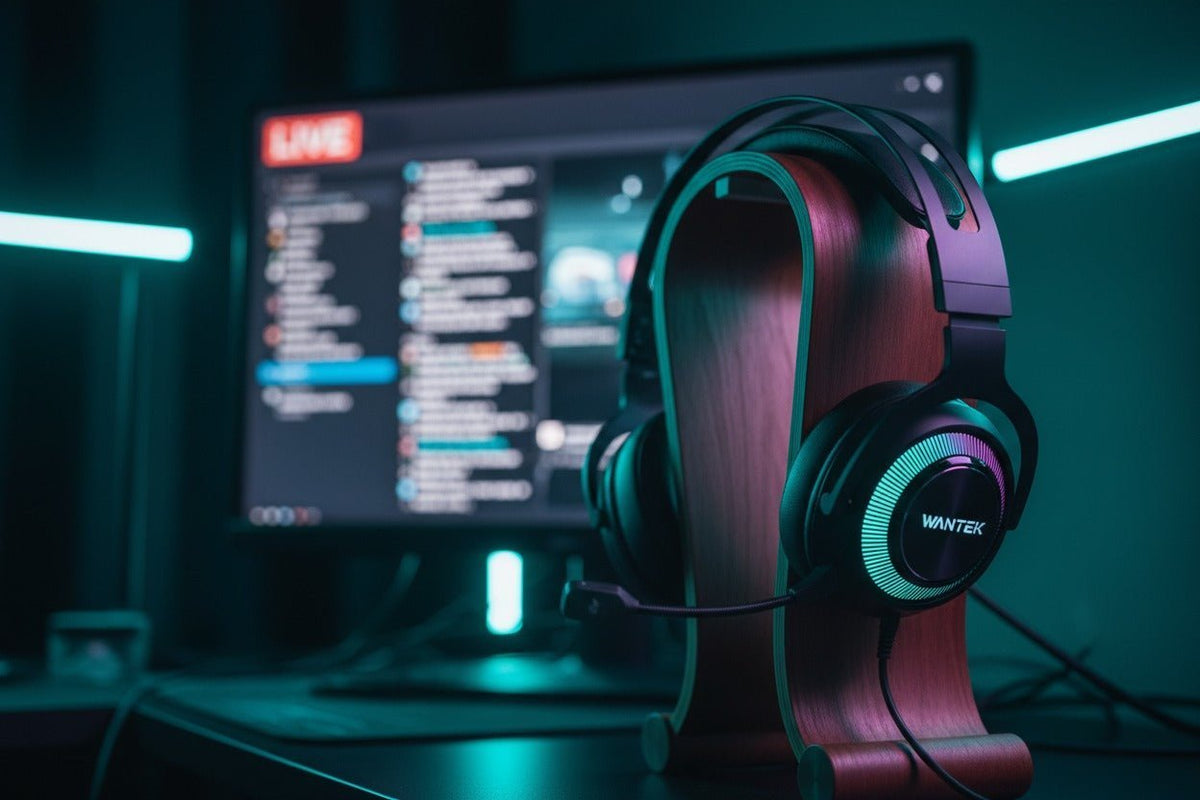
A good streaming headset has to solve two jobs at once: let you hear your game or monitoring mix clearly and keep your voice intelligible without adding a separate desk microphone. For most streamers, the most useful comparison is not “wired versus wireless” in isolation. It is microphone evidence, connection path, room noise, comfort, controls, and how the headset fits the rest of the streaming setup.
Quick answer: The Audio-Technica ATH-M50xSTS-USB is the most streaming-specific wired option in this shortlist. The Razer BlackShark V2 Pro (2023) is a strong wireless alternative when you want a boom mic with published independent praise and a dedicated 2.4 GHz PC/PlayStation path. The Beyerdynamic MMX 300 Pro is a closed-back wired choice with a cardioid condenser mic, while the Drop + EPOS PC38X is worth considering for a quiet room if you prefer an open-back design.
Evidence note: Wantek did not conduct side-by-side laboratory testing of these headsets for this article. The comparisons below are based on current manufacturer documentation plus published microphone evaluations from independent reviewers.

Best Headsets With Good Mics for Streaming: Quick Comparison
| Headset | Connection | Why consider it | Main limitation |
|---|---|---|---|
| Audio-Technica ATH-M50xSTS-USB | USB-A, with USB-C adapter | Purpose-built streaming headset with a cardioid condenser boom mic, sidetone, and up to 24-bit/96 kHz USB support | Wired only; no on-headset master volume control |
| Razer BlackShark V2 Pro (2023) | 2.4 GHz wireless or Bluetooth 5.2 | Strong published microphone results, removable boom mic, and up to 70 hours of manufacturer-rated battery life | No 3.5 mm analog audio path; verify the intended wireless mode for each device |
| Beyerdynamic MMX 300 Pro | 3.5 mm wired | Closed-back design with a cardioid condenser mic and replaceable wear parts | Wired only, premium price, and no companion software |
| Drop + EPOS PC38X | 3.5 mm wired | Open-back headset with strong published microphone performance and separate PC/console cable paths | Open-back design provides little isolation from room noise |
1. Audio-Technica ATH-M50xSTS-USB: Built Around Streaming
The ATH-M50xSTS-USB is the clearest fit when streaming is the primary job rather than an occasional extra. Audio-Technica documents a closed-back design, a back-electret condenser boom microphone with a unidirectional pickup pattern, and USB support for 44.1, 48, 88.2, and 96 kHz at 16- or 24-bit depth. The USB version also includes a USB-A-to-USB-C adapter. See the Audio-Technica ATH-M50xSTS-USB manual for the current specifications.
Independent testing is the reason this model belongs near the top of a streaming-focused shortlist. PC Gamer currently identifies the ATH-M50xSTS StreamSet as its gaming-headset microphone pick, while Expert Reviews found the mic clear, well isolated from common household background noise, and effective for monitoring. That does not make it equivalent to every standalone microphone, but it gives the model stronger evidence than a headset chosen from specifications alone.
Version check: The analog ATH-M50xSTS and the ATH-M50xSTS-USB are not the same connection setup. The analog version uses a headphone plug plus a separate XLR microphone connector and requires a compatible phantom-powered mic input. Choose the version around your interface, not just the model name.
2. Razer BlackShark V2 Pro (2023): Wireless Without Treating the Mic as an Afterthought
For streamers who want to move away from the desk without giving up an integrated boom mic, the BlackShark V2 Pro (2023) is a practical wireless comparison. Razer documents 2.4 GHz wireless, Bluetooth 5.2, a removable unidirectional microphone, USB-C charging, and up to 70 hours of battery life. The current Razer support page also distinguishes the 2023 model from the older Micro-USB generation.
Tom's Hardware continues to single out the 2023 model for unusually strong headset-microphone performance in its current wireless gaming-headset coverage. The main setup caution is connection behavior: this headset has no 3.5 mm analog audio connection, and Bluetooth should not be assumed to behave like the dedicated 2.4 GHz path for every gaming or streaming workflow.
If you are comparing this model mainly for gaming voice chat rather than live production, Wantek's gaming headsets with good mics guide goes deeper into microphone samples, room behavior, and owner-reported friction.
3. Beyerdynamic MMX 300 Pro: Closed-Back Wired Option With a Condenser Boom Mic
The MMX 300 Pro is a wired, closed-back alternative for streamers who do not need wireless mobility. Beyerdynamic specifies a cardioid back-electret condenser microphone, a 3.5 mm wired connection, and replaceable earpads, headband parts, and cable. The manufacturer product page also lists console compatibility through 3.5 mm.
Microphone reviews are not perfectly unanimous, which is useful context. SoundGuys describes the mic as exceptionally clear and natural in its testing, while Tom's Hardware rates it above average but stops short of calling it broadcast quality. The sensible takeaway is that the MMX 300 Pro has credible mic evidence, but you should still listen to samples before paying a premium specifically for voice quality.
4. Drop + EPOS PC38X: Strong Mic Evidence for Quiet Rooms
The PC38X takes a different approach because it is an open-back headset. EPOS documentation describes it as a wired open-acoustic design with a two-plug 3.5 mm PC cable and a single-plug 3.5 mm console cable. SoundGuys also publishes microphone samples and rates the microphone strongly. You can compare the connection details in the EPOS PC38X fact sheet.
The tradeoff is room isolation. Open-back earcups intentionally let outside sound in and allow some headphone audio to leak out. That can feel more spacious and breathable in a quiet room, but it is a poor default for a shared space, a loud PC environment, or a room where you are already fighting background noise.

Wired vs. Wireless Headsets for Streaming
| Decision | Wired | Wireless |
|---|---|---|
| Battery management | No charging requirement | Runtime and charging become part of the workflow |
| Mobility | Cable keeps you near the desk or interface | Better for standing, moving off camera, or changing position |
| Connection checks | Verify USB, 3.5 mm TRRS, split PC jacks, or XLR/interface requirements | Verify 2.4 GHz receiver, Bluetooth behavior, platform support, and whether modes switch or mix |
| Failure points | Cable routing, connector wear, and interface compatibility | Battery, pairing, firmware/software, RF conditions, and receiver compatibility |
Do not reduce this decision to “wired has no latency” or “Bluetooth is unusable.” Real behavior depends on the device, transport, codec, operating system, game, monitoring path, and software stack. For live gaming, use the connection path the headset manufacturer actually intends for that platform and verify microphone input as well as headphone output.
What Makes a Headset Mic Good for Streaming?
A useful streaming microphone is defined by intelligibility and consistency, not by one specification. Frequency-response range, sample rate, and bit depth can describe part of the signal path, but none of them proves that a headset will reject your keyboard, avoid clipping, or sound natural on your voice.
- Boom placement: A microphone that stays a consistent distance from your mouth is easier to gain-stage and less sensitive to head movement than a distant laptop or webcam mic.
- Directionality: Cardioid or unidirectional designs can reduce pickup from some directions, but they do not replace room treatment or software processing.
- Noise behavior: Listen to samples recorded in more than one environment. A mic that sounds good in a silent room may behave differently around keyboards, fans, or room reflections.
- Mute and monitoring: Hardware mute and sidetone can matter more during a live stream than small differences on a spec sheet.
- Software path: OBS filters, operating-system input gain, voice-chat processing, and manufacturer software can materially change the final result.
Once you have the headset, use the same microphone position and input level you will use on stream. Wantek's headset mic setup guide covers connection, gain, positioning, and software checks in more detail.
When a Separate Microphone Makes More Sense
A headset is attractive because the mic moves with your head and keeps the desk simple. A separate USB or XLR microphone makes more sense when you want independent upgrade paths, more physical controls, different polar patterns, or a mic that can stay in the same position while you change headphones.
If you already own headphones you like, compare that route before replacing everything. Wantek's PC microphone guide for gaming and streaming covers standalone options and the tradeoffs of USB versus XLR.
Streaming Headset Setup Checklist
Confirm the exact connection path
Identify whether the headset uses USB, 3.5 mm, XLR plus an interface, a 2.4 GHz receiver, Bluetooth, or more than one mode. Confirm that the selected path carries both playback and microphone input.
Position the boom consistently
Place the microphone near the side of your mouth rather than directly in front of your lips, then keep that position consistent while you set input gain.
Record a local sample before going live
Check normal speech, louder reactions, keyboard noise, and silence. Listen for clipping, pumping, hiss, excessive room sound, and unstable volume.
Add processing only when it solves a problem
Noise suppression, gating, compression, and limiting can help, but aggressive settings can make speech sound unnatural or cut off quiet words. Change one control at a time and re-record.
Which Streaming Headset Should You Choose?
Choose the ATH-M50xSTS-USB when streaming-specific microphone design matters more than wireless freedom. Choose the BlackShark V2 Pro (2023) when you need a wireless headset and want unusually strong published microphone evidence. Choose the MMX 300 Pro if you prefer a premium closed-back wired design, and choose the PC38X if you want an open-back headset and your room is quiet enough for it.
None of those choices removes the need to test your real signal chain. Your room, microphone position, input gain, processing, and connection mode can change the result more than a headline specification.
Streaming Headset FAQ
Is a wired headset always better for streaming?
No. Wired headsets avoid charging and wireless pairing, while wireless models add mobility. Choose by microphone evidence, connection support, room conditions, and how much movement your streaming setup requires.
Do I need a 48 kHz microphone for streaming?
Do not use sample rate alone as a quality threshold. Microphone design, placement, gain, noise handling, processing, and platform settings have a larger practical effect on voice intelligibility.
Is Bluetooth good enough for a streaming headset?
Sometimes, but behavior varies by headset, codec, operating system, and microphone mode. For gaming streams, verify the manufacturer's intended low-latency connection path instead of assuming every Bluetooth mode behaves the same.
Is a headset mic better than a separate USB microphone?
Not universally. A headset keeps the microphone position consistent and the desk simple. A separate microphone gives you more independent upgrade options and can offer greater control over recording setup.
Compare Wantek Gaming Headsets by Connection
Want a Wantek or Voistek option after comparing the evidence above? Start with the connection you need, then verify microphone controls and platform support for the exact model.

