
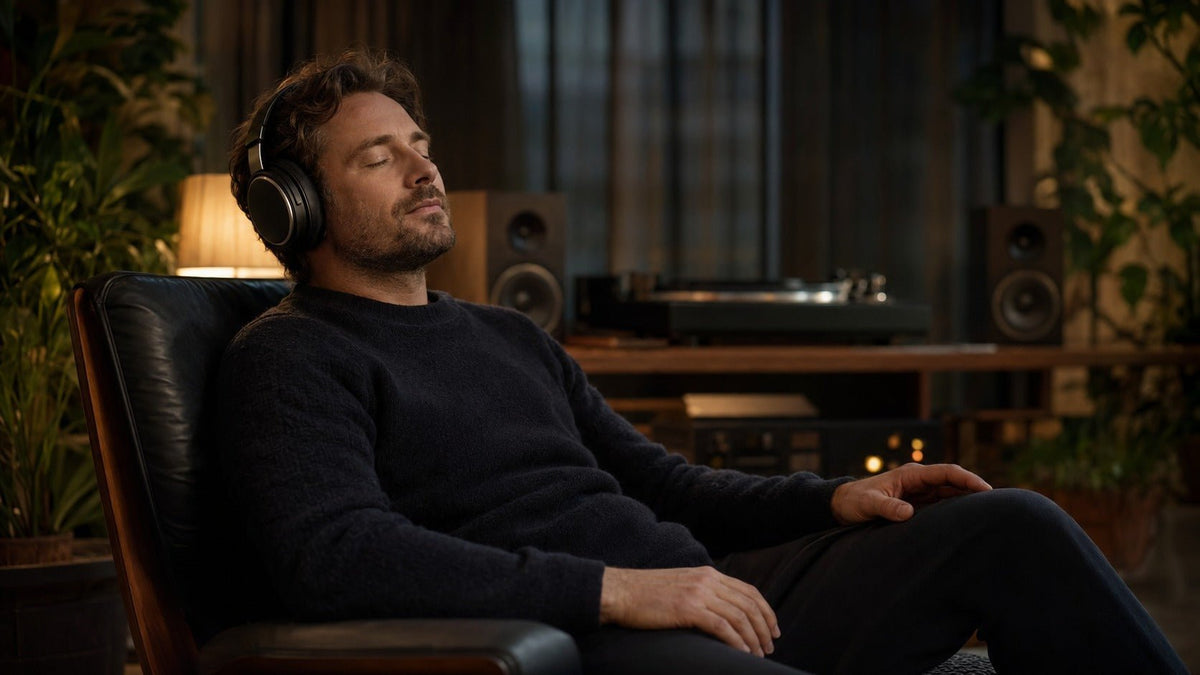
The best headphones for music are not determined by genre alone. Start with where you listen, whether you need isolation, how much bass you prefer, and whether you value a spacious presentation or a more intimate closed-back sound. Then use genre as a useful final filter.
For critical listening in a quiet room, wired open-back headphones remain a strong starting point because they can create a spacious presentation and do not require Bluetooth compression or active processing. For commuting, offices and travel, closed-back wireless headphones are usually more practical because they reduce leakage and can add active noise cancellation.
Quick answer: Choose balanced, spacious headphones for classical, jazz and acoustic music; prioritize controlled low-bass extension for hip-hop, R&B and EDM; look for clear mids and controlled treble for rock and metal; and choose a balanced, adjustable headphone if your library covers many genres.
What matters more than the genre label?
| Factor | Why it matters | Typical trade-off |
|---|---|---|
| Tonal balance | Determines the relative emphasis of bass, mids and treble. | A tuning that sounds exciting to one listener may sound exaggerated to another. |
| Low-bass extension | Important for electronic bass, kick drums and low-frequency effects. | Excess bass can mask midrange detail. |
| Midrange clarity | Vocals, guitars, piano and many acoustic instruments occupy the midrange. | Recessed mids can make vocals and instruments feel less forward. |
| Treble balance | Affects cymbals, harmonics, perceived detail and brightness. | Too much upper-frequency emphasis can become tiring. |
| Open vs. closed back | Open backs often sound more spacious; closed backs isolate more effectively. | Open headphones leak sound and provide little isolation. |
| Wired vs. wireless | Wireless adds mobility, ANC and DSP; wired listening avoids Bluetooth as the audio path. | Convenience and isolation versus simplicity and source flexibility. |

Best headphone characteristics by music genre
Classical and orchestral music
Classical music often benefits from a spacious presentation, stable imaging and a balanced midrange and treble. The goal is not simply "more treble." Instrument placement, large dynamic swings and natural timbre matter more than an artificially bright tuning.
Open-back designs are particularly useful in quiet rooms because they can create a more spacious listening presentation. Current independent testing continues to favor wired open-back headphones for listeners who place sound quality ahead of isolation and portability.
The Sennheiser HD 560S is one practical example. It is a wired, open-back, 120-ohm headphone designed around a relatively accuracy-focused presentation.
Jazz, acoustic and vocal music
Prioritize midrange clarity, realistic instrument body and treble that reveals detail without making cymbals, brass or vocal sibilance unnecessarily aggressive.
The Sennheiser HD 660S2 is another open-back option built around a 300-ohm dynamic driver. It is designed for home listening rather than isolation or portable wireless use.
Do not assume that an open-back design is automatically superior for every listener. If the room is noisy, the advantage of a spacious presentation can be overwhelmed by environmental sound.
Rock and metal
Rock and metal need more than aggressive treble. A useful headphone should keep electric guitars, vocals, bass and dense percussion separated without turning cymbals into constant glare.
Look for:
- clear midrange for guitars and vocals;
- controlled bass rather than bass that masks guitar texture;
- treble that retains attack without becoming piercing; and
- good dynamic contrast for drums and sudden changes in intensity.
A balanced headphone can therefore work better across rock subgenres than one tuned only for maximum bass or maximum brightness.
Hip-hop, R&B and EDM
These genres often place greater demands on sub-bass extension and low-frequency impact. A closed-back headphone can be useful because the acoustic design generally retains low-frequency energy more easily and works better in noisy environments.
If you specifically want exaggerated physical bass rather than neutral reproduction, the Skullcandy Crusher Evo provides adjustable Sensory Bass. That feature makes it a deliberate bass-focused choice, not a reference headphone.
Listeners who want deep bass while preserving a more balanced overall presentation should prioritize low-frequency extension and EQ flexibility rather than choosing the product with the largest advertised driver.
Pop and mixed playlists
If your library moves between pop, rock, acoustic, hip-hop, electronic music and podcasts, versatility matters more than matching one genre.
A balanced wireless headphone with EQ can be useful because the sound can be adjusted without changing hardware. The Sennheiser HDB 630, for example, supports Bluetooth, USB-C and analog listening plus detailed EQ controls.
For listeners who place greater emphasis on travel and noise cancellation, the Sony WH-1000XM6 combines Bluetooth 5.3, LDAC, ANC and a manufacturer-rated maximum of 30 hours of continuous music playback with noise cancellation enabled.
Five current headphones that illustrate different listening priorities
| Model | Design | Best starting point for | Important limitation |
|---|---|---|---|
| Sennheiser HD 560S | Wired, open-back, 120Ω | Quiet-room listening, balanced tuning, classical, jazz and mixed libraries | No isolation, ANC or wireless connection |
| Sennheiser HD 660S2 | Wired, open-back, 300Ω | Dedicated home listening with a suitable source | High impedance and open design make it a less convenient travel option |
| Sennheiser HDB 630 | Closed-back wireless with ANC, USB-C and analog input | Listeners who want high-quality portable audio with strong EQ flexibility | Closed-back wireless presentation differs from a large open-back headphone |
| Sony WH-1000XM6 | Closed-back wireless ANC | Commuting, travel and mixed everyday listening | Designed around portability and ANC rather than open-back home listening |
| Skullcandy Crusher Evo | Closed-back Bluetooth with adjustable Sensory Bass | Listeners who intentionally want very strong adjustable bass impact | Not intended as a neutral or reference-style tuning |
Open-back vs. closed-back headphones for music
Choose open-back when:
- you listen mainly in a quiet room;
- sound leakage will not disturb anyone;
- you prioritize a spacious presentation; and
- you do not need active noise cancellation.
Choose closed-back when:
- you commute or travel;
- other people are nearby;
- you need more isolation;
- strong low-frequency extension is important; or
- you want ANC and portable Bluetooth features.
If you are still deciding between enclosure styles, Wantek’s headphone types guide provides a broader overview of common headphone designs and where they fit.
Wired vs. wireless for music listening
Modern wireless headphones can sound very good, but Bluetooth remains one part of the signal chain. The actual result depends on the headphones, codec, source device, DSP, fit and recording—not the codec name alone.
Wired listening removes Bluetooth transmission from the path, but that does not automatically make any wired headphone better than any wireless headphone.
If you want wireless convenience but occasionally want a direct digital source, some current premium models also support USB-C audio. That creates a useful middle ground between Bluetooth portability and traditional analog-only headphones.
For a deeper comparison of connection choices, see our wired vs. wireless headphones for music guide.
Do you need an amplifier?
It depends on the headphone and source.
Wireless headphones contain their own electronics and amplification. Wired headphones depend more directly on the connected source.
Impedance alone is not enough to determine how difficult a headphone is to drive, but high-impedance audiophile models such as the 300-ohm HD 660S2 deserve more attention to source capability than an active Bluetooth headphone.
Are studio headphones automatically better for music?
No. Studio use and recreational music listening are different tasks.
Recording headphones need useful isolation and low leakage around microphones. Mixing and mastering headphones may prioritize consistency, detail and translation to other playback systems. A consumer listener may instead prefer stronger bass, ANC or a more relaxed tuning.
Choose for the task rather than assuming "studio" means objectively better.
How to choose headphones for a mixed music library
Start with the listening environment.
Decide whether you can use an open-back design.
Identify your bass preference.
Separate deep extension from exaggerated bass quantity.
Prioritize comfort.
A headphone that sounds good but becomes uncomfortable after 30 minutes is a poor match for long albums.
Decide whether ANC matters.
It can be more valuable than a small theoretical sound-quality advantage in a noisy environment.
Check the source.
Wired impedance, Bluetooth codec support and USB audio can change the practical setup.
Use EQ when appropriate.
Small tonal adjustments can be more useful than buying a different headphone for every genre.
Frequently asked questions
What headphones are best for all genres of music?
A balanced headphone with controlled bass, clear mids and non-fatiguing treble is the safest starting point. If you listen in noisy places, also prioritize isolation or ANC over an open-back design.
Are open-back headphones better for classical music?
They can be a strong choice in quiet rooms because the design often produces a more spacious presentation. They leak sound and isolate poorly, so they are not ideal everywhere.
What should I look for in headphones for hip-hop and EDM?
Prioritize low-bass extension, controlled punch and enough midrange clarity to prevent bass from masking vocals and synth detail. Closed-back headphones are often practical for this use.
What headphones are good for rock and metal?
Look for clear mids, controlled bass and treble that preserves guitar and cymbal detail without excessive harshness. Strong treble alone is not a requirement for rock or metal.
Are wireless headphones good enough for serious music listening?
Yes, current wireless headphones can provide high-quality listening. The result depends on the entire system, including tuning, source, codec, DSP and fit rather than Bluetooth specifications alone.
Do I need different headphones for every genre?
No. A well-balanced headphone can handle a broad library, and EQ can adjust moderate tonal preferences. Specialized headphones make more sense when your listening environment or desired bass presentation is very different.

