
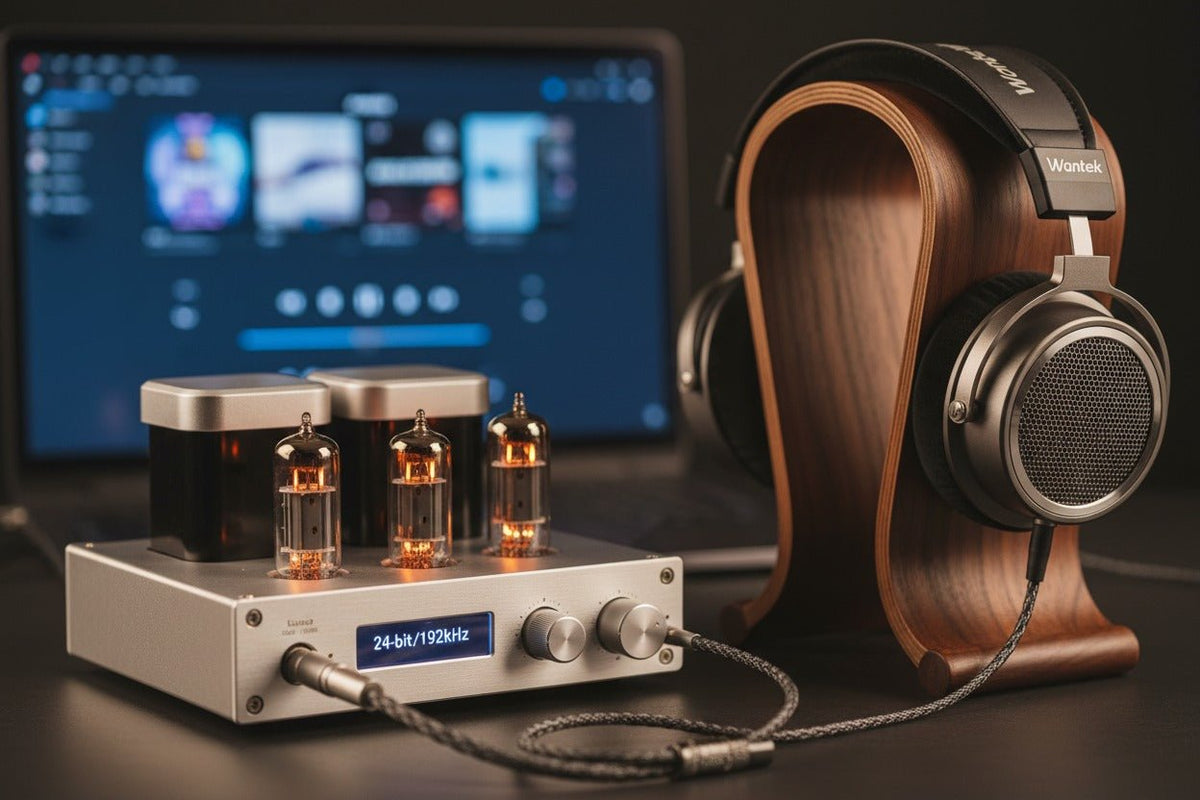
Lossless audio does not require a special category of “lossless headphones.” It requires a lossless source, a playback path that preserves the signal, and headphones that suit your listening environment and source hardware. For predictable lossless playback, a wired connection remains the simplest path, but the headphone itself is only one part of the chain.
Fast answer: For quiet-room listening, the Sennheiser HD 660S2, Audeze LCD-X, Focal Clear Mg, Beyerdynamic DT 1990 PRO MKII, and Sony MDR-MV1 are five current wired open-back options with distinct strengths and verified manufacturer specifications.
Important: This is a specification- and use-case-based shortlist, not a lab-tested ranking. An external DAC or headphone amplifier is useful only when your source, connection, format, or required output level calls for one.
What Lossless Audio Actually Requires

Lossless formats such as FLAC and ALAC preserve the audio data needed to reconstruct the source signal after decoding. “Hi-res” is a separate idea: it generally describes digital audio with higher bit depth or sample rate than CD-quality 16-bit/44.1 kHz audio.
The complete path matters. A streaming app or local file is decoded by the source device, converted from digital to analog somewhere in the chain, amplified, and then reproduced by the headphone drivers. Passive analog headphones do not decode FLAC or ALAC themselves, so calling a passive headphone “lossless” is shorthand for saying it can be used in a lossless playback chain.
Hi-Res Audio certification is not a sound-quality ranking
The Japan Audio Society’s Hi-Res Audio criteria define technical requirements for eligible products and signal paths. Meeting those criteria does not prove that one certified headphone sounds better than another, and a very good headphone does not become unsuitable for lossless listening simply because it lacks that logo.
Wired, Bluetooth, and USB: Where Lossless Can Be Lost
Conventional Bluetooth audio usually adds a codec stage between the source and headphones. Apple explicitly states that Bluetooth connections are not lossless, while also noting that current USB-C AirPods Max models can play lossless audio through a USB-C cable. That distinction is important: a headphone can be wireless for everyday use and still support a separate wired digital mode.
A passive 3.5 mm or 6.35 mm headphone receives an analog signal after digital-to-analog conversion has already happened in the phone, computer, dongle, interface, DAC, or amplifier. USB audio stays digital longer and is converted later in the chain. For a broader connection decision, see Wantek’s wired vs. wireless headphones for music guide.
Practical rule: Do not buy an external DAC or amp just because a headphone is marketed for audiophiles. First confirm what your source can output, what connector you need, and whether the headphone reaches your preferred volume cleanly.
How These Five Headphones Were Selected
The shortlist keeps the original page’s five-model concept but tightens the selection standard. Each model must have a current manufacturer page, verifiable specifications, a wired open-back design suited to quiet-room or studio use, and a distinct reason to consider it. The list does not claim hands-on testing or an absolute first-to-fifth performance ranking.

Five Wired Headphones for Lossless and Hi-Res Listening
| Model | Verified specs | Practical fit |
|---|---|---|
| Sennheiser HD 660S2 | Open dynamic, 38 mm, 300 Ω, 104 dB SPL at 1 Vrms, 260 g | Home listening when you want a traditional high-impedance open-back design and can confirm adequate source output. |
| Audeze LCD-X | Open planar magnetic, 106 mm, 20 Ω, 103 dB/1mW, 612 g | Studio or home use when planar-magnetic design is the priority and the 612 g weight is acceptable. |
| Focal Clear Mg | Open dynamic, 40 mm magnesium driver, 55 Ω, 450 g | Premium home listening with moderate impedance and a conventional dynamic-driver signal path. |
| Beyerdynamic DT 1990 PRO MKII | Open dynamic, TESLA.45, 30 Ω, 376 g, 5 Hz–40 kHz | Mixing, mastering, and editing; the current MKII is easier to pair with varied sources than the former 250 Ω model. |
| Sony MDR-MV1 | Open dynamic studio monitor, manufacturer-stated 5 Hz–80 kHz response | Spatial and stereo production or lightweight open-back monitoring where source flexibility matters. |
Sennheiser HD 660S2: Traditional High-Impedance Open-Back
Sennheiser specifies the HD 660S2 as an open dynamic headphone with a 38 mm transducer, 300 Ω impedance, 104 dB SPL at 1 Vrms, and a 260 g weight. It includes 6.3 mm and 4.4 mm cables plus a 3.5 mm adapter. That combination makes it a straightforward home-listening option, but its 300 Ω impedance means source capability deserves more attention than with the lower-impedance models below.
The important distinction is that 300 Ω does not automatically mean “must buy a dedicated amplifier.” The real question is whether your existing source can deliver enough clean voltage for the listening level you want.
Audeze LCD-X: Planar Magnetic for Studio and Home Use
The LCD-X uses 106 mm planar-magnetic drivers and is specified at 20 Ω, 103 dB/1mW sensitivity, and 612 g. Audeze also publishes a recommended power level above 250 mW. Those figures make source matching less about impedance alone and more about available power, headroom, and the output stage you plan to use.
Its biggest practical trade-off is easy to identify without inventing a sound ranking: weight. At 612 g, it is substantially heavier than the other models here, so long-session comfort is worth evaluating before purchase.
Focal Clear Mg: Premium Dynamic-Driver Option
Focal lists the Clear Mg as an open-back headphone with a 40 mm magnesium M-shaped dome driver, 55 Ω impedance, 450 g weight, and a 5 Hz–23 kHz frequency response within its stated tolerance. The supplied cabling supports both common single-ended listening and a 4-pin XLR connection.
Frequency-response extension on a spec sheet should not be treated as a shortcut to “better” lossless playback. The Clear Mg belongs here because it is a current premium wired open-back model with clearly documented electrical and acoustic specifications, not because one number proves superior fidelity.
Beyerdynamic DT 1990 PRO MKII: Current Studio-Focused Successor
The current DT 1990 PRO MKII replaces the older 250 Ω DT 1990 Pro used in the original article. Beyerdynamic specifies the MKII at 30 Ω, 376 g, and 5 Hz–40 kHz, using its TESLA.45 driver. The company positions it for mixing, mastering, and editing and supplies both straight and coiled detachable cables.
This update matters because repeating the first-generation 250 Ω figure would give readers the wrong source-matching expectation for the current model. Lower nominal impedance does not guarantee perfect pairing with every output, but it removes the original article’s blanket assumption that this model necessarily demands a high-voltage headphone amp.
Sony MDR-MV1: Open-Back Monitor for Spatial and Stereo Production
Sony positions the MDR-MV1 as an open-back reference monitor for mixing and mastering both spatial and stereo sound. Its manufacturer-stated frequency response extends from 5 Hz to 80 kHz, and the detachable cable terminates in a 6.3 mm plug with a 3.5 mm adapter for broader equipment compatibility.
The MDR-MV1 is the most production-specific option in this shortlist. Its reason for inclusion is not a claim that spatial audio automatically improves lossless music; it is that Sony designed it around open-back studio monitoring, stereo work, and spatial production while supporting high-resolution playback.
Do You Need a DAC or Headphone Amplifier?
Not always. Every digital playback chain needs digital-to-analog conversion somewhere, but that converter may already be inside your phone, computer, audio interface, USB dongle, or other playback device. A separate DAC is useful when your existing device cannot provide the connection, sample-rate support, noise performance, or output path you need.
Apple, for example, states that an external DAC is required on iPhone or iPad for Apple Music tracks above 48 kHz. That is a source-device limitation, not a universal rule for every lossless track or every headphone.
A separate headphone amplifier is similarly conditional. Consider one when your current output cannot reach your preferred listening level cleanly or when the headphone manufacturer specifies power needs your source cannot meet. Use impedance and sensitivity together rather than treating either number in isolation.
Current Lossless Streaming Options
| Service | Current lossless offering | What to verify |
|---|---|---|
| Apple Music | Lossless and Hi-Res Lossless; Apple documents playback up to 24-bit/192 kHz. | Connection path and DAC support; above 48 kHz can require an external DAC on some Apple devices. |
| TIDAL | FLAC at 16-bit/44.1 kHz for High and HiRes FLAC up to 24-bit/192 kHz for Max. | Track format, device support, and whether your DAC supports the selected quality. |
| Qobuz | FLAC 16-bit/44.1 kHz plus high-resolution 24-bit audio up to 192 kHz. | Available version of the album and the playback hardware used for high-resolution output. |
| Spotify | Lossless for eligible Premium listeners, up to 24-bit/44.1 kHz. | Plan eligibility, app/device support, network conditions, and connection type. |
TIDAL update: MQA is no longer part of the current TIDAL lossless path. TIDAL removed access to MQA and 360 Reality Audio on July 24, 2024 and now uses FLAC/HiRes FLAC for stereo lossless playback.
How to Choose the Right Model for Your Setup
- Start with the room. All five models here are open-back. They leak sound and provide little isolation, so they make the most sense in a quiet room rather than on a commute or in a shared office.
- Check the source before buying accessories. Identify the output connector, supported formats, and available headphone power before assuming you need a new DAC or amp.
- Use electrical specs together. Impedance, sensitivity, and the source’s output capability matter more than a single “easy to drive” label.
- Account for physical comfort. The Audeze LCD-X is 612 g while the Sennheiser HD 660S2 is 260 g; that difference can matter more over a long session than an extra line on a format spec sheet.
- Match the job. A studio-oriented monitor such as the MDR-MV1 or DT 1990 PRO MKII may make sense for production work, while a home listener may prioritize comfort, source pairing, and preferred tuning.
Final Take
For lossless listening, the best purchase is not the headphone with the largest frequency-response number or the most aggressive “Hi-Res” marketing. Choose a headphone that fits your room, source, comfort needs, and listening job, then verify that the complete playback path preserves the format you intend to use.
The five models above remain useful candidates because they cover different wired open-back approaches without requiring a fictional overall ranking. If your existing source already drives your chosen headphone cleanly and supports the format you want, adding more hardware is optional—not a prerequisite for lossless playback.
Frequently Asked Questions
Do headphones themselves make audio lossless?
No. Lossless describes the source and transmission/decoding path. Passive wired headphones reproduce the analog signal they receive; they do not decode FLAC or ALAC themselves.
Do I need wired headphones for lossless audio?
A wired path is the simplest predictable option, but not every “wireless” headphone is limited to Bluetooth. Some models also support lossless playback through USB-C or another wired mode.
Do I always need an external DAC for hi-res lossless?
No. You need a DAC somewhere in the chain, but it may already be built into your source. Add an external DAC only when the source or target format requires it.
Does a Hi-Res Audio logo guarantee better sound?
No. The logo indicates compliance with defined technical criteria. It does not rank headphones against one another or prove that a certified model will sound better to every listener.
Can AirPods Max play lossless audio?
Apple says current USB-C AirPods Max models can play lossless audio over a USB-C cable. Bluetooth playback remains non-lossless, so the active connection mode matters.

