
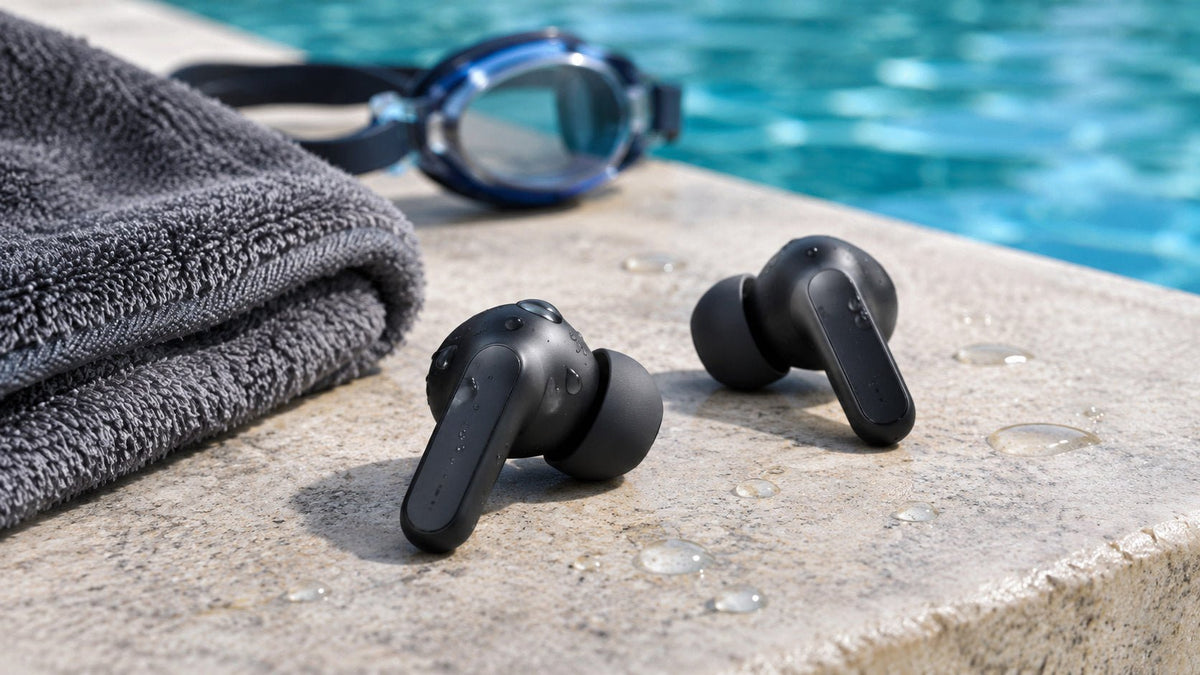
Waterproof earbuds are not all built for the same water exposure. Earbuds rated for splashes or sweat may work for workouts and rainy walks, while swimming calls for explicit manufacturer approval, a secure fit, and a playback method that works underwater. Start with the exact IP rating and the product's water-use instructions—not the word “waterproof” on a listing.
Quick answer: For sweat and occasional splashes, look for a documented splash-resistant design suitable for your activity. For swimming, confirm the manufacturer explicitly allows immersion and offers local playback, such as onboard MP3 storage. A high IP rating does not make Bluetooth streaming reliable below the surface.
What do waterproof earbud IP ratings mean?
The International Protection (IP) code describes an enclosure's tested resistance to particles and water. The first character after “IP” covers dust; the second covers water. An “X” means no rating is specified for that category, not that the device necessarily has no protection.
- IPX4: Protection against splashing water from different directions. Consider it for sweat and light splashes only when the manufacturer approves those uses; it does not cover immersion.
- IPX5/IPX6: Protection against water jets under defined test conditions. IPX6 covers stronger jets than IPX5; neither rating alone establishes immersion protection or swimming suitability.
- IPX7: Tested for temporary immersion, generally up to 1 meter for 30 minutes under specified conditions. This is not automatic permission to swim or expose the earbuds to soap or pool chemicals.
- IPX8: Tested for immersion beyond IPX7 conditions, with depth and duration defined by the manufacturer. Check the actual limit and whether swimming is expressly supported.
- IP68: The “6” indicates dust-tight protection, while “8” indicates the manufacturer-defined immersion level. It is not a universal guarantee against every water activity.
Different water tests address different conditions. An immersion rating by itself should not be interpreted as approval for high-pressure jets, hot showers, or repeated exposure to chlorinated or salt water. For the technical rating distinctions, see RTINGS' explanation of headphone IP ratings.
| Use | What to verify | Do not assume |
|---|---|---|
| Sweaty workouts | Published sweat/water rating and care instructions. | “Sport” automatically means waterproof. |
| Rain | Ingress rating and manufacturer limits. | Any IP rating covers heavy rain indefinitely. |
| Swimming | Explicit swim approval plus depth/duration limits. | High IP rating alone guarantees pool use. |
| Underwater audio | Onboard storage or supported underwater source. | Bluetooth from a phone will remain reliable underwater. |

Choose earbuds for your actual activity
Gym workouts, running, and rain
For everyday exercise, the most useful combination is documented sweat protection, a stable fit, accessible controls, and comfortable single-charge battery life. Ear hooks or wings can help with movement, but they are not substitutes for checking the water rating. If you regularly run in rain, read the maker's specific rain-use and drying guidance rather than treating an IP number as unlimited weather protection.
Pool laps and open-water swimming
Look for headphones that the manufacturer actually describes as swim-ready. Verify allowable depth, immersion time, fresh-water versus pool or saltwater instructions, controls that can be used while wet, and how music is loaded. A device marketed as an IPX8 or IP68 workout earbud may still be intended only for running, not underwater listening. For music transfer and setup before a swim, see our guide to listening to music while swimming.
Showering and water sports
Do not treat “waterproof” as permission to wear earbuds in a hot shower, sauna, or while exposed to pressurized water. Heat, soap, and forceful jets are different stresses from a controlled immersion test. Follow the exact model's exclusions, even when its IP rating appears high.
Why Bluetooth earbuds struggle underwater
Bluetooth uses 2.4 GHz radio, which water strongly attenuates. A phone resting beside a pool cannot generally maintain normal audio streaming to submerged earbuds. Swim-focused devices often include onboard MP3 storage so audio plays directly from the headset, without an active phone connection underwater.
Check whether the model switches between Bluetooth for dry-land listening and MP3 mode for swimming, and confirm supported file formats and transfer instructions. Bluetooth version numbers do not solve the underlying signal problem. For a deeper comparison of specific approaches, see our swimming headphones guide.

In-ear earbuds or bone-conduction headphones for swimming?
Sealed in-ear swim earbuds sit in the ear canal and rely on an appropriate tip seal and secure retention. Check whether the tips stay comfortable during turns and whether the manufacturer supplies water-use tips. A fit that works in the gym may shift when you push off the wall.
Bone-conduction swim headphones sit outside the ear canal and usually use a band to hold the transducers in position. They may fit more comfortably with certain swim caps or goggles, but their open-ear design does not by itself establish waterproofing or reliable underwater streaming. Verify water approval and onboard audio just as carefully as for earbuds.
Whichever form you choose, test the wearing position with your cap and goggles before a long swim. Compare fit, button access, local storage capacity, file compatibility, and battery life in the playback mode you plan to use, not just the advertised total with a charging case.
Water exposure, cleaning, and charging
Water resistance can decline with wear or damage, and charging cases may have different protection from the earbuds inside them. Follow the manufacturer’s rinse and drying instructions for the exact product and water type. Never charge while the contacts are wet unless the documentation expressly permits it.
For a concrete example of model-specific restrictions, Apple's AirPods water-resistance guidance says its splash-resistant AirPods are not intended for swimming or showering and explains drying before charging. Those instructions describe AirPods, not every swimming headset.

Waterproof earbud buying checklist
- Start with the activity: workout sweat, rain, swimming, and underwater playback call for different assurances.
- Read the complete rating: identify the water digit, dust digit or X, and the maker's immersion conditions.
- Confirm approved water use: check whether pool water, salt water, showering, and specific depths are permitted or excluded.
- Verify playback and fit: for swimming, check onboard music, file-transfer method, controls, and compatibility with a cap and goggles.
- Compare realistic battery and maintenance: look at single-charge time in the actual audio mode, charging-case protection, and post-use care.
Compare an IP68 swimming model
BC3 Pro is a bone-conduction swim headset, not an in-ear earbud. Wantek lists IP68 protection, 32GB of onboard MP3 storage, Bluetooth 5.3, and up to 6 hours of battery life. For swimming, play stored MP3 files rather than relying on underwater Bluetooth. The product listing does not specify a numeric immersion depth or duration, so check the model's water-use instructions before swimming.
Frequently asked questions
Does IP68 automatically mean earbuds are safe for swimming?
No. IP68 describes dust protection and manufacturer-defined immersion testing. Confirm the brand explicitly approves swimming, along with water type, depth, duration, and any care restrictions.
Can Bluetooth earbuds stream music underwater?
Not reliably during normal submerged swimming. Water strongly weakens Bluetooth radio signals. Choose a swim-approved model with local MP3 playback or another manufacturer-documented underwater audio method.
What IP rating is appropriate for running or gym workouts?
IPX4 may cover splashes for many workouts, provided the manufacturer permits sweat and exercise use. Check fit, sweat-care instructions, and any limits rather than choosing by the rating alone.
Can I shower with waterproof earbuds?
Only if the specific manufacturer explicitly supports showering. An IPX7 or IP68 rating alone does not establish resistance to heat, soap, repeated water exposure, or pressurized spray.

