
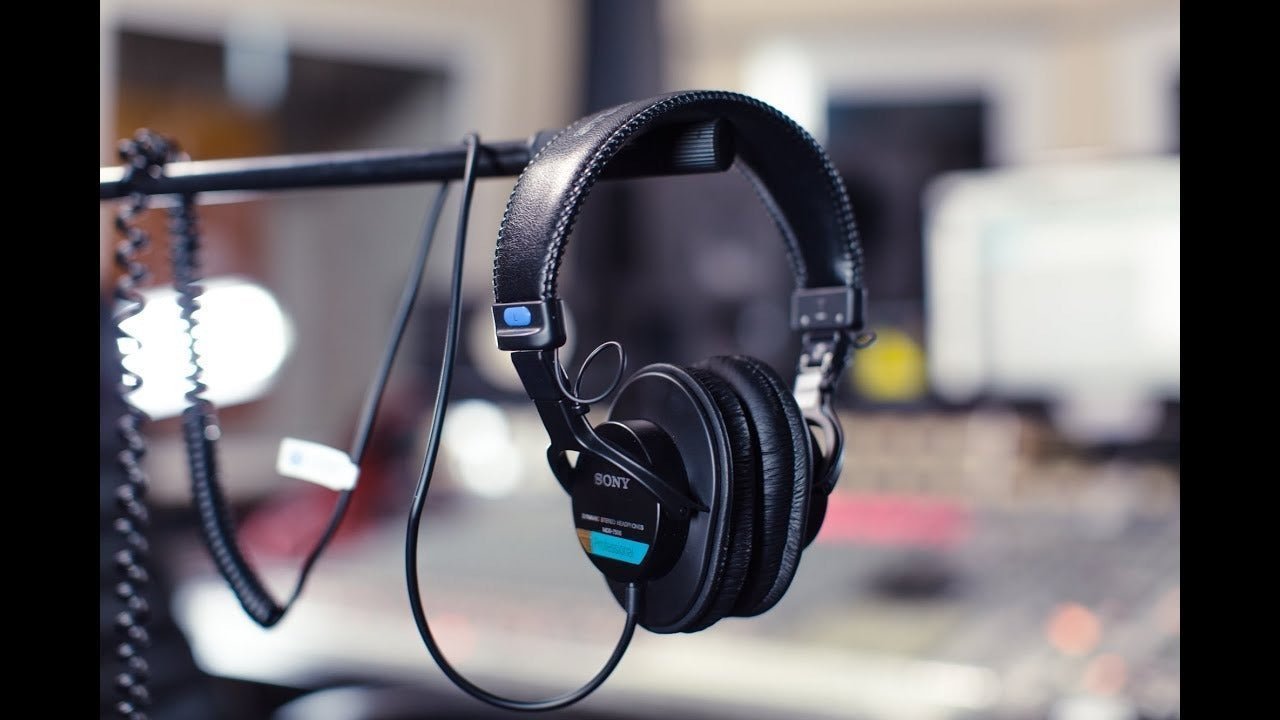
The Sony MDR-7506 is a current wired closed-back professional monitor headphone that has remained in production for decades. Sony currently lists a 40 mm driver, folding construction, closed-ear design, 10 Hz–20 kHz published frequency response, and a 3.5 mm/6.3 mm adapter at an MSRP of $114.99 in the U.S.
Why it still matters: MDR-7506 is simple, serviceable in use, widely familiar in studios and broadcast environments, and easy to connect to professional or consumer analog outputs. Its strengths do not mean it is perfectly neutral or automatically the best headphone for mixing.

Sony MDR-7506: Current Specifications
| Feature | Specification | Practical meaning |
|---|---|---|
| Design | Closed-ear, over-ear, folding | Reduces leakage compared with open-back designs and folds for transport. |
| Driver | 40 mm dynamic | Part of the acoustic design; driver size alone does not determine accuracy. |
| Published response | 10 Hz–20 kHz | Useful as a manufacturer specification, not a frequency-response accuracy score. |
| Connection | 3.5 mm with gold-plated 3.5/6.3 mm Unimatch adapter | Works with many interfaces, mixers, recorders and headphone outputs. |
| Construction | Folding professional monitor headphone | Useful for studios, broadcast, field recording and editing. |
| Current U.S. MSRP | $114.99 | Check current Sony pricing and dealer promotions before purchase. |
Sony still sells MDR-7506 directly as a Professional Stereo Monitor Headphone, rather than treating it as a discontinued legacy model.
Why It Has Stayed Common in Production Work
The MDR-7506 combines a closed design, folding earcups, a long coiled cable, an included 6.3 mm adapter and a relatively simple wired signal path. Those are practical features in studios, broadcast rooms, video production and field kits.
Familiarity also matters. Engineers who have used the same headphone for years learn how its tonal balance relates to speakers and other playback systems. That experience is more meaningful than a claim that the headphone is universally “perfectly accurate.”
Closed-Back Design Helps With Tracking
Because the earcups are closed, MDR-7506 leaks less sound into nearby microphones than an open-back headphone. That is useful for vocal tracking, location monitoring and other situations where playback leakage can contaminate a recording.
Closed-back does not mean active noise cancellation. The MDR-7506 provides passive isolation only.
Frequency Response: Avoid the “Flat” Shortcut
The old page described the MDR-7506 as essentially uncolored and perfectly accurate. That is too strong. Sony publishes a broad 10 Hz–20 kHz operating range, but that number says nothing about how level the response is inside that range.
Independent measurements are more useful when judging tonal balance. For mixing, it is better to learn the headphone's response and cross-check on monitors or other references than to assume any one headphone tells the complete truth.
Treble Can Be a Useful Diagnostic—and a Preference Issue
MDR-7506 is often described in independent reviews as having a prominent upper-mid/treble presentation. That can make noise, sibilance or editing artifacts easy to notice, but it can also sound bright to some listeners.
This is why “professionals use it” should not be converted into “everyone will prefer its sound.” Monitoring familiarity and task fit matter more.
The Cable Is Fixed
One important ownership trade-off is the permanently attached coiled cable. It is convenient at a console but less flexible than a detachable cable for travel or repair.
If the cable is damaged, service is more involved than simply replacing a detachable lead. Pad replacement is easier and commonly done as the original cushions wear.
Comfort and Pad Wear
Pad material degrades with time and use. Worn pads change comfort, seal and potentially the sound. If buying a used MDR-7506, inspect the cushions and headband before judging the condition from the drivers alone.
For long editing sessions, head shape and glasses can matter as much as headphone weight. Test a full working session rather than a short audition.
MDR-7506 for Recording vs. Mixing
For recording and monitoring, the closed design and straightforward wired connection are clear advantages. For mixing, MDR-7506 can be useful as one reference, but a single closed-back headphone should not automatically become the only monitoring system.
For broader studio choices, see the Studio Headphones for Recording & Mixing guide.
What to Check Before Buying Used
- Play a mono signal and confirm both channels are equally stable.
- Move the coiled cable gently and listen for intermittent audio.
- Inspect pads and headband material for cracking or shedding.
- Check the folding hinges and swivels.
- Verify the 6.3 mm adapter if you need it for an interface or mixer.
- Compare the price with Sony's current new MSRP and warranty.
Frequently Asked Questions
Is Sony MDR-7506 discontinued?
No. Sony currently sells the MDR-7506 as a professional stereo monitor headphone in the U.S.
Does MDR-7506 have active noise cancellation?
No. It is a wired closed-back monitor headphone with passive isolation, not electronic ANC.
Is MDR-7506 good for mixing?
It can be a useful familiar reference, but it is not perfectly neutral and should ideally be cross-checked with speakers or other references.
Does the MDR-7506 cable detach?
No. The classic MDR-7506 uses a fixed coiled cable and includes a 3.5 mm to 6.3 mm adapter.

