
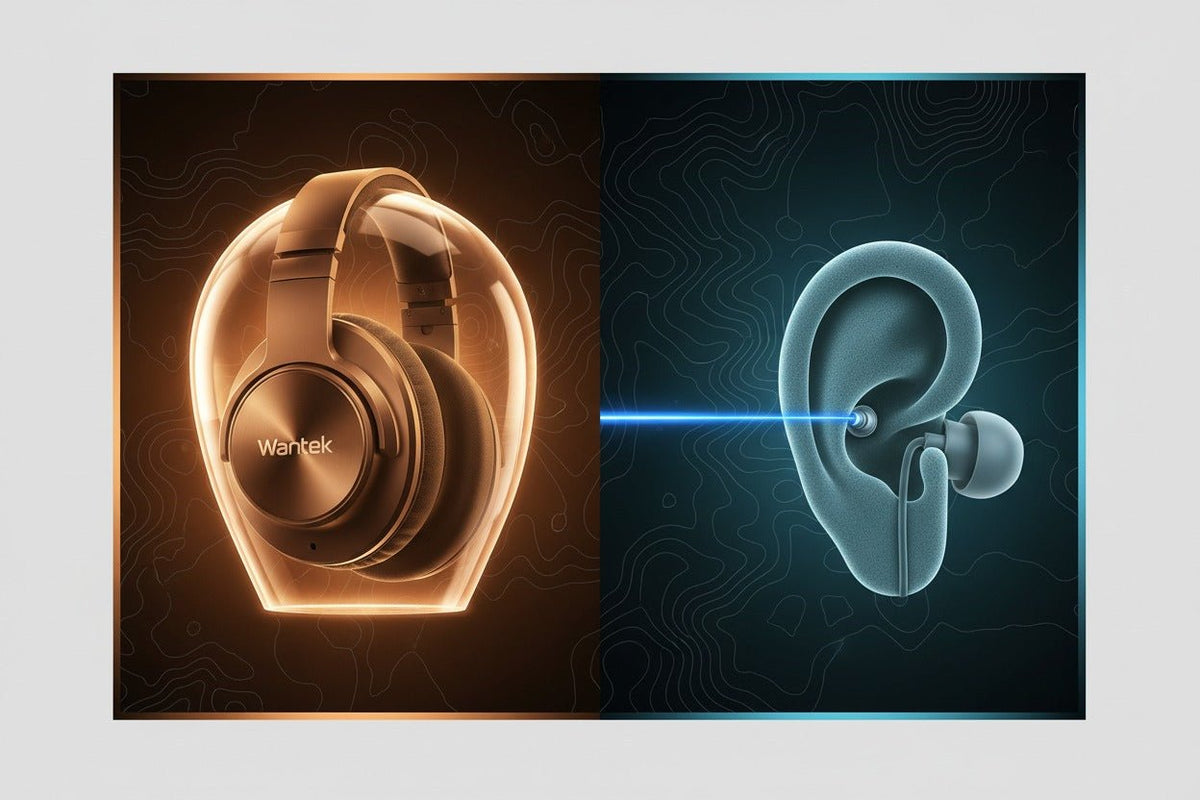
Choose over-ear headphones if you want cushions around your ears and can accommodate the larger size. Choose in-ear headphones if pocketable storage and a secure ear-tip fit matter more. For desk use, check pressure and heat; for workouts, check stability and sweat resistance. For flights or commuting, compare the exact models' fit and noise control. Neither design guarantees better sound, stronger ANC, or clearer calls.

Where the Headphone Touches Your Ear
Over-ear, also called around-ear, headphones use cushions intended to surround the outer ear. Sealing in-ear headphones place a tip at or inside the ear canal. Not every earbud creates a seal: open-fit earbuds rest near the canal entrance, while open-ear designs keep the canal unobstructed. On-ear cushions press against the outer ear. These are differences in fit, not rankings of sound quality.
Comfort and Seal
For over-ear fit, check the usable cushion opening, cup depth, clamping pressure, headband adjustment, and heat during longer sessions. Glasses can interrupt the cushion seal or create pressure at the temples. A large outer earcup does not necessarily provide enough room inside the pad. Try the headphones for the length of your normal work or listening session when possible.
For in-ear fit, try the supplied tip sizes and the insertion method specified by the manufacturer. A poor seal can change bass and isolation; forcing a tip deeper is not a solution to pain. Left and right ears may need different sizes. Check whether the housing presses on the outer ear as well as whether the tip seals.
If a canal fit is the main issue, the small-ear earphone fit guide discusses checks beyond choosing the smallest advertised tip.
Noise Isolation and ANC
Passive isolation comes from a physical seal and the materials around it. Active noise cancellation (ANC) uses microphones and processing to reduce some sounds reaching your ears. Bose's explanation of the mechanisms distinguishes the two. ANC commonly helps with steady background noise, but it cannot remove every voice or sudden sound.
Neither shape automatically isolates better. A closed-back over-ear model with well-fitting pads can reduce outside sound, while an open-back over-ear model typically allows much more sound in and out. Sealed in-ear tips can also provide substantial passive isolation. Compare the actual model and fit in your usual environment, rather than assuming one design always wins. The illustration below is conceptual, not a promise of complete silence.

Portability, Calls and Connections
- Carry space: over-ear headphones take up more bag room, even if they fold. In-ear models tend to have smaller cases, but case size and charging capacity vary. Compare the complete kit rather than the earpieces alone.
- Calls: microphone noise reduction affects what other people hear, while listening ANC affects what you hear. Check recordings or reliable call samples for your device and app; wearing style alone does not establish speech quality.
- Movement: for running or gym use, check whether the tips, wings, hooks, or headband stay secure when you move. Verify the exact model's sweat-resistance rating; neither wearing style guarantees it.
- Connections: choose the required 3.5 mm, USB, or Bluetooth connection before comparing convenience. For wireless use, verify charging requirements, playback time per charge, case recharges where applicable, and switching between your devices.
For work calls where avoiding an ear-canal fit matters, the open-ear phone-call guide covers a separate option and its call-quality limits.
Frequently Asked Questions
Do Bigger Drivers Mean Better Sound?
No. Driver diameter alone does not establish tuning, distortion, or perceived quality. Compare the actual headphone and its fit rather than using size as a performance ranking.
Which Style Fits Work, Travel, or Exercise?
Over-ear headphones may suit long desk sessions if their pads stay comfortable. Compact, secure in-ear designs may be more practical for exercise. Either style can work for travel; check fit, isolation, and carrying space.
Does ANC Reduce What My Caller Hears?
Listening ANC targets noise reaching your ears. Microphone noise reduction targets outgoing speech. Check those features separately.

