
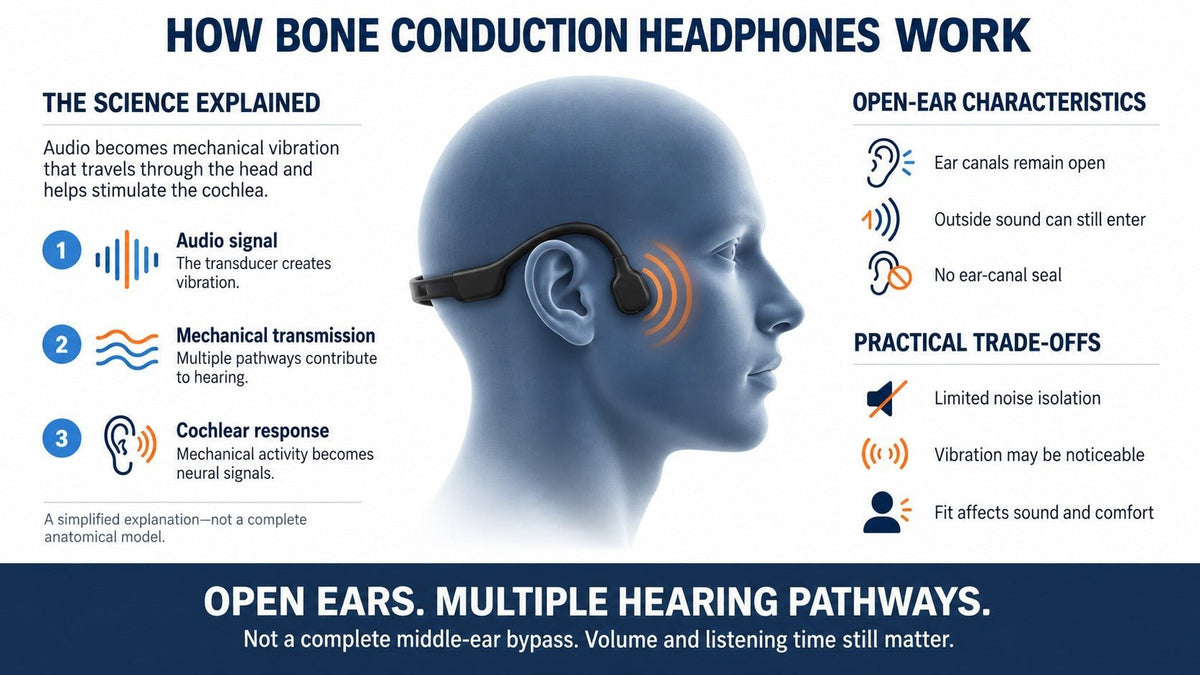
Bone conduction headphones turn an audio signal into mechanical vibration rather than relying mainly on a speaker sending sound through the ear canal. The vibration travels through the head and contributes to movement inside the cochlea, where the auditory system converts mechanical activity into neural signals that we perceive as sound.
That is the short explanation. The familiar claim that bone conduction simply “bypasses the eardrum” is useful as shorthand, but the real physiology is more complex. Bone-conducted hearing can involve the inner ear, middle ear, outer ear, skull, and surrounding tissues at the same time.
How normal air-conduction hearing works
To understand bone conduction, start with ordinary hearing. According to the National Institute on Deafness and Other Communication Disorders, airborne sound enters the ear canal and reaches the eardrum. The eardrum vibrates and transfers that movement to three small middle-ear bones: the malleus, incus, and stapes.
The middle-ear system transfers mechanical energy into the fluid-filled cochlea in the inner ear. Movement inside the cochlea causes structures including the basilar membrane to move, stimulating sensory hair cells. The resulting electrical signals travel through the auditory nerve toward the brain.
Conventional earbuds and headphones mainly use this air-conduction pathway. Their drivers move air, creating pressure changes that enter the auditory system through the ear canal.
How bone conduction headphones create sound
Bone conduction headphones start with the same basic audio information as conventional headphones, but the physical delivery method is different.
- The headset receives an audio signal. Music, speech, or another audio source is converted into an electrical signal that represents the sound.
- A transducer converts that signal into mechanical vibration. Instead of relying mainly on a speaker diaphragm to move air inside or directly beside the ear canal, the headset creates vibration at its contact point with the head.
- The vibration travels through the head and surrounding tissues. This mechanical energy contributes to several bone-conduction pathways within the auditory system.
- Mechanical activity reaches the inner ear. The different pathways contribute to fluid and structural movement within the cochlea.
- The cochlea converts that activity into neural signals. The auditory system then processes those signals as sound.
A review of bone-conduction hearing physiology describes several mechanisms that can contribute to this process. That is why a simple diagram showing one vibration traveling directly from the cheekbone to the cochlea does not tell the full story.

Do bone conduction headphones really bypass the eardrum?
They reduce dependence on the normal air-conduction route, but “completely bypass the eardrum and middle ear” is too absolute.
Research describes multiple mechanisms involved in bone-conducted hearing. These include sound generated in the ear canal, inertia of the middle-ear ossicles, inertia of cochlear fluid, deformation of structures surrounding the cochlea, and other pressure-transmission effects.
A review by Stenfelt and Goode identified five major contributors to bone-conducted hearing, while later research continues to examine how strongly each pathway contributes under different conditions. Research specifically examining bone-conduction headsets likewise describes several pathways rather than a single direct route.
For a consumer explanation, the most accurate shorthand is this: bone conduction provides another mechanical route for stimulating the auditory system without depending primarily on airborne sound entering the ear canal.
What physical mechanisms contribute to bone conduction?
| Mechanism | What happens | Why it matters |
|---|---|---|
| Ear-canal sound | Vibration of structures around the ear can generate sound pressure inside the ear canal. | The outer ear can still contribute to bone-conducted hearing. |
| Ossicular inertia | Skull vibration can create relative movement of the middle-ear bones. | The middle ear is not necessarily irrelevant during bone conduction. |
| Cochlear-fluid inertia | Head vibration can create relative motion of fluid inside the cochlea. | Research identifies this as an important contributor to bone-conducted hearing. |
| Inner-ear structural effects | Vibration can deform structures surrounding the fluid-filled inner ear. | This can contribute to pressure differences and cochlear motion. |
| Additional pressure pathways | Pressure transmitted through structures and fluids within the head may also contribute. | Bone conduction is a combined mechanical process rather than one simple vibration path. |
The relative contribution of these mechanisms changes with frequency, vibration location, anatomy, coupling, and other conditions. That is another reason to avoid treating a single illustration as a complete model of how every bone conduction headset works.
What part of the ear ultimately detects bone-conducted sound?
The cochlea remains central to hearing. Whether mechanical energy arrives mainly through ordinary air conduction or through bone conduction, the process ultimately depends on mechanical activity in the inner ear producing signals that the auditory nervous system can process.
This is also why bone conduction has long been useful in audiology. Comparing air-conduction and bone-conduction hearing thresholds can help clinicians distinguish different components of hearing loss.
Consumer Bluetooth bone conduction headphones should not, however, be treated as equivalent to clinical bone-conduction hearing systems. They may use related physical principles, but they are designed for different purposes and should not inherit medical-device claims simply because both use bone conduction.
Bone conduction vs. regular headphones
The most useful practical distinction is what happens around the ear canal.
| Question | Bone conduction headphones | Conventional headphones |
|---|---|---|
| Primary delivery method | Mechanical vibration coupled to the head contributes to cochlear stimulation. | A driver primarily creates airborne sound directed toward the ear canal. |
| Ear canal | Usually remains physically open. | Earbuds may seal the canal; over-ear models surround the ear. |
| Environmental sound | Airborne environmental sound can still enter an open ear canal. | Isolation varies by fit, seal, earcup design, and active noise cancellation. |
| Mechanical sensation | Some listeners notice vibration at the transducer contact points. | Normally rely less on noticeable vibration against the head. |
| Isolation | Open-ear designs generally provide little acoustic isolation from the environment. | Can provide substantial passive or active isolation depending on the model. |
Why can you still hear surrounding sounds?
Most consumer bone conduction headphones leave the ear canal physically open. That means environmental sound can continue entering through the normal air-conduction pathway while the headphones deliver audio through mechanical vibration.
This can make outside sound more accessible than it would be with strongly isolating earbuds or headphones. It does not guarantee complete situational awareness.
Playback volume still matters. So do background noise, distance from a sound source, direction, individual hearing, and attention. Someone concentrating on a podcast or music can miss information even when the ears are physically open.
The useful distinction is therefore access to environmental sound, not “100% awareness” or a guaranteed safety advantage.
Why do bone conduction headphones sometimes feel like they are vibrating?
The sensation comes from the transducer mechanically coupling with the side of the head. How noticeable it feels depends on the headset, playback level, frequency content, placement, contact pressure, and the individual wearer.
Moving the transducer slightly can also change perceived sound because mechanical coupling changes with position. A secure fit should maintain contact without relying on excessive pressure.
This physical coupling is one reason two people can perceive the same bone conduction headset differently even when the electronic settings are identical.
Why can bass sound different?
Bone conduction and sealed conventional headphones create different acoustic conditions.
A well-sealed in-ear headphone can control a small volume of air inside the ear canal and reproduce low-frequency sound using that acoustic seal. Open-ear bone conduction designs do not create the same sealed environment and instead depend heavily on mechanical coupling between the transducer and the wearer.
That does not mean every bone conduction headset has the same frequency response or that a fixed frequency cutoff applies to the whole category. Performance varies by transducer, fit, signal processing, mechanical design, and measurement conditions.
The practical trade-off is simpler: listeners who prioritize strong isolation and deep bass may prefer sealed conventional headphones, while listeners who prioritize an unobstructed ear canal may prefer an open-ear design.
Are bone conduction headphones safer for hearing?
An open ear canal does not make unlimited high-volume listening safe.
Bone conduction still produces mechanical activity in the cochlea. Listening risk therefore cannot be reduced to whether a speaker sits inside the ear canal.
The World Health Organization's safe-listening guidance emphasizes both sound level and exposure duration: as listening level increases, the amount of time that can be tolerated safely decreases.
For bone conduction headphones, the useful rule is the same basic one that applies to other personal audio devices: avoid unnecessarily high playback levels, limit prolonged loud listening, and take breaks during long sessions.
Open-ear construction is therefore a design difference—not proof that a headset is incapable of contributing to harmful sound exposure.
What happens in noisy environments?
Keeping the ear canal open has a trade-off: surrounding noise can compete with the audio you are trying to hear.
In a quiet environment, this may be exactly what you want. In a loud gym, train station, workshop, or busy street, environmental sound can mask music or speech.
The wrong response is simply turning the headset much louder. That increases sound exposure while the open design still does not provide the isolation of a sealed earbud or over-ear headphone.
Bone conduction therefore works best when its open-ear design matches the listening environment rather than when it is treated as a universal replacement for every headphone type.
Are all open-ear headphones bone conduction?
No. “Open-ear” describes how the product interacts with the ear canal; “bone conduction” describes a sound-transmission method.
Bone conduction models use vibration-based transducers coupled to the head. Other open-ear headphones place small air-conduction speakers near the ear without sealing the canal.
Both approaches can leave the ear canal open, but they should not be treated as technically identical. Their fit, sound leakage, bass response, mechanical sensation, placement, and acoustic behavior can differ.
How does bone conduction work for swimming?
The underlying bone-conduction principle does not suddenly become a different technology underwater, but the listening environment changes substantially. Water changes the acoustic and mechanical conditions around the headset and the wearer.
There is also a separate wireless issue: ordinary Bluetooth operates around 2.4 GHz, and water strongly limits the practical transmission path. That is why swim-oriented headphones commonly rely on audio stored directly on the headset rather than normal phone-to-headset Bluetooth streaming underwater.
Only use a headset for swimming when the specific model's documented water protection and operating instructions support that use. “Bone conduction” by itself does not mean “waterproof.”
For a model-by-model comparison, see the bone conduction headphones for swimming guide.
The simple explanation
Bone conduction headphones convert an audio signal into mechanical vibration. That vibration travels through the head and activates several mechanisms that ultimately create movement inside the cochlea. The auditory system then converts that mechanical activity into neural signals that are perceived as sound.
The technology does not require the ear canal to be sealed, which is why most consumer bone conduction headphones can leave the ears physically open.
The common phrase “sound bypasses the eardrum” captures part of the idea but oversimplifies the physiology. Research shows that bone-conducted hearing can involve the outer ear, middle ear, inner ear, skull, and surrounding tissues simultaneously.
The main consumer trade-off is therefore not “normal hearing versus a completely separate hearing system.” It is a different way of delivering mechanical energy to the same auditory system, with different implications for fit, isolation, environmental sound, vibration sensation, and sound reproduction.
Frequently asked questions
Do bone conduction headphones send sound directly to the brain?
No. Mechanical activity ultimately stimulates the cochlea, which helps convert that activity into neural signals. Those signals then travel through the auditory system toward the brain.
Do bone conduction headphones completely bypass the eardrum?
Not completely. They reduce dependence on normal air conduction, but research shows that outer-ear and middle-ear mechanisms can still contribute to bone-conducted hearing.
Why can I hear outside sounds while wearing bone conduction headphones?
Most models leave the ear canals physically open, so airborne environmental sound can still enter normally. Playback level and attention still affect how much of the environment you notice.
Can bone conduction headphones still affect hearing at high volume?
Yes. The cochlea is still involved in hearing the audio, so listening level and exposure duration remain relevant even when the ear canal is left open.
Do all bone conduction headphones work underwater?
No. Swimming requires model-specific water protection and operating guidance. Swim-oriented models often use onboard audio because normal Bluetooth connections do not remain reliable through water.


1 comment
Question; I had ramus on mandible replaced with rib, after motor vehicle accident. I have had a couple of bone conducting head ware. Is there one that goes straight to the temporal bone, if I search for Temporal bone, it usually displays the one that vibrate into ramus of the mandible. Can you suggest a functional alternatives? Pods work but effects the situational awareness.