
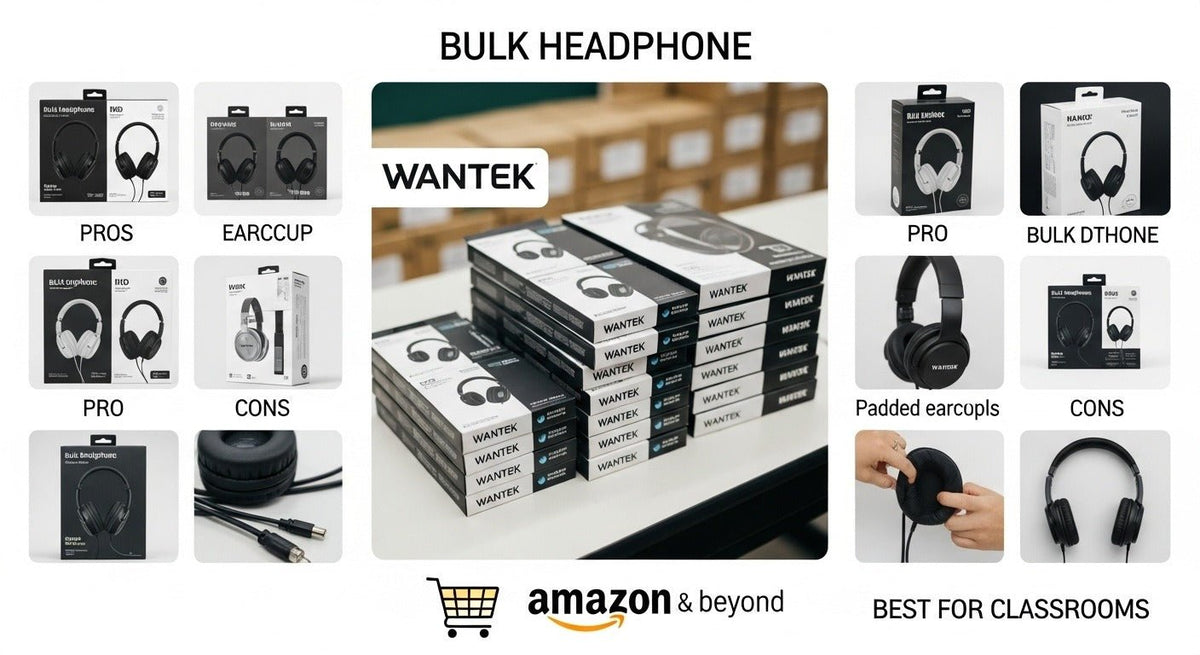
Buying bulk headphones on Amazon can be practical when you need familiar purchasing, broad selection, and fast fulfillment. For a larger classroom, office, training, or call-center rollout, however, the decision should be based on exact product identity, compatibility, seller continuity, samples, replacements, and total cost—not the lowest visible unit price.

Quick answer: Amazon is useful for smaller or time-sensitive bulk orders when the exact item, seller, quantity, and return terms are clear. Direct suppliers or distributors become more useful when you need repeatable SKUs, samples, compatibility guidance, larger planned quantities, customization, or a defined replacement process.
Amazon, a distributor, or a direct supplier?
| Route | Useful when | Verify before ordering |
|---|---|---|
| Amazon / Amazon Business | You want broad selection, a familiar checkout process, or fast access to in-stock products. | Exact SKU, seller, quantity available, delivery window, return terms, and whether the same item can be reordered. |
| Distributor or reseller | You want account support and purchasing across multiple brands or product categories. | Exact model, substitutions, stock continuity, warranty owner, and replacement process. |
| Direct supplier | You need samples, compatibility guidance, planned repeat orders, or more control over a standardized deployment. | Lead time, minimum quantities, shipping terms, approved sample, change control, and support after delivery. |
Amazon Business also offers quantity-discount and bulk-buying tools on eligible products, so an Amazon purchase is not limited to ordinary consumer checkout. Its current bulk-buying documentation describes quantity discounts and a Request for Quote path for qualifying high-volume purchases. Check the current terms on the Amazon Business bulk-buying page because eligibility and offer details can change.
Define the deployment before comparing listings
The same inexpensive headphone can be suitable for one rollout and unusable for another. Start with the devices and users, then convert those needs into a short purchasing specification.
- Device and connector: 3.5 mm, USB-A, USB-C, Bluetooth, or another required connection.
- Audio task: listening only, calls, language learning, testing, training, or mixed use.
- Microphone: none, inline microphone, or boom microphone.
- Wearing style: mono, dual-ear, on-ear, over-ear, or in-ear.
- Shared-use requirements: cleaning, replaceable cushions, storage, labeling, and cable management.
- Operational requirements: delivery deadline, spare stock, replacement lead time, and repeat-order horizon.
For a school or business deployment, Wantek's bulk headphones planning page organizes the decision around use case, connector, quantity, and compatibility rather than treating every bulk order as the same purchase.
On Amazon, verify the exact product and seller
A marketplace listing can combine several variables that matter at scale. Before ordering, record the exact model or SKU, color or connector variant, seller, fulfillment method, included accessories, and stated warranty or return terms. Save the listing details used for approval so the purchasing team can compare them with what arrives.
This matters because a later order can look similar while coming from a different seller, revision, or bundle. For a one-person purchase, that may be manageable. Across dozens or hundreds of seats, small differences can create support problems.
Do not assume a listing will stay identical for repeat orders
Standardization has value only if the same configuration can be sourced again. If the rollout will expand over time, ask whether the exact SKU is expected to remain available and what happens when the supplier changes a cable, control module, packaging configuration, firmware, or included accessory.
If repeatability is critical, a distributor or direct supplier may be easier to manage because the purchasing conversation can explicitly cover model continuity and substitutions. That does not make every direct supplier better; it simply gives you a different control point to verify.
Sample before a meaningful rollout
Use a sample or small pilot to test the same devices, software, desks, storage process, and cleaning routine that the final users will have. A useful pilot checks more than whether sound comes out.
| Check | Test | Failure to catch |
|---|---|---|
| Compatibility | Use the real laptops, tablets, phones, or desk systems. | Wrong connector, unsupported controls, or microphone-routing problems. |
| Fit and durability | Have representative users wear and handle the unit. | Excess pressure, poor adjustment range, weak hinges, or unstable fit. |
| Cable and controls | Test cable length, strain points, mute, volume, and inline controls where applicable. | Desk-layout conflicts or controls that do not behave as expected. |
| Shared use | Run the intended cleaning and storage process. | Materials or accessories that are difficult to maintain at scale. |

Plan replacements before the first unit fails
A bulk purchase needs a replacement workflow. Decide who keeps spare units, how users report failures, whether cushions or cables are replaceable, and how quickly another identical unit can be obtained. The right spare quantity depends on rollout size, usage intensity, observed failure rate, and replacement lead time; there is no universal percentage that fits every deployment.
Compare total cost instead of the checkout price
The visible unit price is only one part of the purchase. Depending on the deployment, total cost can also include shipping, adapters, charging hardware, storage, replacement stock, cleaning supplies, staff setup time, returns, and downtime caused by incompatible equipment.
For wireless products, add battery charging and device-management requirements to that comparison. For wired products, check connector compatibility and cable durability. If you are specifically sourcing wireless units in quantity, the wholesale Bluetooth headphones buyer's guide goes deeper into specification, supplier verification, documentation, samples, and landed-cost planning.
When Amazon is the simpler choice
Amazon can make sense when the order is relatively small, the exact product is already known, delivery speed matters, and your organization is comfortable with the listed seller and return terms. It can also be useful for pilot quantities before a broader sourcing decision.
When a direct supplier deserves a closer look
A direct supplier or established distributor becomes more relevant when the order must be repeated, the exact model needs to stay consistent, multiple connector variants are required, a sample must be approved, or procurement needs a defined quote and replacement process. Large orders should be evaluated as a deployment rather than a cart-size problem.
Plan a Wantek bulk order
Start with your quantity, use case, target devices or connector requirements, destination country, and delivery deadline.
Frequently asked questions
Is Amazon a good place to buy headphones in bulk?
Yes for some smaller, urgent, or standardized orders. For larger rollouts, also compare exact SKU continuity, compatibility, samples, warranty handling, replacement lead time, and total deployment cost.
Does Amazon offer bulk pricing?
Amazon Business currently documents quantity discounts on eligible products and bulk-purchasing tools for larger orders. Availability and thresholds vary, so verify the current offer on the product and Amazon Business pages before buying.
How many spare headphones should I order?
There is no universal ratio. Base spare stock on quantity, usage intensity, pilot or historical failure data, replacement lead time, and how disruptive a missing unit would be.
Should schools test samples before a bulk order?
For meaningful quantities, a sample or pilot is useful for checking device compatibility, fit, cable length, cleaning, storage, and microphone requirements before full rollout.

