
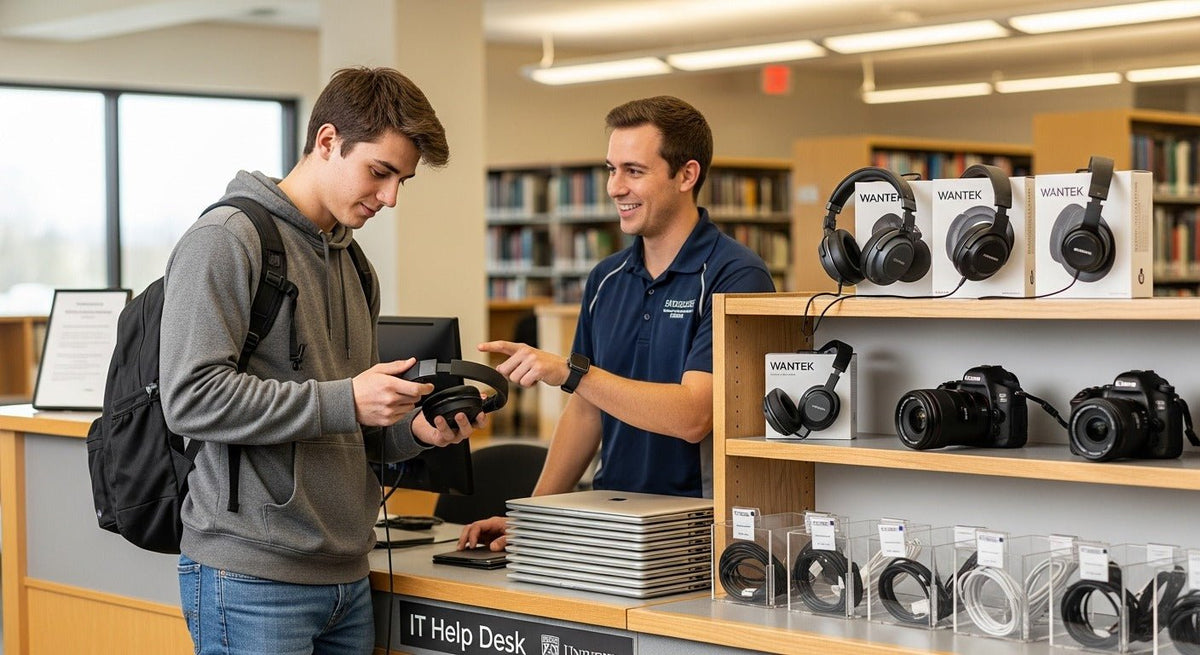
Free headphones for students do exist, but the most dependable options are usually school-owned loaners, classroom-funded equipment, or disability-related academic aids—not random online giveaways. Start with your school before spending time on promotions.
Quick answer: College students should check the campus library, IT help desk, media center, student-support office, and accessibility office. K–12 students should ask a teacher, counselor, library/media center, or school IT team about loaners or classroom sets. Teachers can also request classroom materials through programs such as DonorsChoose.
What “Free Headphones” Actually Means
Before applying for anything, separate truly no-cost access from deals that only look free.
- Free to borrow: Your school owns the headphones and lets you check them out for a set period.
- Free to the student: A school, donor, grant, or classroom program pays for the equipment. The headphones may remain school or classroom property.
- Accommodation-related equipment: A school may provide an auxiliary aid or effective alternative when required for equal access, depending on the student's individual needs and the institution's process.
- Promotion with purchase: A headset, gift card, or accessory tied to buying a laptop or tablet is not a free standalone pair of headphones.
- Giveaway or product test: Entry may be free, but selection is uncertain. Treat this as a bonus opportunity, not a reliable plan.
1. Check Your Campus Library or IT Desk First
Some universities explicitly lend headphones as part of their equipment checkout programs. The University of Texas at Austin lists both on-ear and over-ear headphones for checkout at multiple library locations, while Harvard Library says students can borrow basic gear including headphones and laptop chargers. Policies, loan periods, and eligibility vary by campus, so search your school's site for terms such as headphones checkout, loanable technology, equipment lending, or media equipment.

Search your school's website
Try “headphones checkout,” “technology lending,” “equipment loan,” and “media center.”
Ask the right desk
Library circulation, campus IT, media services, and student-support offices are better starting points than a general admissions office.
Confirm the terms
Ask how long you can keep the headphones, whether reservations are required, and whether replacement fees apply.
Examples: UT Austin Libraries equipment checkout and Harvard Library borrowing information.
2. Ask Your School About Classroom or Student-Support Equipment
For K–12 students, the fastest route is often local rather than national. A teacher, counselor, school librarian, media specialist, or IT staff member may know whether the school has spare wired headphones, a shared classroom set, testing headsets, or a device-access program.
Do not assume every school supplies headphones. Some districts explicitly require students to bring their own, while others maintain classroom or testing sets. The only reliable answer is your school's current policy.
For teachers: use classroom funding rather than asking students to hunt for giveaways
DonorsChoose allows eligible U.S. public-school teachers to request classroom materials, and funded items are shipped to the teacher's school. The resources remain classroom property rather than becoming personal student property. Headphone projects are common on the platform.
See how DonorsChoose works for teachers. If you are evaluating a whole-class setup, Wantek's classroom headphones guide covers wired vs. wireless choices, durability, storage, and shared-use considerations.
3. If You Need an Accessibility Accommodation, Contact the Accessibility Office
Students with disabilities may be eligible for academic adjustments, auxiliary aids, or assistive technology when necessary for equal access. The U.S. Department of Education explains that postsecondary schools covered by Section 504 or Title II must provide appropriate auxiliary aids and services when required, while individually prescribed devices or other personal-use equipment are not automatically the school's responsibility.

The practical step is to contact your school's disability or accessibility services office and explain the academic barrier you are trying to solve. The office may request documentation and may provide a different effective aid than the exact device you had in mind.
Official guidance: U.S. Department of Education: Auxiliary Aids and Services for Postsecondary Students with Disabilities.
4. Treat Student Promotions as Discounts, Not Guaranteed Free Headphones
Back-to-school promotions can reduce the effective cost of technology, but the offer must be read literally. A promotion that requires a major purchase is not the same as receiving headphones at no cost.
For example, Apple's U.S. College Student Offer for 2026 runs from July 16 through September 24, 2026. The official terms list Apple Gift Cards with eligible MacBook Air, MacBook Pro, iPad Air, and iPad Pro purchases. It does not describe a free standalone pair of headphones for U.S. students. Promotions vary by country and year, so always read the current terms for your market.
Current U.S. terms: Apple College Student Offer 2026.
5. Giveaways and Product Tests Are Possible, but They Are Not a Plan
Brands, creators, research panels, and product-testing communities sometimes offer headphones, but availability changes constantly and selection is never guaranteed. Avoid articles that present these routes as if every student can simply sign up and receive a pair.

If you enter a giveaway, verify that it originates from the brand's official site or verified account, read the eligibility rules, and be cautious with any offer that asks you to pay a fee merely to unlock a supposedly free item.
The Fastest Route by Situation
College student who needs headphones this week
Check the campus library and IT desk first. Short-term checkout is usually more realistic than waiting for a promotion or giveaway.
K–12 student whose family cannot provide a pair
Ask a teacher, counselor, school library/media center, or IT team whether a school-owned pair or classroom set is available.
Teacher who needs headphones for multiple students
Check school purchasing channels, PTA/PTO support, local education foundations, and teacher funding platforms such as DonorsChoose.
Student who needs audio equipment for disability-related access
Use your school's formal accessibility process so the request is evaluated around the academic barrier and an effective accommodation.
What to Ask Before Accepting Any “Free” Pair
- Is it yours to keep? A loaner may need to be returned the same day, at the end of the semester, or when you leave the school.
- Will it connect to your device? Check whether you need 3.5 mm, USB-A, USB-C, or Bluetooth.
- Does your school allow it? Some schools restrict Bluetooth or personal electronics during the instructional day.
- Are there replacement fees? “Free to borrow” does not necessarily mean free to lose or damage.
- Is a purchase required? If you must buy a laptop, subscription, or another product, calculate the total cost rather than treating the headphones as free.
Frequently Asked Questions
Can college students get free headphones from their school?
Sometimes. Some campus libraries and technology centers lend headphones at no additional charge, but availability and loan periods vary. Search your school's library and IT pages before buying.
Does Apple give students free headphones in the U.S.?
Not under Apple's U.S. 2026 College Student Offer. The current U.S. terms provide qualifying buyers with Apple Gift Cards on eligible Mac or iPad purchases, not free standalone headphones.
Can students request headphones directly from DonorsChoose?
DonorsChoose is designed for eligible teachers to create classroom requests. Funded materials are sent to the school and remain classroom resources rather than personal property for an individual student.
Can disability services provide headphones?
They may provide an auxiliary aid or another effective accommodation when required for equal access. The exact device depends on the student's needs, documentation, and the school's accommodation process.
Are free-headphone giveaways worth trying?
They can be legitimate, but they are unpredictable. Use them as an optional extra, not your primary plan. School loan programs and classroom resources are more dependable starting points.


3 comments
good
its is good
I need headphones for school purpose but my school doesnt supplies them